Count and noncount nouns
Let’s take a closer look at the noun hand. Notice that you can say the following:
The hand a hand hands
Here are some other nouns which demonstrate the same pattern:
The store a store stores
the idea an idea ideas
the tissue a tissue tissues
Let’s compare hand to the noun furniture. As with hand, we can say the furniture. But we can’t say *a furniture or *furnitures. Here are some other nouns which demonstrate the same pattern as furniture:
the dust *a dust *dusts
the energy *an energy *energies
the biology *a biology *biologies
Thus, there are some nouns that can be counted, and so we can use a or an with them and canal so make them plural. These nouns are called, appropriately, count nouns. Hand is a count noun. So are store, idea, and tissue.
There are other nouns that typically are not counted, and so we do not use a or an with them and do not typically make them plural. These nouns are called, also appropriately, non-count nouns. (Another name for a non-count noun is a mass noun.) Furniture is a non-count noun. So are dust, energy, and biology.
You may well be saying to yourself, ‘‘Wait a minute. I can count furniture. I can say something like: three couches and three chairs make six pieces of furniture. ’’And of course, you’d be right. But notice that in this sentence, the words couch and chair can be made plural, but not the word furniture. And the word piece can be made plural, but, again, not the word furniture.
Quick tip
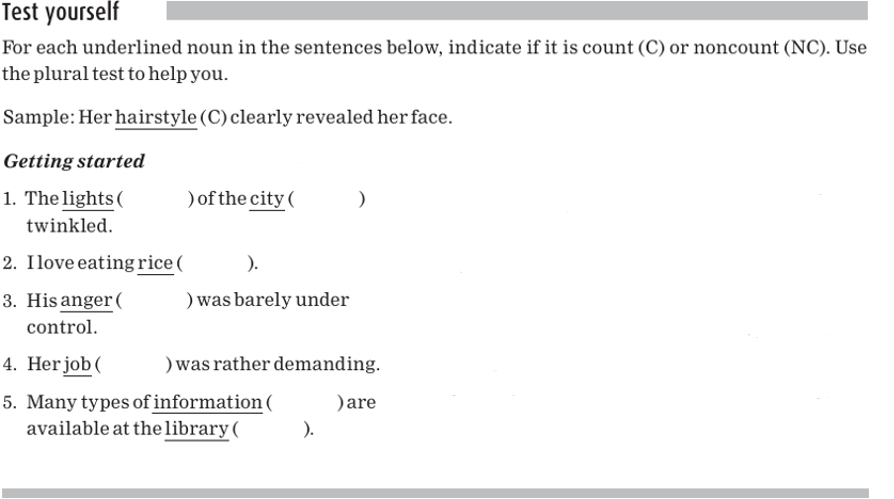
If you can pluralize a noun in a sentence, it is functioning as a count noun.
Note that a noun is considered to be a count noun if it can be made plural, even if it’s not plural in a particular sentence. Thus, in the sentence I ate a cookie, cookie is a count noun because one could pluralize it to cookies without changing its basic meaning.
Answers
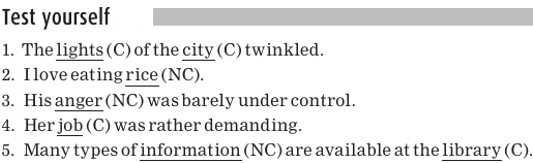
There is also another good way to decide if a noun is count or noncount. Take a look at the use of the words much and many in the following sentences.
1.He has many children.
2.That man has many interests.
3.That will take too much time.
4.They have many lights on in the house.
5.We have much furniture in our store.
6. I wonder how much wealth is in Silicon Valley.
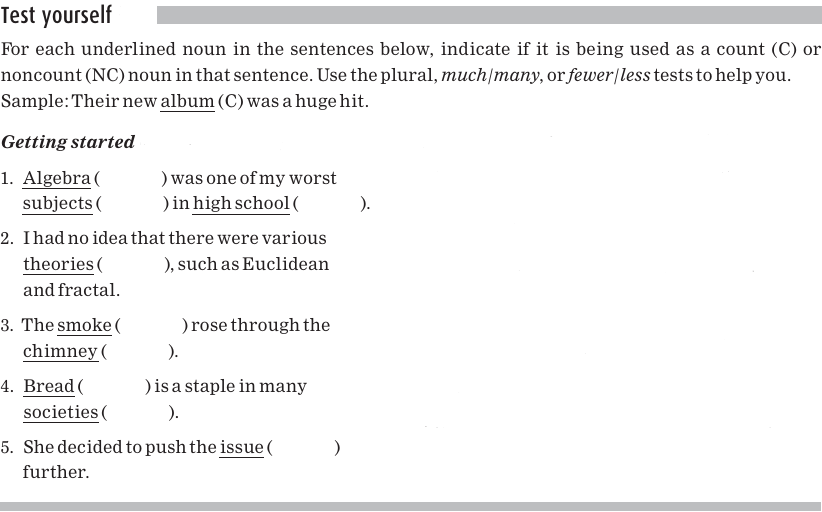
As you may have noticed, many is used with count nouns, much is used with noncount nouns.
Quick tip
If you can use many with a noun (when it is pluralized), it’s a count noun. If you can use much with a noun, it’s a non-count noun.
Answers
To enhance your understanding
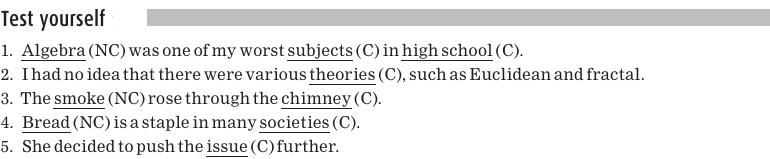
Many nouns can be used as either count nouns or as non-count nouns, depending on how they are being used in a specific sentence. Let’s look at the following sentence containing the word sugar:
13. The sugar is spilling on to the floor.
In this sentence, is sugar being used as account or non-count noun? Would you say: The sugars are spilling on to the floor? Or Many sugars are spilling on to the floor? Probably not. So sugar, in sentence 13, is a non-count noun.
Now take a look at another sentence with sugar:
14. This gourmet shop has sugars I’ve never even heard of.
In this sentence, is sugar being used as a count or non-count noun? First, notice that sugar here is pluralized. Second, notice that you can say This gourmet shop has many sugars I’ve never even heard of. So, sugar, in sentence 14, is a count noun. In terms of meaning, what is important here is that the sentence is talking about different types of sugars, say, brown sugar, white sugar, confectioners’ sugar, etc. And one more sentence type with sugar:
15. The sugar that works best in this recipe is brown sugar.
Here, sugar, while not pluralized, could be pluralized and refers, in fact, to a kind of sugar. For example, you could say: The sugars that work best in this recipe are brown sugar and white sugar. For these reasons, sugar is being used here as a count noun.
Here are some more examples of sentences with nouns which, like sugar, are typically used as non-count nouns but can also be used as count nouns.
16a. I like to drink milk. (milk used as non-count noun)
16b. That store has milks with different kinds of flavoring: chocolate, vanilla, mocha, and strawberry. (milks used as count noun)
16c. The milk that is the healthiest is nonfat milk. (milk used as count noun)
17a. A plentiful supply of water is important for a community’s survival. (water used as noncount noun)
17b. There are different kinds of gourmet waters on the market these days. (waters used as count noun)
17c. The water I usually order in restaurants is imported. (water used as count noun)








