0
EN
1
المرجع الالكتروني للمعلوماتية

Grammar

Tenses

Present

Present Simple

Present Continuous

Present Perfect

Present Perfect Continuous

Past

Past Simple

Past Continuous

Past Perfect

Past Perfect Continuous

Future

Future Simple

Future Continuous

Future Perfect

Future Perfect Continuous

Parts Of Speech

Nouns

Countable and uncountable nouns

Verbal nouns

Singular and Plural nouns

Proper nouns

Nouns gender

Nouns definition

Concrete nouns

Abstract nouns

Common nouns

Collective nouns

Definition Of Nouns

Animate and Inanimate nouns

Nouns

Verbs

Stative and dynamic verbs

Finite and nonfinite verbs

To be verbs

Transitive and intransitive verbs

Auxiliary verbs

Modal verbs

Regular and irregular verbs

Action verbs

Verbs

Adverbs

Relative adverbs

Interrogative adverbs

Adverbs of time

Adverbs of place

Adverbs of reason

Adverbs of quantity

Adverbs of manner

Adverbs of frequency

Adverbs of affirmation

Adverbs

Adjectives

Quantitative adjective

Proper adjective

Possessive adjective

Numeral adjective

Interrogative adjective

Distributive adjective

Descriptive adjective

Demonstrative adjective

Pronouns

Subject pronoun

Relative pronoun

Reflexive pronoun

Reciprocal pronoun

Possessive pronoun

Personal pronoun

Interrogative pronoun

Indefinite pronoun

Emphatic pronoun

Distributive pronoun

Demonstrative pronoun

Pronouns

Pre Position

Preposition by function

Time preposition

Reason preposition

Possession preposition

Place preposition

Phrases preposition

Origin preposition

Measure preposition

Direction preposition

Contrast preposition

Agent preposition

Preposition by construction

Simple preposition

Phrase preposition

Double preposition

Compound preposition

prepositions

Conjunctions

Subordinating conjunction

Correlative conjunction

Coordinating conjunction

Conjunctive adverbs

conjunctions

Interjections

Express calling interjection

Phrases

Sentences

Clauses

Part of Speech

Grammar Rules

Passive and Active

Preference

Requests and offers

wishes

Be used to

Some and any

Could have done

Describing people

Giving advices

Possession

Comparative and superlative

Giving Reason

Making Suggestions

Apologizing

Forming questions

Since and for

Directions

Obligation

Adverbials

invitation

Articles

Imaginary condition

Zero conditional

First conditional

Second conditional

Third conditional

Reported speech

Demonstratives

Determiners

Direct and Indirect speech

Linguistics

Phonetics

Phonology

Linguistics fields

Syntax

Morphology

Semantics

pragmatics

History

Writing

Grammar

Phonetics and Phonology

Semiotics

Reading Comprehension

Elementary

Intermediate

Advanced

Teaching Methods

Teaching Strategies

Assessment

قم بتسجيل الدخول اولاً لكي يتسنى لك الاعجاب والتعليق.

ADJECTIVES Identifying adjectives

المؤلف:  EVELYNP.ALTENBERG & ROBERTM.VAGO

المصدر:  English Grammar Understanding the basics

الجزء والصفحة:  P58-C4

2025-11-04

655

+

-

20

ADJECTIVES

Identifying adjectives

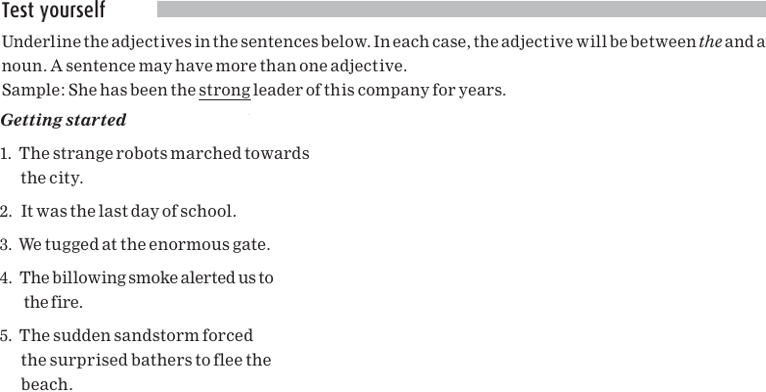
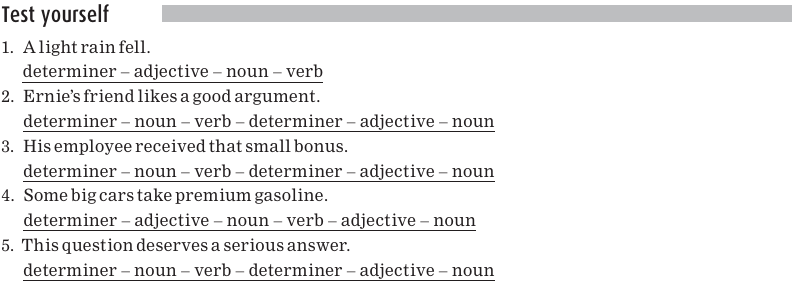
An adjective is a word that refers to a characteristic of a noun. How can you identify an adjective?

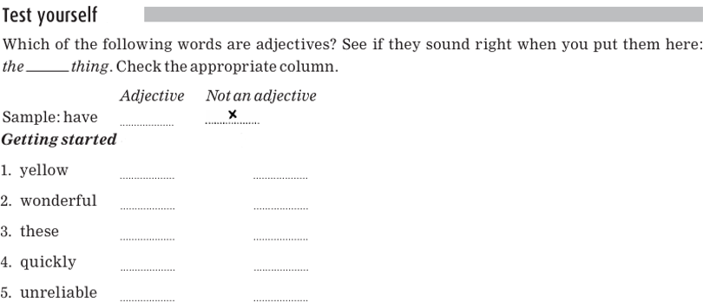
If you can put a word between the and a noun (like boy, or idea), then that word is an adjective.


Quick tip

If you can put a word between the and a noun (for example, the _____ boy), then that word is an adjective.

For example, since we can say the tall boy, tall is an adjective. Similarly, we can say the silly boy, the interesting boy, and the young boy. Therefore, silly, interesting, and young are alladjectives.


A number of adjectives, all used in the phrase the ________ boy are listed below. The adjectives are underlined:

1. the brilliant boy

2. the embarrassed boy

3. the blonde boy

4. the hungry boy

5. the delightful boy


Compare these phrases to*the very boy,*the a boy, and*the talk boy. Very, a, and talk are not adjectives.

What do adjectives actually do? Adjectives always tell us something about a noun.

Another way of saying this is that they modify a noun. In the phrases we’ve just looked at, the underlined adjectives tell us something about, or modify, the noun boy.
 

Answers
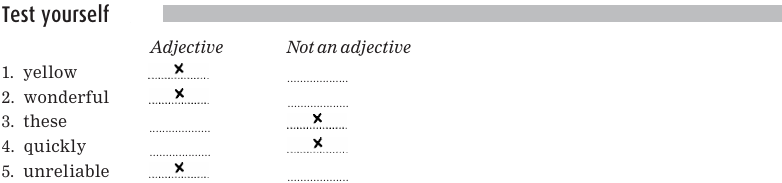
 

Answers
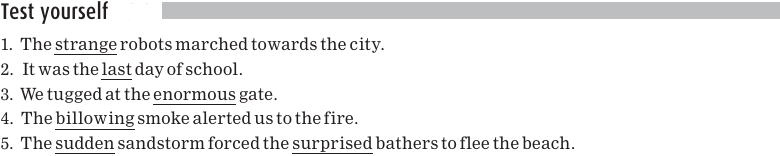
 

As we’ve said, a good way to decide if a word is an adjective is to see if it can be placed between the and a noun. But that doesn’t mean that that’s the only place where an adjective can occur; it’s just a way to test a word to see if it’s an adjective.


Here are some sentences where the adjective is in a different place. In each case, the adjective is underlined.

6. He is a tall boy.

7. My best friend loves chocolate cake.

8. The house had a low roof.

9. Large cars are harder to drive than small cars.


Let’s make sure that each of the underlined words above passes the adjective test, that is, that it can appear between the and a noun.

10. tall: the tall boy

11. best: the best movie

12. chocolate: the chocolate bar

13. low: the low ceiling

14. large: the large window

15. small: the small window.


As you can see, each of these words passes the adjective test. Notice also that each of these words describes a characteristic of a noun.
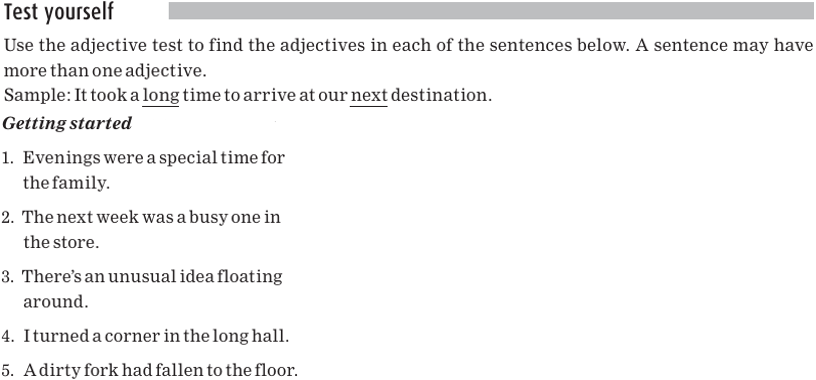
 

Answers
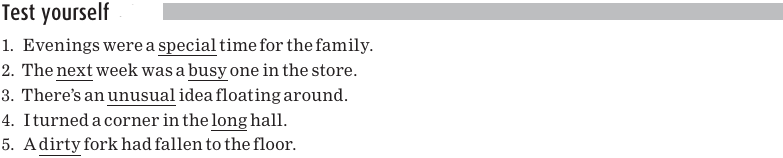
 

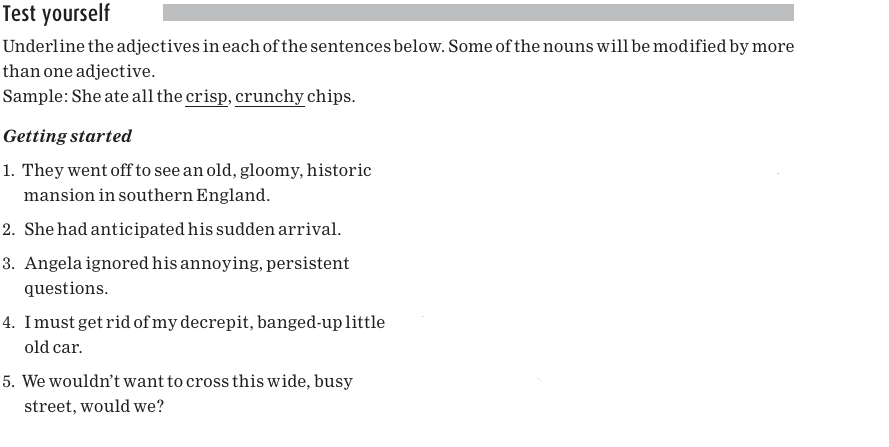
What do you notice about the underlined adjectives in the phrases below?

16. the delicious rich cake

17. my tall, red-haired, entertaining friend

18. a bright, colorful, blue, striped pattern

As you can see, a noun can have more than one adjective modifying it. In fact, there is no limit to the number of adjectives that can modify a noun (except the patience and tolerance of the listener!).
 

Answers

 

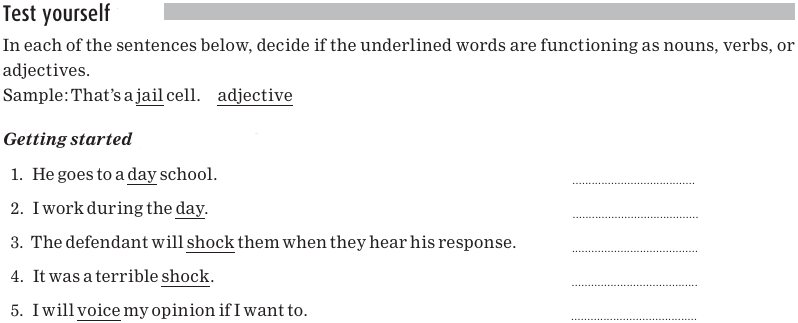
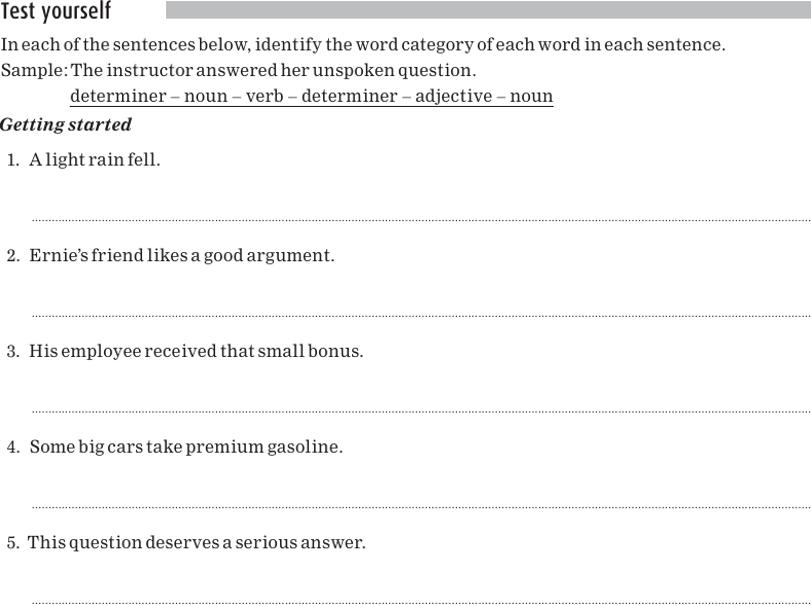
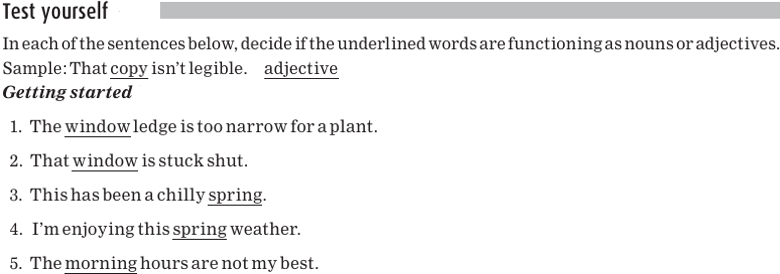
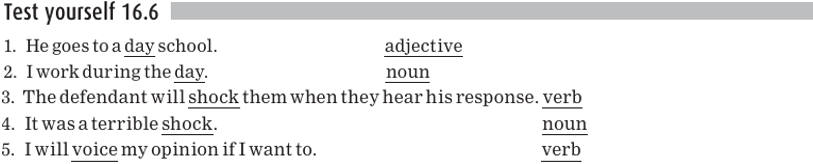
Remember that sometimes a word can function as one word category, or part of speech, in one sentence, and as another word category in another sentence (see Concrete and abstract nouns). For example, let’s look at the word cream. In the sentence I brought the cream, cream is a noun. But in the sentence That’s a cream cake, cream is an adjective, telling us more about the noun cake.
 

Answers

 

Answers
 

Answers
اخر الاخبار

اشترك بقناتنا على التلجرام ليصلك كل ما هو جديد