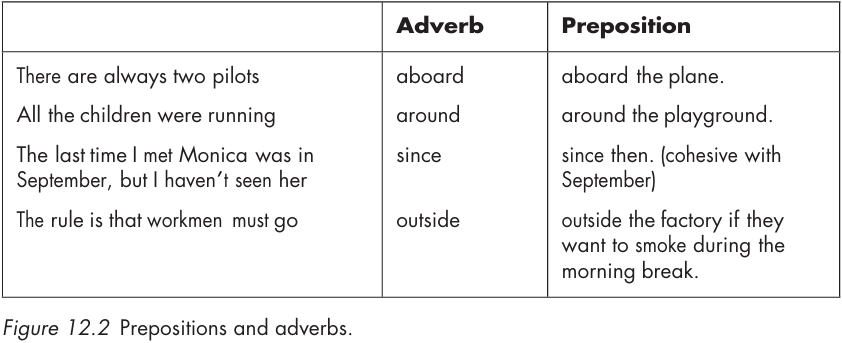
Prepositions and adverbs
These are sometimes called prepositional adverbs, as they can function as either class. Common examples include the following:
Aboard about across above before below beyond down in inside near off out outside through throughout under underneath up.
(prep) Their behavior is beyond belief.
(adv) From the top of the hill you can see the manor house and the woods beyond.
Here are some structural criteria for distinguishing prepositions from adverbs:
• A preposition, but not an adverb, requires a nominal complement, and when this is a pronoun, the preposition governs its case (for him, without them).
• In paired examples such as We went into the café – we went in, what was a preposition in the first version is replaced by an adverb in the second.
• The adverb is heavily stressed, whereas the preposition is normally unstressed, or only lightly stressed (lower down the scale vs lower DOWN; we walked past the café; we walked PAST.
In certain positions prepositions are stressed; for instance, when stranded at the end of a wh-question: What is it FOR? Where is it FROM? The preposition with is stressed in the expression with it (trendy), and also in the adjunctive use I’ll take it WITH me. Without is similarly stressed in I can’t do WITHOUT it, WITHOUT you. In combinations with do – (do without, go without, meaning ‘must have’), the word without functions as an adverbial particle. There’s no milk left, so we’ll just have to do without (meaning ‘not have’).
With regard to the phrasal verb ‘come to’, meaning ‘regain consciousness’, the particle to is heavily stressed: The unconscious boy came TO.