Subordinating conjunctions
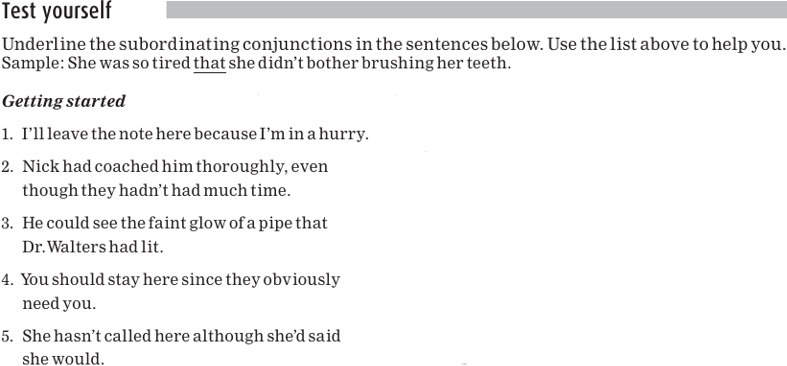
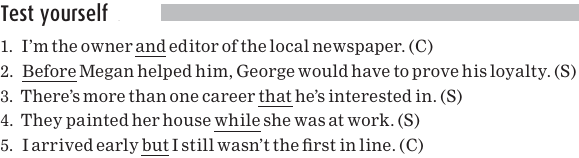
Another kind of conjunction is called a subordinating conjunction. Here are some examples of sentences with subordinating conjunctions. The subordinating conjunctions are underlined.
1. She continued arguing until everyone finally agreed with her.
2. They live down south when the weather gets cold.
3. Jack will buy a house once he gets a job.
4. She listened to his comments politely, even though they sounded silly.
5. They stopped talking when it was Eleanor’s turn.
Subordinating conjunctions connect sentences; however, the two parts that are connected are not of equal value in terms of the meaning of the whole sentence. There is a main sentence with a subpart; the subordinating conjunction connects the subpart to the main sentence. Here are sentences 1 through 5 again, but this time with the main sentences in bold.
6. She continued arguing until everyone finally agreed with her.
7. They live down south when the weather gets cold.
8. Jack will buy a house once he gets a job.
9. She listened to his comments politely, even though they sounded silly.
10. They stopped talking when it was Eleanor’s turn.
Quick tip
Subordinating conjunctions connect a sentence with another sentence, which is a subpart of it. The subpart sentence is called a dependent clause (or subordinate clause). In the following sentence, the subordinating conjunction is underlined and the dependent clause is in italics: Nick decided to try to escape, although he knew his chances were slim.
The common subordinating conjunctions are listed below.
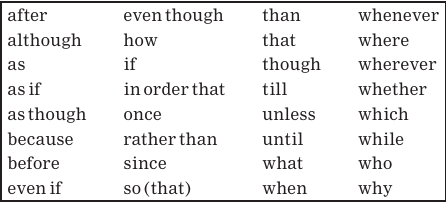
You can see that sometimes a subordinating conjunction consists of more than one word.
Answers
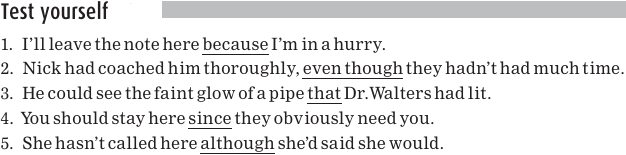
Here are the same sentences we saw earlier, but this time with the dependent clauses in italics; the subordinating conjunctions are still underlined.
11. She continued arguing until everyone finally agreed with her.
12. They live down south when the weather gets cold.
13. Jack will buy a house Once he gets a job.
14. She listened to his comments politely, even though they sounded silly.
15. They stopped talking When it was Eleanor’s turn.
Notice that the subordinating conjunction is always the first word of the dependent clause.
Quick tip
The subordinating conjunction is always the first word of the dependent clause.
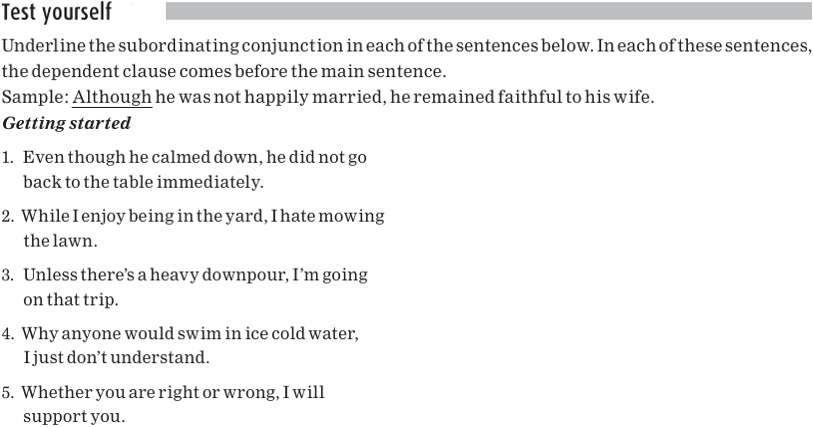
In all of the examples we’ve looked at so far, the dependent clause has come after the main sentence. But sometimes the dependent clause comes before the main sentence. In the following examples, the subordinating conjunctions are underlined, and the main sentences are in bold:
16. If he knew the truth, her father would throw the doll away.
17. When I brought my first pay check home, I wanted to frame it.
18. Once he gets a job, Jack will buy a house.
19. When it was Eleanor’s turn, they stopped talking.
Notice that sentences 18 and 19 are the same as sentences 13 and 15, except that in sentences 18 and 19 the subordinating conjunction and the rest of the dependent clause come before the main sentence rather than after it.
Answers
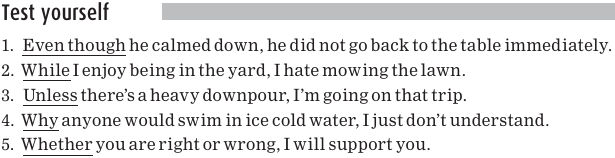
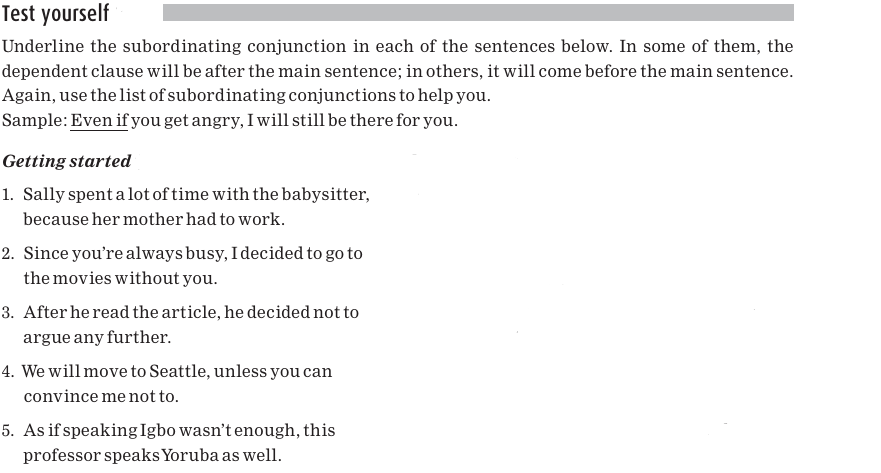
Answers
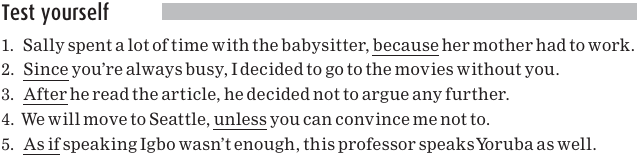
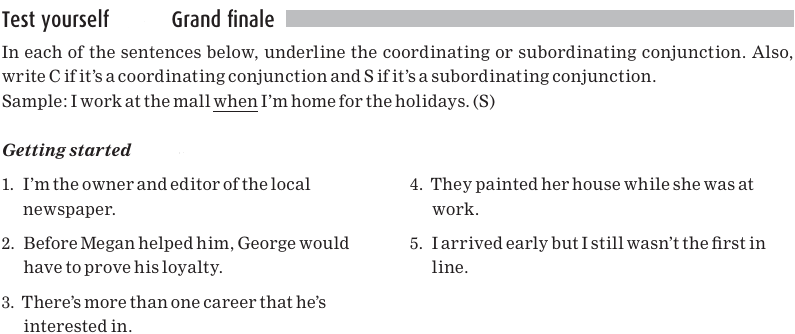
Answers
To enhance your understanding
Don’t confuse conjunctions with prepositions. Some words may function as either:
20a. I’ve been working hard, for I hope to be promoted. (Coordinating conjunction: connects two sentences.)
20b. I’ve been working hard for IBM. (Preposition: introduces a noun.)
21a. John left before they served dinner. (Subordinating conjunction: connects two sentences.)
21b. John left before dinner. (Preposition: introduces a noun.)








