Relative pronouns
Here are some sentences with interrogative pronouns, like the ones you’ve already seen. The interrogative pronouns are underlined.
1. Who was laughing?
2. Whose is this?
Now look at the following sentences, which contain the same underlined words. How are these sentences different from sentences 1 and 2?
3. I like the woman who lives next door.
4. He’s the engineer whose life was disrupted by a messy divorce.
You’ve probably noticed that, unlike sentences 1 and 2 above, sentences 3 and 4 are not questions. The same pronouns are being used, but not to ask a question. Instead, these pronouns are used in sentences 3 and 4 to replace a noun that’s already mentioned earlier in the sentence. When used this way, these pronouns are called relative pronouns. They are listed in the following Quick tip.
Quick tip
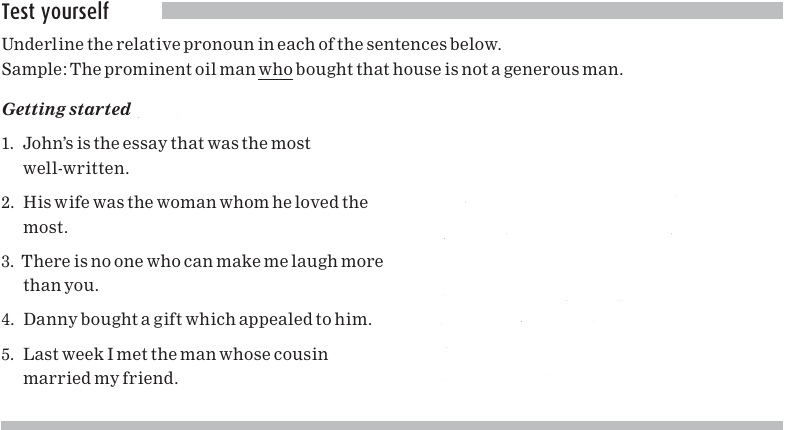
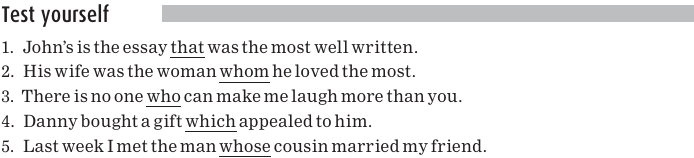
The common relative pronouns are: that, which, who, whom, whose. They refer back to a noun in the sentence.
Answers
Let’s look at sentences 3 and 4 more closely.
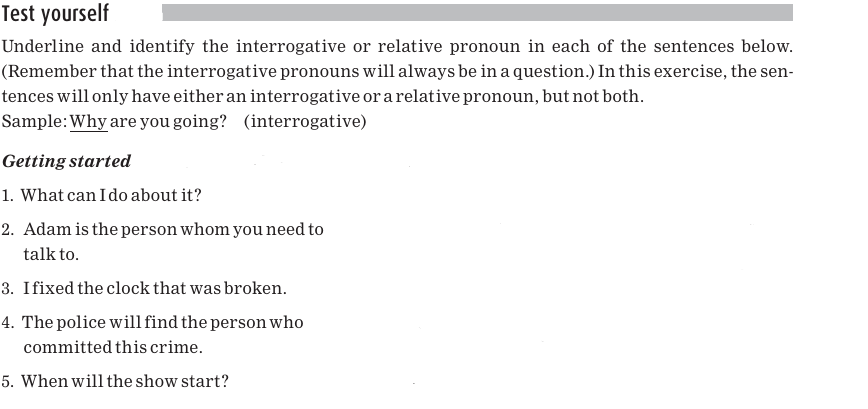
3. I like the woman who lives next door.
In this sentence, who lives next door? Answer: the woman. So instead of saying something like I like the woman. The woman lives next door, were place the second occurrence of the woman with the pronoun who, giving us the sentence I like the woman who lives next door. In fact, the word who is doing two things: it’s representing the woman and it’s joining lives next door to the main part of the sentence.
4. He’s the engineer whose life was disrupted by a messy divorce.
In this sentence, whose life was disrupted by a messy divorce? Answer: the engineer’s. So instead of saying something like He’s the engineer. The engineer’s life was disrupted by a messy divorce, we replace the second occurrence of the engineer (actually, in this case, the engineer’s) with the pronoun whose, giving us the sentence He’s the engineer whose life was disrupted by a messy divorce. Again, the word whose is doing two things: it’s representing the engineer and it’s joining life was disrupted by a messy divorce to the main part of the sentence.
In the following sentence, what broke?
5. Sam fixed the computer that broke.
Answer: the computer. So instead of saying something like Sam fixed the computer. The computer broke, were place the second occurrence of the computer with the pronoun that giving us the sentence Sam fixed the computer that, that broke. Again, the word that is doing two things: it’s representing the computer and it’s joining broke to the main part of the sentence.
You may remember that we talked about subordinating conjunctions, which are words that connect a sentence (the main sentence) with another sentence which is a subpart of it. The relative pronouns here are doing the same thing and in fact, relative pronouns are one kind of subordinating conjunction.
Quick tip
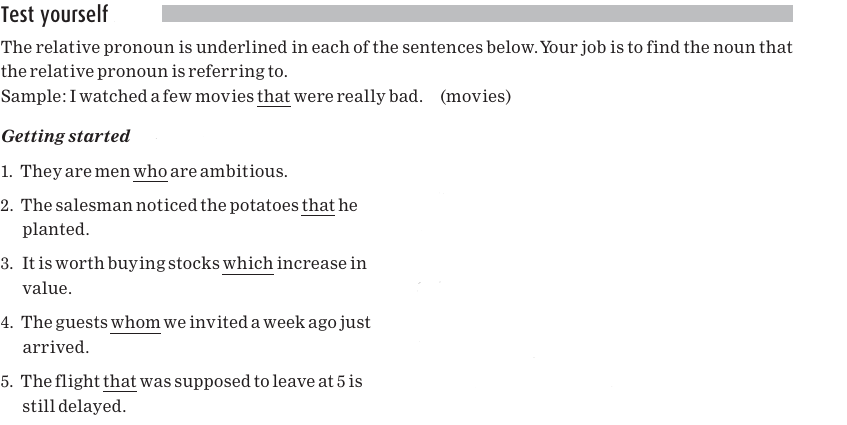
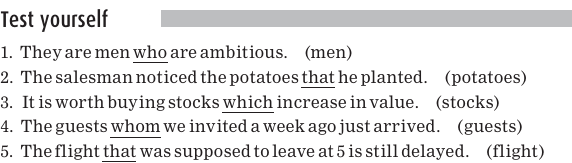
Relative pronouns are a type of subordinating conjunction. A relative pronoun typically occurs soon after the noun it refers to. Example: He liked the teacher who gave easy tests.
Answers
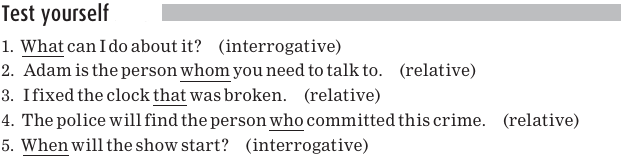
Answers
To enhance your understanding
Notice that the word that has lots of uses. These are demonstrated here:
6. I think that man is intriguing. (demonstrative determiner)
7. I think that is the way to go. (demonstrative pronoun)
8. I think that the sun will shine tomorrow. (subordinating conjunction: introducing a clause)
9. I think the car that you want was sold yesterday. (relative pronoun: introducing a clause and referring back to a noun)
You can have more than one that within the same sentence:
10. I think that that is the cat that belongs to you.
And that’s that!








