The suffixes of auxiliary verbs
Each helping verb is actually a two-part package. There’s the helping verb itself, and then there’s the effect that the helping verb has on the verb that follows it.
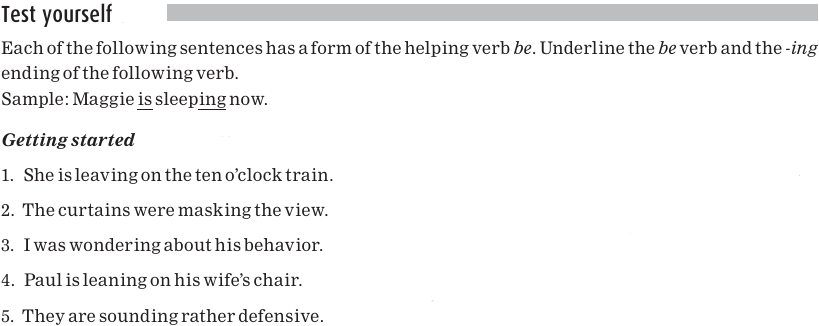
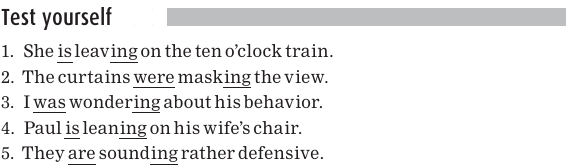
Look at the sentences below. In each of them, the helping verb is a form of progressive be (underlined). What effect does progressive behave on the verb that follows it?
1. The children were working hard.
2. I am considering a new job offer.
3. Nothing was limiting his development.
4. Many new advances are emerging.
5. Sam is watching his favorite TV show.
You can see that the verb after the form of be always has-ing added to its base. This-ing form of the verb is referred to as the present participle in traditional grammar.
Quick tip
When the helping verb is progressive be, the next verb always has-ing added to its base form. Example: is sleeping. The-ing verb form is called the present participle.
Answers
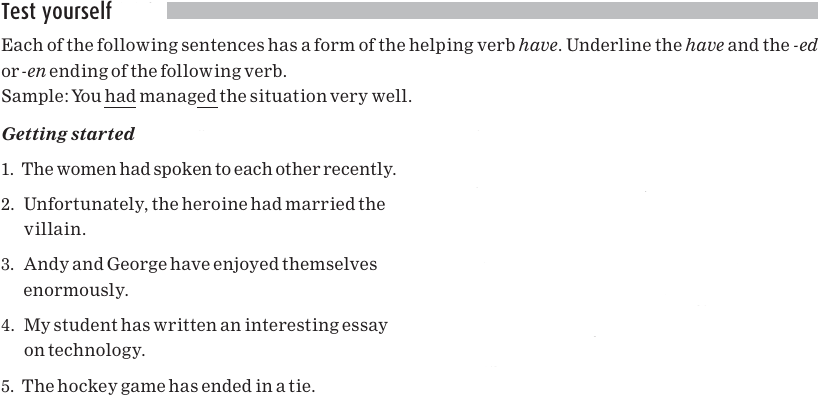
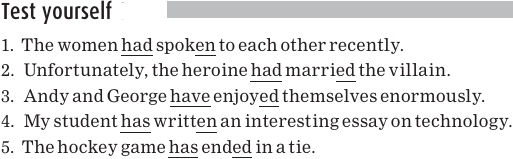
In each of the following sentences, the helping verb is a form of have (underlined). What effect does have have on the verb that follows it? (This is a little trickier than the pattern with be.)
6. She had greeted me happily.
7. They have eaten dinner early today.
8. That had interested the reporter.
9. Sarah had managed to pry apart the shells.
10. Carla and Raphael have written many books together.
11. He and Bill had shaken hands.
The verb following have most frequently has the suffix-en or-ed added to it. The form of the verb following the helping verb have is traditionally called the past participle.
Quick tip
When have is the helping verb, the next verb typically has-ed or-en added to its base form. Examples: has eat en, have watched. The verb form following the helping verb have is called the past participle.
Answers
The-ed and-en suffixes are the most common endings for past participles. However, for historical reasons, there are actually several ways to form past participles. Note the following patterns of some typical verbs:
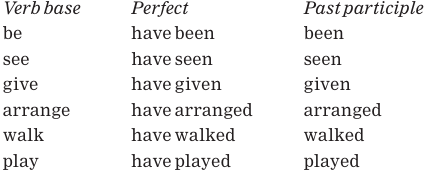
Another way to form past participles is by changing a vowel of the verb base, sometimes also adding the suffix-en. Some examples are:
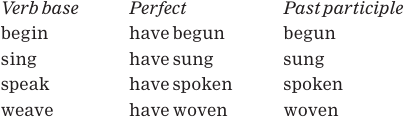
Sometimes no change at all is made to the verb:

There is no magic or hard and fast rule to determine what the past participle of a particular verb is. We simply have to memorize it when we learn English.
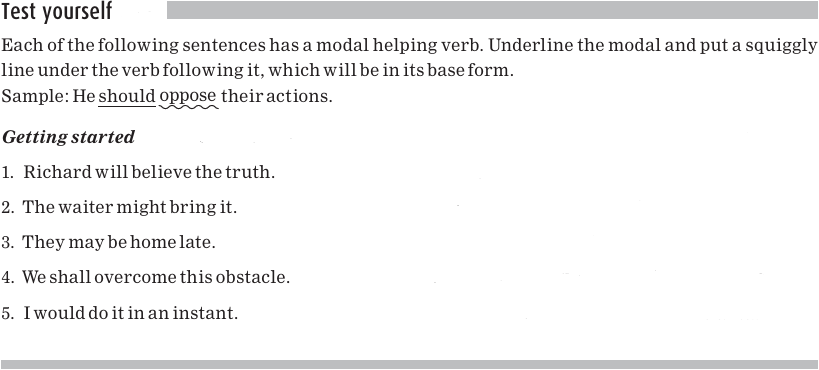
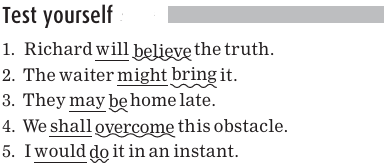
In each of the following sentences, the helping verb is a modal (underlined). What effect does a modal have on the verb that follows it?
12. The piano salesman should consider his actions.
13. He will recognize it immediately.
14. Sam could be a star quarterback.
15. The major may speak to you later.
Quick tip
When the helping verb is a modal, the next verb is always in its base form. Example: can study.
Answers
What happens to the following verb if there is more than one helping verb in a sentence? Is the pattern the same when a helping verb is followed by another helping verb, rather than the main verb? The patterns we have talked about are the same, whether there is one helping verb or more than one helping verb in a sentence. You can see this in the following sentences:
16. They have been seeing the doctor regularly.
17. You have been observing the situation closely.
Since have (in bold) is a helping verb in these sentences, the next verb, be, gets the-en ending (also in bold). And since be (underlined) is also a helping verb, the verb after be gets the-ing ending (also underlined).
We can also see consistent patterns in the following two sentences:
18. They should have seen the doctor regularly.
19. You might be observing the situation closely.
In sentence 18 the modal (in bold) causes the next verb, have, to be in its base form. The have helping verb then affects the form of the next verb, the main verb see, which appears in its past participle form, seen. Similarly, in sentence 19 the modal, might, causes the next verb, be, to be in its base form. Then the be affects the form of the next verb, the main verb observe, which appears in its present participle form, observing.
What happens if a sentence has all three kinds of helping verbs? The pattern still remains the same, as you can see in the next set of examples:
20. They should have been seeing the doctor regularly.
21. You might have been observing the situation more closely.
The modal, which is the first helping verb (in bold), causes have to be in its base form. The have helping verb (underlined) causes the next verb, be, to appear in its past participle form, that is, with the-en suffix (also underlined), and be (with a squiggly line) causes the next verb, the main verb, to be in its present participle form, that is, ending in-ing (also with a squiggly line).
So the overall pattern is completely consistent, whether a sentence has one, two, or three helping verbs.
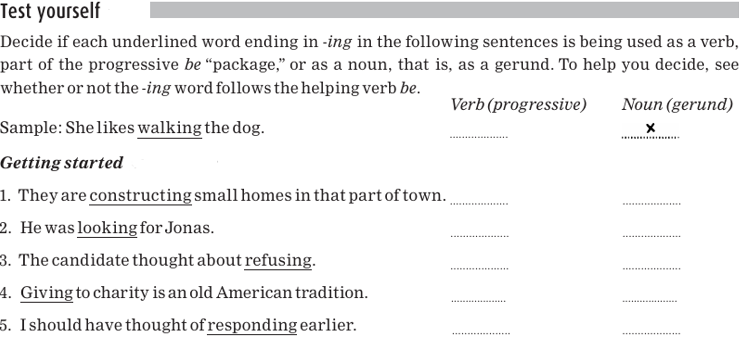
As we’ve seen, when progressive be is the helping verb, the next verb always has-ing added to it. But sometimes verbs ending in the-ing suffix have a different use, as we can see in these next sentences:
22. Skiing energizes me.
23. I love cooking.
In these sentences, the-ing word does not follow the helping verb be. Instead, the-ing ending changes the verb into a noun. In fact, notice that the-ing word can be replaced with a typical noun in these sentences, for example: Sugar energizes me, I love Mary. A noun that consists of a verb and the suffix -ing is called a gerund.
Quick tip
A noun that consists of a verb and the suffix-ing is called a gerund. Example: Entertain-ing is fun.
Here are some more examples of sentences with gerunds:
24. Reading is one of life’s pleasures.
25. Thinking can be hard work!
26. The criminal admitted lying.
27. They stopped worrying about it.
Answers

Here is a summary of the three helping verbs we’ve discussed and the form of the verb that follows each:

Two additional helping verbs will be discussed later.








