Zero-anaphora (“pro-drop”)
Another apparent problem for the well-formedness conditions in (31) is illustrated by the examples in (37a, b). Both of these examples contain two verbs, and all four of the verbs subcategorize for a SUBJ, but there is no subject NP to be seen in either example. Furthermore, the transitive verb provei ‘I tried’ in (37a) lacks an OBJ NP. The missing subjects and objects seem to violate the Completeness condition, yet the sentences are fully grammatical.
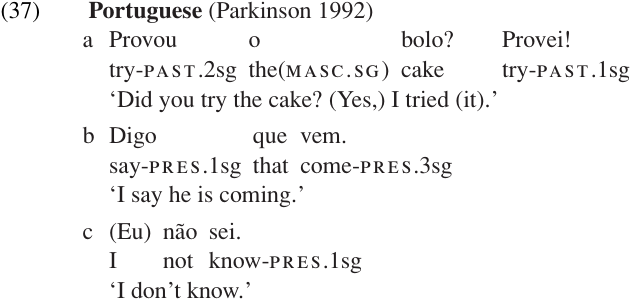
Subject pronouns are generally optional in Portuguese, as indicated in (37c); such pronouns could be added to examples (37a,b) as well. But subject pronouns are, in a sense, redundant, because the person and number of the subject are already indicated by the form of the verb. Since the pronoun adds no new information, it is not surprising that it can be easily omitted. (Third person pronouns, which add information about masculine vs. feminine gender, are less likely to be omitted than first and second person pronouns.) However, pronouns can sometimes be omitted even when there is no verbal morphology to preserve the information. Portuguese verbs do not agree with their objects, but object pronouns can be dropped when the referent can be identified from the immediate context, as in (37a).
This is an area where languages differ from each other in somewhat un predictable ways. Some languages in which verbs agree with their subjects, including Portuguese and Italian, allow subject pronouns to be freely omit ted. In other languages with similar agreement patterns, such as French and German, subject pronouns are not freely omitted. Certain other languages, including Chinese and Japanese, lack agreement morphology entirely, but nevertheless allow pronominal arguments to be omitted. Languages which allow pronouns to be omitted are sometimes referred to as “pro-drop languages.” Some authors, however, prefer to restrict the term PRO-DROP to cases where information is preserved by verb agreement, using the term ZERO-ANAPHORA for cases where there is no verb agreement. (The term ANAPHORA will be discussed in Noun classes and pronouns).
We noted that certain verbs in English allow their objects to be omitted, as illustrated in (38). We suggested that these verbs subcategorize for an optional OBJ relation.
(38) a John has already eaten.
b Mary drinks like a fish.
c Arthur loves to read.
But these examples are different from the Portuguese sentences (37a,b) in several important respects. First, the omitted objects in (38) have no definite referent: we have no idea what John ate, what Arthur likes to read, etc. In (37), however, each of the verbs (including the 3rd person vem‘ he is coming’ in (37b)) is understood to have a definite, specific subject. Similarly, the omitted object NP in the answer of (37a) is understood to refer to a specific cake. A second difference is that only certain transitive verbs in English allow their objects to be omitted; this is a feature that must be listed in the verb’s lexical entry. In languages like Portuguese, however, all verbs seem to allow the same patterns of pro-drop.
In both of these respects, pro-drop and zero-anaphora are very much like using anormal, visible pronoun. A common way of analyzing examples like (37a,b) is to assume that they contain invisible (or NULL) pronouns, which are often represented as pro. Under this analysis, pro-drop languages are those which contain pro as an element of their lexicon, while non-pro-drop languages do not.








