The adverb channel
The channels of adverbial clause subordinators sketched above are strikingly similar to the ones that we observed in the case of complementizers (“Complement clauses”; see also “Clause subordination Discussion”). But there are also channels that appear to be restricted to the former. This applies most of all to the channel leading from adverbs to subordinators. It is spatial and temporal adverbs in particular, such as ‘here’, ‘there’, ‘now’, ‘then’, etc., that provide a common source for adverbial subordinators. When this channel is used, adverbs grammaticalize into adverbial subordinators (SUB). The kind of construction involved typically takes a form as in (65a) which is reinterpreted as (65b).

Once again we are dealing with a process whereby a lexical item (in this case an adverb) is reinterpreted as a functional category, and a main clause as a subordinate adverbial clause. In the Central African Bantu language Lingala, the locative adverb a̒wa ‘here’ provided the source for the temporal conjunction ‘while’, ‘when’, and further for the causal subordinator a̒wa ‘since’, ‘because’, for example:

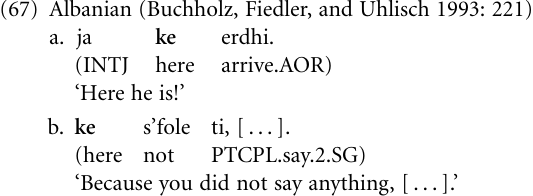
Similarly, the Albanian adverb ke ‘here’ (67a) appears to have provided the source for a conjunction marking a causal clause (67b).
Finally, one might mention the Latin temporal conjunction dum ‘while, as long as’, which can be traced back to the adverb dum ‘now’ in early Latin, surviving in this meaning as an enclitic of imperative verbs, for example Accede-dum ‘Come here, now!’ (Janson 1979: 104–5).
Of all three main types of clause subordination, adverbial clauses exhibit the largest variety of sources for subordination markers. One may also mention that morphologies used for a mood type frequently called ‘‘subjunctive’’ can also serve to present volitional and counterfactual propositions which may be used for adverbial-clause subordination (Harris and Campbell 1995: 306–7).








