Noun incorporation
The last type of grammatical-function-changing phenomenon that we illustrate here is noun incorporation. Gerdts (1998: 84) defines incorporation as “the compounding of a word (typically a verb or preposition) with another element (typically a noun, pronoun, or adverb). The compound serves the combined syntactic function of both elements.” Noun incorporation is the most common type. It involves the combination of a noun stem and a verb or adjective into a complex derived verb stem. The following examples all illustrate noun incorporation. They are from Gerdts (1998: 84–5), who cites Sapir (1911), Woodbury (1975), and Comrie (1992), respectively. We have put the incorporated noun stems in boldface type.
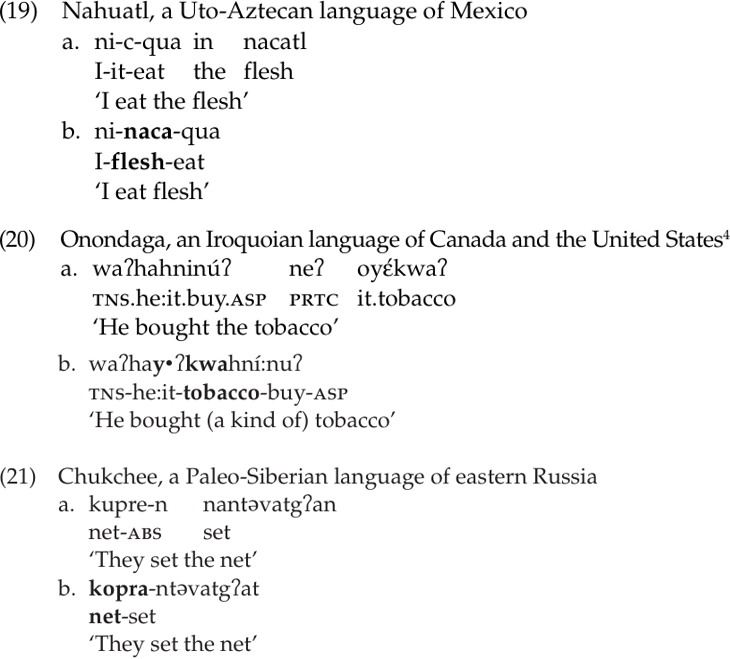
It can be shown on the basis of positional and phonological criteria that we do not go into here that the noun stems in (19–21b) are incorporated into the verb stem, as Gerdts notes. Examples (19–21) illustrate a general characteristic of noun incorporation cross-linguistically: incorporated noun stems do not take a determiner or bear case-marking morphology.
Our goal has merely been to present the phenomenon of noun incorporation. There is much more that we could have discussed. Linguists have explored questions such as the following: When do speakers of languages with noun incorporation make use of it, and when do they use freestanding nouns? What restrictions are there on nouns that may be incorporated? Are there syntactic constraints on incorporation? We leave you to explore these issues on your own. Mithun (1984) and Gerdts (1998) would be good places to start.
The table in Morphology and Syntax Summary summarizes the grammatical-function-changing phenomena. The definitions are purposely non-theoretical, in line with the inclusive nature, but readers will find that various theoretical frameworks offer more specific vocabularies for describing these sorts of phenomena (see, e.g., Baker 1988; Dixon and Aikhenvald 2000).
4 We have simplified the morpheme-by-morpheme gloss of the Onondaga phrases somewhat.








