Componence, realization and function
Any structure can be considered to be composed of elements which form a configuration of elements or ‘functions’, whether semantic such as Agent-Process-Affected or syntactic such as the clause configuration Subject-Predicator-Object or the modifier head-modifier structure of the nominal group.
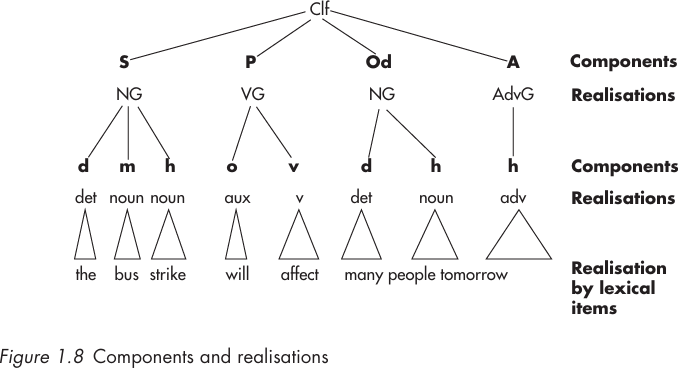
Each of these is in turn realized by a unit which is itself, at least potentially, a configuration of elements, and these in turn are realized by others until the final stage is reached and abstract categories such as subject, head, modifier, etc., are finally realized by the segments of the spoken or written language. The ‘structural tree’ on page 19 diagrams this model of analysis at the three unit ranks of clause, group and word, to illustrate the clause The bus strike will affect many people tomorrow.
An important property of language is the fact that there is no one-to-one correspondence between the class of unit and its function. While it is true that certain classes of unit typically realize certain functions, Nominal Groups at Subject and Object functions, for instance, it is nevertheless also true that many classes of unit can fulfil many different functions, and different functions are realized by many different classes of unit. For instance, the NG next time can fulfil the following clause functions, among others:
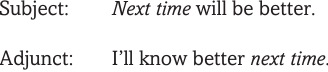
The nearest to a one-to-one relationship in the grammar is that between the process and the verbal group that realizes it.
This many-to-many relationship is fundamental for understanding the relationship of the grammar of English to discourse. By this it is not implied that discourse (or even a text) is a kind of super-sentence, a grammatical unit that is simply ‘larger’ than a sentence and with the same kind of relationship holding between its parts as that which holds between grammatical units.
A piece of discourse is quite different in kind from a grammatical unit. Rather than grammatical, it is a pragmatic-semantic unit of whatever length, spoken or written, and which forms a unified whole, with respect both to its internal properties and to the social context in which it is produced.
To take a minimal instance, a pragmatic act such as ‘leave-taking’ may be realized by a modalized declarative clause (I’ll be seeing you) or by the formulaic expression Goodbye, among others. Typically, a discourse is made up of various types of pragmatic acts, which in turn are realized semantically and syntactically. Although we start from the grammar rather than from the text, the relationship between the two is of primary interest.








