EXPRESSING OUR EXPERIENCE OF PEOPLE AND THINGS
NOUNS AND NOMINAL GROUPS
The main function of nominal groups is to refer to the participants in situations. These are not only persons, places, objects, institutions and other collectives, but also activities (swimming), abstractions (thought), qualities (beauty), emotions (anger) and phenomena (thunder, success).
Structurally, a nominal group can be realized basically by a noun or pronoun acting as the head of the NG: gardens, children, winter, food, news, they. On the other hand, nominal groups can be long and complex.
When we name an entity, we usually add some information about it which shows how we perceive it. In expressing this ‘experiential’ information about an entity, some of it is placed before the noun and some after it, as we can see in some of the groups contained in the example text:
One fine morning in October 1969, a celebrated visitor was due to appear at the Hilton Hotel on Castellana Avenue. A huge crowd had already gathered before the main entrance to the hotel – casually dressed men and women, excited schoolchildren holding US flags, and a number of interested tourists out for a stroll. A buzz of expectation filled the air. Suddenly, the wide glass doors opened and uniformed aides lined either side of the drive. Shouts of acclamation greeted the visitor walking down the steps: Neil Armstrong, the first human being to set foot on the moon.
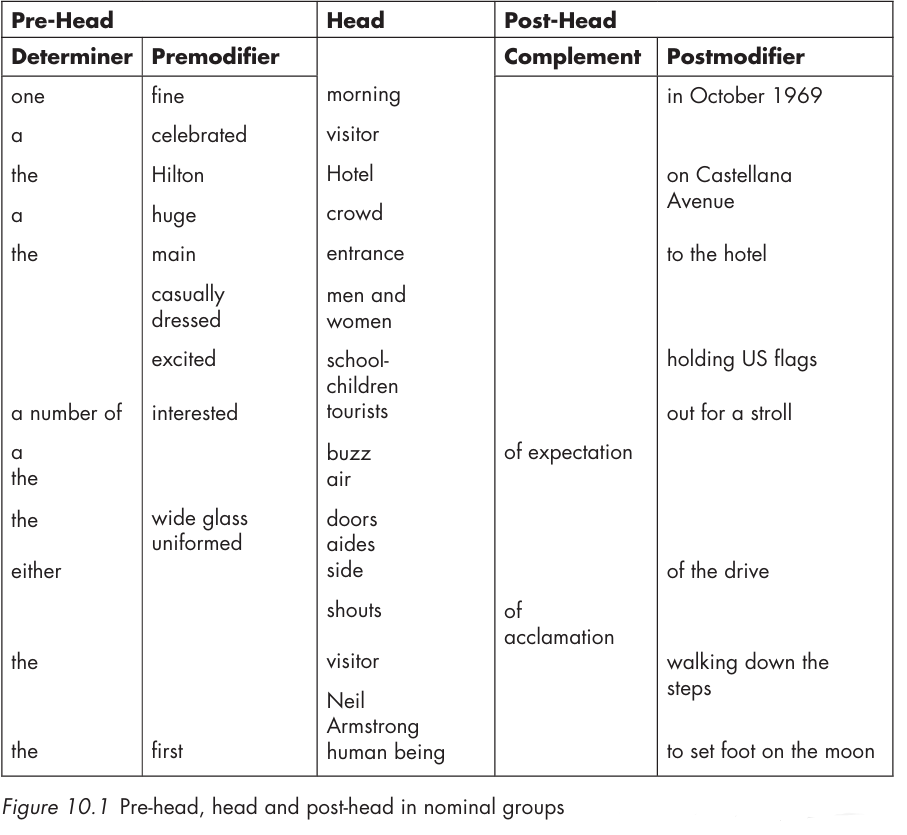
In this text, we see that the post-head information, given on the right about the head nouns in the middle column, also contains nouns with their own pre-head and post- head information.








