INDEFINITE REFERENCE: SPECIFIC AND NON-SPECIFIC
Although the term ‘indefinite’ might appear to be synonymous with ‘non-specific’, it can in fact be applied to both non-specific and specific entities, whether these are count or mass:
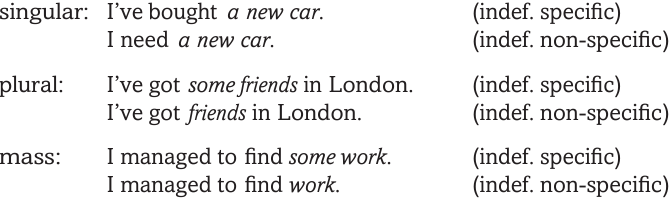
The examples show that with singular count nouns (a car), the article a(n) refers to both specific and non-specific entities, the different interpretations being deduced pragmatically from shared knowledge and also from the different predicates. When we need a car, it is obviously not yet specific, but potentially any car. When we have bought a car, it is obviously a specific one. The article a(n) can be indeterminate, however, between specific and non-specific interpretations:
Ted wants to buy a house in Sussex. (= any house, as long as it’s in Sussex)
Ted wants to buy a house in Sussex.
It’s number 2, Farm Road, Brighton. (= a specific house)
As an indefinite determinative, some (unstressed) is used mainly with mass and plural count nouns, but the stressed form is sometimes used with mass or count nouns with the meaning of indefinite specific as in: There is still some hope of recovery, or non-specific as in I’ll need some book or other to read on the beach. Either would be meaningful here.








