Some Essential Properties of Relative Constructions and Questions in Punjabi
In Punjabi, as in Hindi, if the relativization does not cross a finite CP, it is optional to front the relative phrase in relative clauses. Unlike Hindi speakers, however, native speakers of Punjabi find it more natural to use rel-in-situ.
(1)
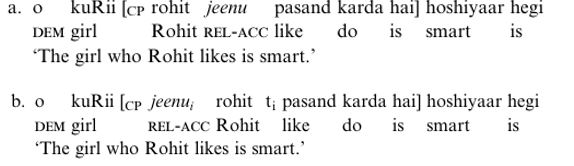
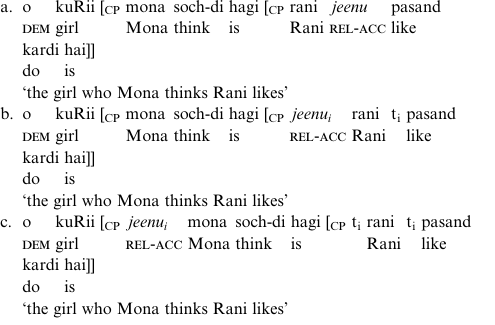
When a relative phrase originates in an embedded finite clause, it has the choice of either staying in situ as in (2a), moving partially to the Comp position in the embedded clause as in (2b), or moving to the matrix clause as in (2c). Notice that the counterparts of (2a–b) in Hindi, namely are ungrammatical.
(2)
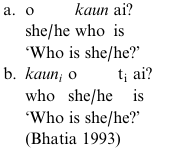
In question formation in Punjabi, if the wh-phrase does not cross a finite CP, then movement is possible but not obligatory, which is like rel movement in both Hindi and Punjabi, as shown in (3).
(3)
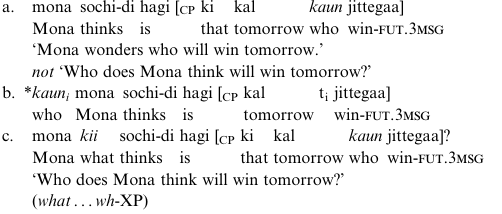
If question formation involves crossing a finite CP, wh-in-situ does not give a matrix question reading, as shown in (4a). In contrast to what we find with wh-movement in Hindi, full fronting of a wh-phrase out of an embedded finite clause is not possible in Punjabi, as demonstrated in (4b). The only way to achieve a matrix question reading is through the scope-marking strategy, as shown in (4c). This strategy is also available in Hindi.
(4)
Hindi and Punjabi are alike in cases where the relativization or question formation does not cross a finite CP. Movement operations in these two languages diverge once movement crosses a finite CP.








