Toward an Analysis of Partial Movement in Punjabi Relative Clauses
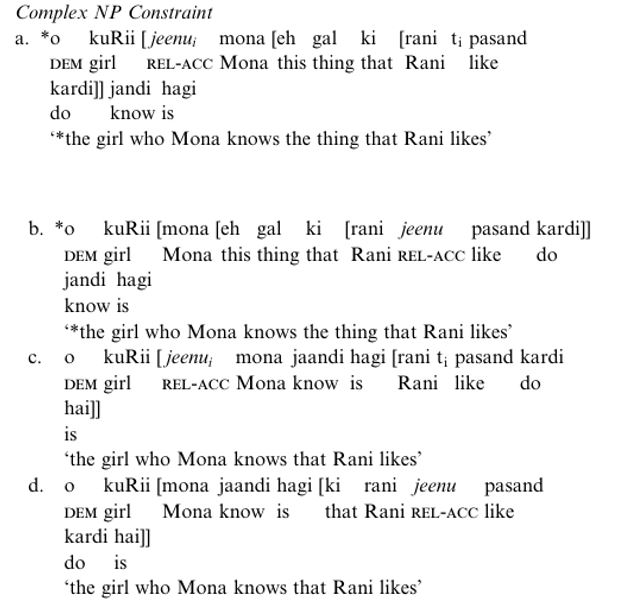
Rel-movement in Punjabi is sensitive to island constraints, namely, the Complex NP Constraint, the Wh-Island Constraint, and the Adjunct Island Constraint. (1a) is ungrammatical because it violates the Complex NP Constraint. Note that (1b) is the in-situ variant and it is ungrammatical. This shows that even the derivation of ostensibly ‘‘in-situ’’ variants like (1b) involves movement. Without the NP island, the sentence is grammatical, as expected; see (1c–d). Hence, the derivation of Punjabi relative clauses involves movement.
(1)
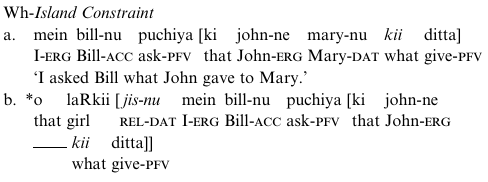
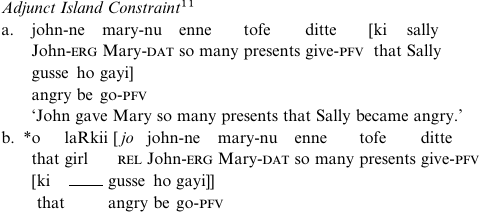
(2) and (3) demonstrate that it is not possible to move relative phrases out of an embedded question (the Wh-Island Constraint) or an adjunct clause (the Adjunct Island Constraint), respectively.
(2)
(3)
If a movement is cyclic and forms an A ¯-chain, we might expect the movement to go through the specifier positions (Specs). However, whether all the copies of a movement chain are allowed to be overtly realized would be another issue. We can schematize a successive-cyclic A ¯ movement chain as in (4).
(4)

(4) shows that the movement of the rel-phrase forms an A ¯-chain, which moves through Spec of the intermediate C0 and finally into the highest Spec,CP for interpretation. One piece of evidence that a rel-phrase moves into a Spec,CP comes from the examples in (5)–(6). In Punjabi, as in Hindi, the Doubly Filled Comp Filter does not seem to be operative. (5) and (6) show that rel-phrases can be overtly realized before complementizer ki, which can be taken as evidence that rel-phrases do move into Spec,CPs.
(5)

(6)

Following Bobaljik’s (2002) copy theory, when the lowest copy of the movement chain is pronounced, the result is the in-situ sentence shown in (7a), which is an example of so-called covert movement in syntax). When the highest copy is pronounced, the result is a structure like (7c) that displays so-called overt movement in syntax (pattern (a)). It is well documented in the literature that PF and LF can privilege different copies in a movement chain (see patterns (b) and (c)); therefore, it is not surprising that an intermediate copy of a movement chain can be pronounced. (7b), illustrating ‘‘partial movement’’ in relative clauses, is an example of this sort.
(7)
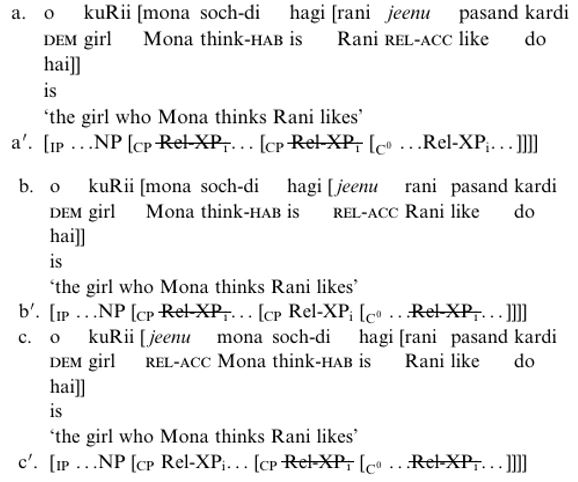
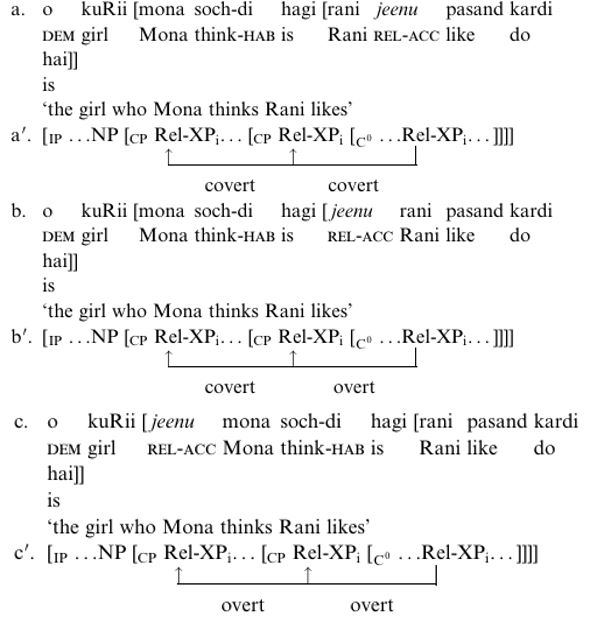
Under this view, there is no overt/covert distinction; it is PF that chooses which copy is to be pronounced. If we follow Chomsky’s (1993, 1995) view in which all overt movement precedes all covert movement or his (2001) proposal in which derivation is restricted by phases, we are able to explain all the possible PF outputs in (8), but this requires assuming in addition three distinct syntactic derivations, as in (8a’,b’,c’). (8a’) involves two covert movement operations; (8b’), overt movement followed by covert movement; and (8c’), two overt movement operations.
(8)
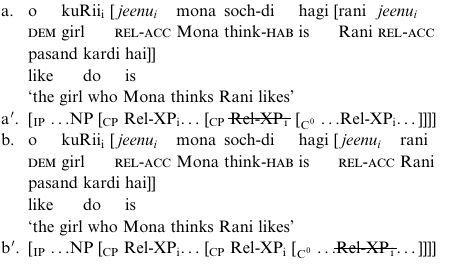
However, Chomsky’s proposal runs into a problem in explaining the facts in (9). (9a/a’) show the lowest copy and the highest one being pronounced, and (9b/b’) the intermediate one and the highest one.
(9)
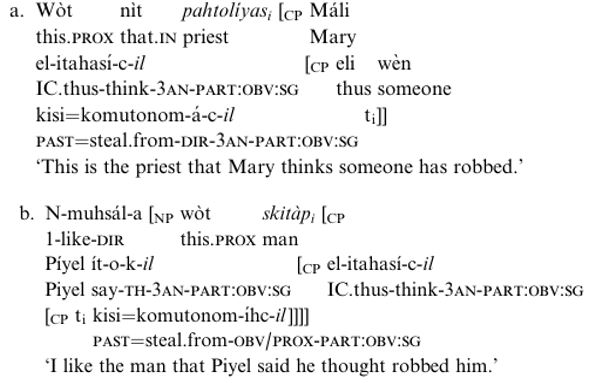
This multiple realization phenomenon is not unique to Punjabi. There are crosslinguistic parallels in the literature such as participle agreement in Passamaquoddy (Algonquian). (10a–b) are examples of externally headed relative clauses, and (11) is an example of internally headed relative clauses (examples are from Bruening 2004).
(10)
(11)
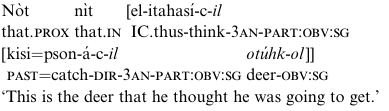
The multiple realization phenomenon found in Passamaquoddy is not identical to the one in Punjabi. However, the goal of using this strategy, multiple realization, in both languages is the same: to mark the path of a movement chain. In Passamaquoddy, marking every participle form of the verb serves to clearly identify the path of a moving operator. As (10)–(11) show, more than one participle form can be marked by a single relative phrase. Further, even when the head is internally realized as in (11), it triggers marking in the higher clause.
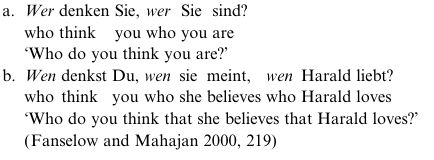
The same multiple Spell-Out phenomenon is found in German; see (12a–b). In addition to the scope-marking strategy, (12) seems to be the default way of forming long-distance questions in the Brandenburg dialect in German.
(12)
In this section, I have presented crosslinguistic facts from Punjabi, Pas samaquoddy, and German to show that the multiple realization of a certain element of a movement chain is possible. In the following section, I show that multiple realization of a movement chain is subject to a PF economy restriction.








