Conceptual blending in thought, rhetoric, and ideology
Persuasive absurdity
In fact, the conceptual integration of two scenarios into an absurd scenario in a blended space is a common argumentative tactic. Take the example below, from an actual jury deliberation in a high-profile murder case, videotaped and partly broadcast by an American television station:
Juror 7: Barbara Davis [victim] doesn’t get to come … when she turns 72 in that casket she doesn’t get to come out of that casket.
Juror 11: Yeah, but there’s not a guarantee that technically he’ll get out either. […]
Juror 13: If she has no chance of getting out of the casket why should he have a chance of getting out of jail?
Juror 2: Exactly. (JurDel.B., p. 22)
Coulson and Pascual (2006) argue that, in this blend, the victim’s casket is construed as a prison from which there is no possibility of release. The disanalogy between the victim’s future and the Hypothetical Future of her murderer at age 72 is used to argue for giving the murderer a life sentence. In this blend, the victim has the animate and intentional properties she had in the Past Space, before the crime occurred. Further, in spite of her death, the victim ages in an analogous fashion to the prisoner. However, unlike the prisoner, when the victim turns 72 she does not “get” to come out of the casket. Thus the middle-aged murder victim is construed in the blend as being 72 years old, and actively desiring to get out of her casket. However, she is unable to do so because she is dead.
The unreal image evoked by this blend was not presented for embellishment or humorous purposes. On the contrary, the aging corpse in Juror 7’s blend was used to argue for the appropriateness of a life sentence for the convicted murderer. In spite of the absurdity of the image in the blend, or indeed perhaps because of it, Juror 7’s argument is compelling. Interestingly, the speaker’s goal in this example was not to draw attention to the absurdities in the blended space, but rather to the inferences and conceptualizations that emerge from it. That is, the speaker is not attempting to argue for the absurdity of a dead individual becoming older and trying to escape from her coffin on the day her murderer is released from prison. Rather, the intended absurdity is the idea of giving a more severe punishment to the victim than to the man who killed her.
Examining other instances of blends produced by speakers under the demands of real-time conversation suggests the comprehension and production of these blends is supported by extensive appeal to conventional cultural, linguistic, and situational knowledge. Oakley and Coulson (under review), for example, analyze the creative blend in the following excerpt from a radio interview with Richard Clarke, former White House Coordinator of counter-terrorism for the Clinton Administration and the George W. Bush Administration. Clarke is deeply critical of the George W. Bush Administration’s handling of the “war on terrorism,” especially their handling of intelligence leading up to the 9/11 terrorist attacks.
there’s uh, some.. uh dots
which are meaningless unless you put them together with lots of other dots. and,
I understand what he’s say=ing.
But there are some dots that come out screa=ming at you.
Uh “do something now about me.”
Generically, “to connect the dots” means to understand the relationship between apparently isolated bits of information, and “failure to connect the dots” refers to the failure to do so. However, the expression has a particular conventionalized meaning in the context of the 9/11 terrorist attacks on the World Trade Center in New York City and the Pentagon in Washington, DC, and relates to the American government’s failure to predict those attacks. One popular explanation of how 19 hijackers were able to outsmart the collective resources of the FBI (Federal Bureau of Investigation), the CIA (Central Intelligence Agency), and the NSA (National Security Agency) is that while a considerable amount of information relevant to the planned attacks was known to various members of these agencies, it was distributed amongst them such that no single agency had enough information to take preventive action. In this context, “failure to connect the dots” refers to the failure by US intelligence agents to understand the relationship between different facts about individuals with links to terrorist groups.
The “connect the dots” blend co-opts the KNOWING IS SEEING metaphor and applies it to the children’s game of Connect the Dots by adding a few new mappings. The most important of these is the mapping between dots and information that is quite simple to establish because a unit of information is often construed as a point. The metaphoric significance of the expression “connect the dots” is bolstered by the fact that there is one entrenched meaning of connect that suits the game, and another that suits the epistemic domain. Because the percept corresponds to the knowledge in the KNOWING IS SEEING metaphor, connected dots correspond to known relationships between different pieces of information. In the game, connected dots afford pattern recognition; in the epistemic domain, knowing relationships between different pieces of information allows the inference of new information. Further, because the clarity of the percept maps onto the quality of the knowledge, unconnected dots that yield an unclear percept map onto poor knowledge. Moreover, the unseen pattern in the game maps onto the fact that important information is unknown to the subject of knowing.
The integration network for “connect the dots” involves one input that pertains to the Connect the Dots game, and another that pertains to national security and intelligence. In the blended space, information gleaned by intelligence agents map onto dots on a two-dimensional plane, and the pattern implicit in these dots (structure projected from the Game Space) maps onto terrorist plots in the Intelligence Space. In the blend, it is possible for the intelligence officer to see terrorist activities represented in the dots. The intelligence officer in the blend draws lines between the dots just as the child does in the presentation space. However, while the child sees a pleasing picture in her drawing, the intelligence officer gains a growing understanding of impending terrorist attacks.
In contrast to this culturally supported connect-the-dots blend which is highly coherent and supported by redundant information, Clarke’s more creative screaming dots blend is difficult to understand, and especially difficult without supporting context. This difficulty is partially related to the fact that there is no pre-existing domain in which (actual) dots are construed as screaming, and without additional information it is unclear both what conventional mappings could be used to unpack this blend, and what target domain information the screaming dots are meant to evoke.
Oakley and Coulson (under review) speculate that the comprehensibility of this blend in context reflects both its recruitment of an existing blending schema, that of fictive interaction (Pascual 2002), and the way it utilizes a contextually established mapping between dots and intelligence information. Fictive interaction involves the use of frames for the structure of ordinary communicative acts to animate epistemic processes, as for example when a lawyer says that the facts in a case “tell a story”. Consequently, knowing that dots map to intelligence information is crucial for understanding the applicability of the fictive interaction schema. Given this information, the manner of interaction conveys a salient inference as the dots in Clarke’s blend do not simply speak, they scream. The implication from this screaming dots blend, then, is that the responsible government agencies were ignoring the warning signs.
In fact, the full meaning of Clarke’s remarks is not apparent until the succeeding discourse where he points out that the CIA observed a meeting of high-level Al Quaeda operatives where the attendees were assumed to be planning an attack, and that two of these people were known to have entered the United States prior to September 11, 2001. His point is that these facts alone constituted actionable intelligence and thus the analogy to the game of “connect the dots” is not well supported. Because Clarke objects to the very premise of the mappings in the connect-the-dots blend, he explicitly disputes the applicability of the term “connect”, recruiting instead the conventionalized fictive interaction blend. While fictive interaction is compatible with Clarke’s construal of certain facts as being in dependently meaningful, it is less compatible with the mapping between facts and dots. Moreover, the impact of additional information about the target domain on the interpretability of the phrase “screaming dots” suggests that what is crucial for the argument is not the structure in the blended space, but rather the mappings between blended structures and concepts in the other spaces in the network.
Indeed, analysis of persuasive texts intended to actually change people’s behavior ultimately depends on the audience’s internalization of the relevant cultural models. For example, Coulson and Oakley (2006) discuss an example of a (real) direct mail advertisement soliciting contributions to a religious organization. The package includes a letter, a prayer page to send with donations, a return envelope for the prayer page, and a purple sealed envelope bearing a message from Jesus Christ. The letter urges its recipient to perform a number of concrete actions in order to show her faith, and be blessed by Jesus. In particular the reader is instructed to:
1. Place the purple sealed envelope under his or her pillow
2. Sleep on this “purple point of contact just like the children of Israel did when God instructed them to do so (Numbers 15:38,39)”
3. Mail back the prayer page with a donation to the Ministry.
4. Open the purple sealed envelope to receive the “purple point of contact blessing.”
As one aspect of its persuasive effort, the letter invokes a blend of conceptual structures from cognitive domains associated with organized religion. For example, the letter repeatedly appeals to a metaphoric construal of making a monetary donation as sowing a seed. For example, towards the end of the letter proper, we read:
We believe you are going to sow a seed so God can bless you with a harvest. God said, “Give and it shall be given unto you …” Luke 6:38. We pray that you will sow $5.00, $10.00, $20.00, or more. Let God lead you. Our prayer is that, by faith, what you sow will start being returned to you before the seventh day of next month, as God sees fit. He knows best how and when to let it begin. Let us pray over this last page and purple sealed word. Let us bow our heads in prayer shall we?
Comprehension of this passage requires assuming a number of underlying mappings, including sowing a seed and sending a donation, as well as between the harvest and the money that the sender receives in return. Mappings in the network are set up by a conventional metaphoric connection between agriculture and investment, which maps the metamorphosis of a seed into crops for harvest onto the difference between the initial investment and its return. The inputs to the seed-sowing blend thus include one space we might call the Agriculture Space, and another we might call the Material Space. The mapping between the seed and the money is cued explicitly by the statement, “We pray that you will sow $5.00, $10.00 …” in which the object of “sow” is not a type of seed (as in the Agriculture input), but a unit of currency that originates in the Material input. Linguistic prompts also help the reader identify the mapping between the harvest and the monetary returns, in “Our prayer is that, by faith, what you sow will start being returned to you …” Since the letter writer will presumably sow money, she can expect money to be returned to her.
The structure in the blend differs from conventional conceptions of agriculture in several ways, especially in its recruitment of structure from a third input which we might dub the Spiritual space. For example, on the prayer page, which the reader sends in with her donation, is written, “I am sowing [followed by a list of potential dollar amounts] as my seed unto the Lord, in faith”. Thus unlike real seeds, the seed of $5 is not planted in the earth, and unlike a conventional investment, it has not been used for its purchasing power.
The example here thus involves a prototypical case of conceptual integration in which the blended concept involves partial structure from each of its inputs as well as novel structure of its own. In the context of the blend, the $5 has some of the properties of conventional money (it can be used to buy things) and some of the properties of a seed (it will undergo a transformation). Further, unlike most agricultural endeavors, the relationship between the initial sowing of the seed and the final harvest is not mediated by farming activity. In contrast to default knowledge about managing investments, the transformation from seed to harvest here occurs “by faith”. Because it is a seed of faith, the coming harvest depends on receiving a blessing from the Lord. Moreover, receiving the blessing depends on following a particular series of instructions outlined in the letter: mailing in the donation, sleeping on the (enclosed) purple envelope, and opening the purple envelope after sunset on the following day.
Coulson and Oakley (2006) argue that the desired rhetorical effect of this letter depends on the existence of systematic correspondences between the three input spaces displayed in the table. Besides conventional agricultural metaphors for investment (e.g. investments that grow), the letter authors are exploiting conventional agricultural metaphors for spirituality (e.g. spiritual growth). The former play into the reader’s greed, while the latter are reminiscent of the Bible and bolster the legitimacy of the religious organization that mailed the letter.1 The integration of these three domains results in a scenario where the reader can satisfy her greed in a virtuous way. Thus the inputs in this blend are being exploited not only for their inferential possibilities, but also for their sociocultural significance.
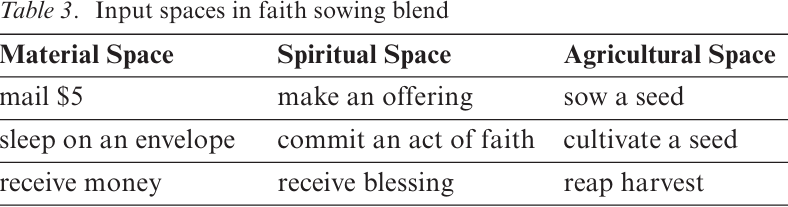
While the letter clearly establishes the mappings between sending the money, sowing a seed, and making an offering to God, establishing the blend goes further. Without the blend, there is no way that anyone would believe that sending off $5 could result in financial gain. Similarly, the reader will not carry around the purple envelope or sleep on it unless she believes the action will have the spiritual and/or the monetary results implied in the blend. So, to reiterate, anyone who performs the actions described in the letter will do so because they have adopted the blend where mailing $5 is sowing a faith seed, sleeping on the envelope is an act of faith, and that the ultimate result of these actions will be a monetary blessing from God. Moreover, the difference between someone who does and someone who does not carry out the instructions has little to do with the mappings (presumably anyone can figure out what one is supposed to do and why), and everything to do with integrating and elaborating the structure in the blend until it becomes a motivating frame.
1. Indeed, the New Testament contains several different versions of the parable of the Sower, about a sower who sows seed on a path, rocks, thorns, and good dirt– and only the latter grew into plants that yielded fruit. One of the few parables in the Bible that is actually followed by exegetical notes from Jesus, the parable is typically interpreted as being about Jesus (the Sower), the gospel, or God’s message (the seeds), and the inability and/or unwillingness of many people to understand God’s message. See Wierzbicka (2001: 257–265) for insightful analysis of this parable. Despite the disanalogies between our letter’s appropriation of this metaphor and the parable of the Sower (e.g. Jesus the Sower of God’s message is presumably not a good mapping for the sinner this solicitation is presumably aimed at), the existence of the cultural model by which a willing person can be dramatically transformed by the power of God is crucial for the success of this blend. Thanks to a reviewer for pointing this out.








