Energy through fusion at last: Synergies in cognitive anthropology and cognitive linguistics
Complex categories
Reduplication12 as a complex category
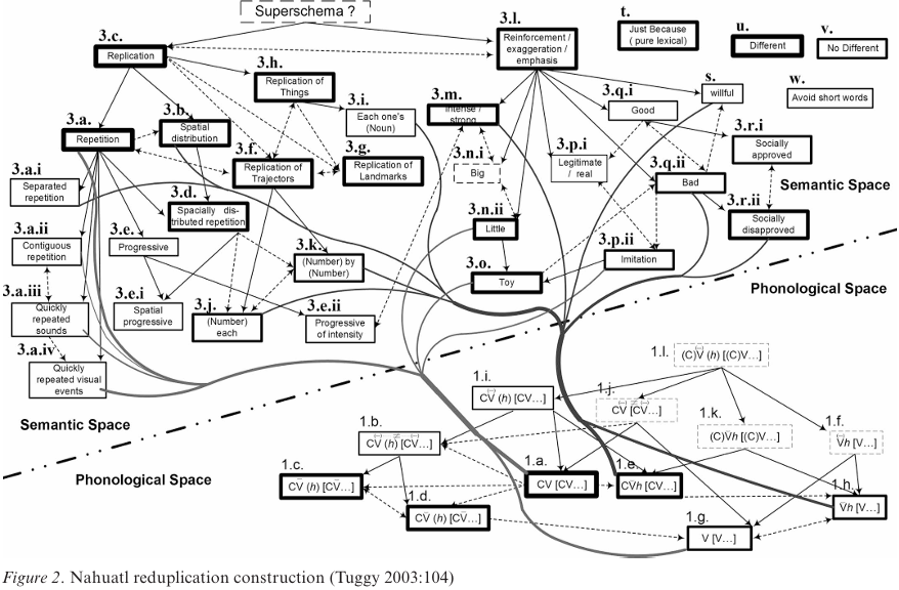
Given Langacker’s idea of the linguistic symbol, it is not hard to imagine quite complex combinations of phonological and semantic units that form networks of meaning and phonology. One such network, the system of grammatical reduplication in Nahuatl, has been set out in great detail by Tuggy (2003), yet he would not claim that his analysis is exhaustive. Figure 2 shows Tuggy’s representation of the symbolic network, which is characterized not by tidy hierarchical or productive rules readily available to a deductively minded speaker, but rather by numbers of irregular phonological forms associated with other forms by similarity. Two phonological prototypes (1.a, e, indicated with bold rectangles) are linked to semantic units characterized by different levels of prototypicality and schematicity. Neither the phonological space nor the semantic space is clearly demarcated, but there are discernable fields. On the left side of the semantic space, most tightly linked to the consonant-vowel reduplication form CV[CV …], are found various kinds of repetition, which are associated with replication, spatial distribution, the progressive aspect, and intensity. At least some of these notions are probably universally associated with grammatical reduplication. On the right side of the diagram, most tightly linked to the form CVh[CV …] there is a sub-network of concepts that reflect evaluations: legitimacy, good, bad, willful, social approval/ disapproval, and difference. These concepts, too, are very commonly, if not universally, found in the semantic space of reduplication morphology.
I would attribute the substantial number of evaluative terms to the metonymic thinking process called subjectification (Langacker 1990). Terms used repeatedly in a certain context take on as part of their meaning the emotions and perspectives of speakers and observers. The process involves metonymy because the emotions and perspectives belong to the evocative scene along with other components, and because terms for other components of the scene (such as repetitive noise) evolve semantically to include the associated emotion (such as irritation) in their conventional meaning. It is the reduplication which evokes the scenario-based emotions and evaluations in the interpretation (Compare Kristiansen 2003). With repeated usages, responses and perceptions of the observer move gradually from offstage to onstage. Additional examples of evaluative complexes have been described. Palmer, Rader and Clarito (forth-coming) found that a subset of lexemes using the Tagalog prefix ka-, which they analyzed as a metonymic partial, expresses evaluations in forms that reduplicate roots. A set of lexemes using the agent-focus prefix mag- also has reduplicative forms that express distributives, repetition, and intensity (Palmer 2003b). Occhi (1999) has analyzed the intricate reduplication grammar of Japanese gitaigo mimetics of emotion. Very much as with Tuggy’s network analysis of reduplication in Nahuatl, Occhi observed that “metonymic and metamorphic extensions among sense modalities (e.g. kan kan), as well as between semantically similar lexemes with different [high (H) and low (L)] pitch patterns (e.g. ira ira LHHH and HLLL), result in fuzzy categorization” (1999: 166) [material in brackets added].
How might this relate to the integration of diversity? As reduplications cue the listener to evaluative, intensive, or distributive interpretations of lexemes, interlocutors can harmonize evaluations without exchanging much specific information. They may seek a consensus of attitudes while maintaining substantial diversity of knowledge.
12. Reduplication: “A term in morphology for a process of repetition whereby the form of a prefix/suffix reflects certain phonological characteristics of the root” (Crystal 1980: 293).








