

Grammar


Tenses


Present

Present Simple

Present Continuous

Present Perfect

Present Perfect Continuous


Past

Past Simple

Past Continuous

Past Perfect

Past Perfect Continuous


Future

Future Simple

Future Continuous

Future Perfect

Future Perfect Continuous


Parts Of Speech


Nouns

Countable and uncountable nouns

Verbal nouns

Singular and Plural nouns

Proper nouns

Nouns gender

Nouns definition

Concrete nouns

Abstract nouns

Common nouns

Collective nouns

Definition Of Nouns

Animate and Inanimate nouns

Nouns


Verbs

Stative and dynamic verbs

Finite and nonfinite verbs

To be verbs

Transitive and intransitive verbs

Auxiliary verbs

Modal verbs

Regular and irregular verbs

Action verbs

Verbs


Adverbs

Relative adverbs

Interrogative adverbs

Adverbs of time

Adverbs of place

Adverbs of reason

Adverbs of quantity

Adverbs of manner

Adverbs of frequency

Adverbs of affirmation

Adverbs


Adjectives

Quantitative adjective

Proper adjective

Possessive adjective

Numeral adjective

Interrogative adjective

Distributive adjective

Descriptive adjective

Demonstrative adjective


Pronouns

Subject pronoun

Relative pronoun

Reflexive pronoun

Reciprocal pronoun

Possessive pronoun

Personal pronoun

Interrogative pronoun

Indefinite pronoun

Emphatic pronoun

Distributive pronoun

Demonstrative pronoun

Pronouns


Pre Position


Preposition by function

Time preposition

Reason preposition

Possession preposition

Place preposition

Phrases preposition

Origin preposition

Measure preposition

Direction preposition

Contrast preposition

Agent preposition


Preposition by construction

Simple preposition

Phrase preposition

Double preposition

Compound preposition

prepositions


Conjunctions

Subordinating conjunction

Correlative conjunction

Coordinating conjunction

Conjunctive adverbs

conjunctions


Interjections

Express calling interjection

Phrases

Sentences


Grammar Rules

Passive and Active

Preference

Requests and offers

wishes

Be used to

Some and any

Could have done

Describing people

Giving advices

Possession

Comparative and superlative

Giving Reason

Making Suggestions

Apologizing

Forming questions

Since and for

Directions

Obligation

Adverbials

invitation

Articles

Imaginary condition

Zero conditional

First conditional

Second conditional

Third conditional

Reported speech

Demonstratives

Determiners


Linguistics

Phonetics

Phonology

Linguistics fields

Syntax

Morphology

Semantics

pragmatics

History

Writing

Grammar

Phonetics and Phonology

Semiotics


Reading Comprehension

Elementary

Intermediate

Advanced


Teaching Methods

Teaching Strategies

Assessment
Symbols used in syntactic analysis
المؤلف:
George Yule
المصدر:
The study of language
الجزء والصفحة:
100-8
16-2-2022
7843
Symbols used in syntactic analysis
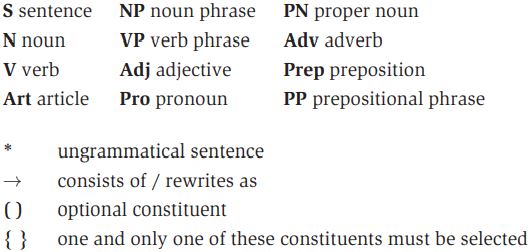
We have already encountered some symbols that are used as abbreviations for syntactic categories. Examples are “S” (= sentence), “NP” (= noun phrase), “N” (= noun), “Art” (= article), “V” (= verb) and “VP” (= verb phrase). Others, such as “PP” (= prepositional phrase), seem fairly transparent. There are three more symbols that are commonly used in syntactic description.
The first is in the form of an arrow →. It can be interpreted as “consists of” or “rewrites as.” It is typically used in the following type of rule:
NP → Art N
This is simply a shorthand way of saying that a noun phrase (NP) such as the dog consists of or rewrites as (→) an article (Art) the and a noun (N) dog.
The second symbol is a pair of round brackets ( ). Whatever occurs inside these round brackets will be treated as an optional constituent. For example, we can describe something as the dog or the small dog. We can say that both the dog and the small dog are examples of the category noun phrase (NP). When we want to use a noun phrase in S NP VP Art N V NP Art N The girl saw a dog Figure 8.2 100 The Study of Language English, we can include an adjective (Adj) such as small, but we don’t have to. It’s an optional constituent in a grammatically well-formed noun phrase. We can represent this observation in the following type of rule:
NP → Art (Adj) N
This shorthand notation expresses the idea that a noun phrase rewrites as (→) an article (Art) and a noun (N), with the option of including an adjective (Adj) in a specific position between them. We use the round brackets to indicate that the adjective is optional. So, we can use this notation to generate the dog, the small dog, a cat, a big cat, the book, a boring book and an endless number of other similar noun phrases.
The third symbol is in the form of curly brackets { }.These indicate that only one of the elements enclosed within the curly brackets must be selected. We use these types of brackets when we want to indicate that there is a choice from two or more constituents. For example, we have seen already that a noun phrase can consist of an expression such as the dog (article plus noun), or it (pronoun), or Cathy (proper noun). Using the abbreviations “Pro” (for pronoun) and “PN” (for proper noun), we can try to capture this observation about English with three separate rules, as shown on the left. However, it is more succinct to write one rule, as shown in the middle or on the right, using curly brackets and including exactly the same information.

It is important to remember that, although there are three constituents inside these curly brackets, only one of them can be selected on any occasion.
The list of common symbols and abbreviations is summarized here.
الاكثر قراءة في Syntax
اخر الاخبار
اخبار العتبة العباسية المقدسة
الآخبار الصحية

قسم الشؤون الفكرية يصدر كتاباً يوثق تاريخ السدانة في العتبة العباسية المقدسة
"المهمة".. إصدار قصصي يوثّق القصص الفائزة في مسابقة فتوى الدفاع المقدسة للقصة القصيرة
(نوافذ).. إصدار أدبي يوثق القصص الفائزة في مسابقة الإمام العسكري (عليه السلام)


