

Grammar


Tenses


Present

Present Simple

Present Continuous

Present Perfect

Present Perfect Continuous


Past

Past Simple

Past Continuous

Past Perfect

Past Perfect Continuous


Future

Future Simple

Future Continuous

Future Perfect

Future Perfect Continuous


Parts Of Speech


Nouns

Countable and uncountable nouns

Verbal nouns

Singular and Plural nouns

Proper nouns

Nouns gender

Nouns definition

Concrete nouns

Abstract nouns

Common nouns

Collective nouns

Definition Of Nouns

Animate and Inanimate nouns

Nouns


Verbs

Stative and dynamic verbs

Finite and nonfinite verbs

To be verbs

Transitive and intransitive verbs

Auxiliary verbs

Modal verbs

Regular and irregular verbs

Action verbs

Verbs


Adverbs

Relative adverbs

Interrogative adverbs

Adverbs of time

Adverbs of place

Adverbs of reason

Adverbs of quantity

Adverbs of manner

Adverbs of frequency

Adverbs of affirmation

Adverbs


Adjectives

Quantitative adjective

Proper adjective

Possessive adjective

Numeral adjective

Interrogative adjective

Distributive adjective

Descriptive adjective

Demonstrative adjective


Pronouns

Subject pronoun

Relative pronoun

Reflexive pronoun

Reciprocal pronoun

Possessive pronoun

Personal pronoun

Interrogative pronoun

Indefinite pronoun

Emphatic pronoun

Distributive pronoun

Demonstrative pronoun

Pronouns


Pre Position


Preposition by function

Time preposition

Reason preposition

Possession preposition

Place preposition

Phrases preposition

Origin preposition

Measure preposition

Direction preposition

Contrast preposition

Agent preposition


Preposition by construction

Simple preposition

Phrase preposition

Double preposition

Compound preposition

prepositions


Conjunctions

Subordinating conjunction

Correlative conjunction

Coordinating conjunction

Conjunctive adverbs

conjunctions


Interjections

Express calling interjection

Phrases

Sentences


Grammar Rules

Passive and Active

Preference

Requests and offers

wishes

Be used to

Some and any

Could have done

Describing people

Giving advices

Possession

Comparative and superlative

Giving Reason

Making Suggestions

Apologizing

Forming questions

Since and for

Directions

Obligation

Adverbials

invitation

Articles

Imaginary condition

Zero conditional

First conditional

Second conditional

Third conditional

Reported speech

Demonstratives

Determiners


Linguistics

Phonetics

Phonology

Linguistics fields

Syntax

Morphology

Semantics

pragmatics

History

Writing

Grammar

Phonetics and Phonology

Semiotics


Reading Comprehension

Elementary

Intermediate

Advanced


Teaching Methods

Teaching Strategies

Assessment
DEVISING DIAGNOSTIC FRAMEWORKS
المؤلف:
BARBARA MINTO
المصدر:
THE MINTO PYRAMID PRINCIPLE
الجزء والصفحة:
143-9
2024-09-23
972
DEVISING DIAGNOSTIC FRAMEWORKS
You use diagnostic frameworks to help you visualize what's going on in the area within which the client's problem occurred. This visualization in turn reveals the elements or activities on which your analysis should focus. To take a very simple example,1 let's say your head hurts, you don't know why, and so you can't decide how to treat it. Step one would be to try to visualize the possible causes of the problem.
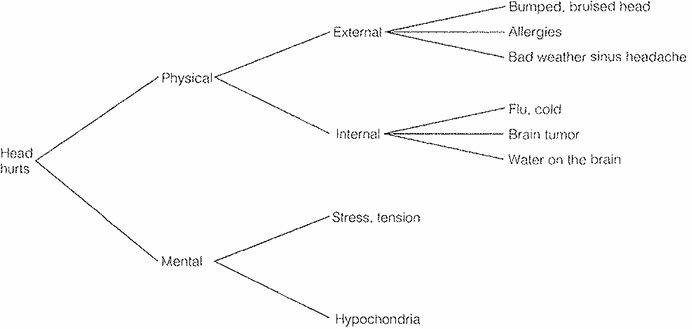
If your head hurts, a MECE classification reveals that it can be caused either by something physical or by something mental. If the cause is physical, the subcauses can have been either external or internal. If external, you may have bumped your head, or have allergies, or be responding to the weather, etc.
With this layout, you can assess the possible causes in the order in which they are easiest to eliminate. In other words, you are not going to set up an appointment to test for a brain tumor if it turns out you have a sinus headache.
We know that, Imposing Logical Order; that there are only three possible ways to structure anything: divide, trace cause and effect, or classify. You use one or more of these techniques in developing a diagnostic framework to get at the likely causes of a problem.
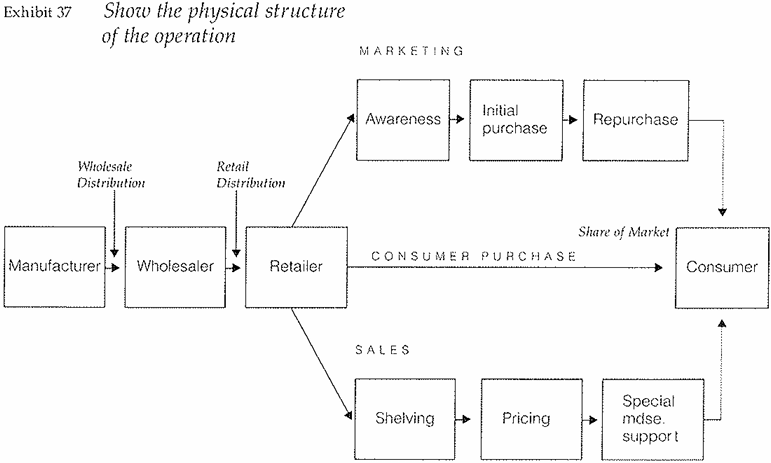
Exhibit 37, for example, shows the elements of sales and marketing available to the retailer to influence the consumer to buy Thus, one of the things you would need to determine would be whether share of market is down (R1) because they don't make the customer sufficiently aware, because they don't convince him to buy, etc.
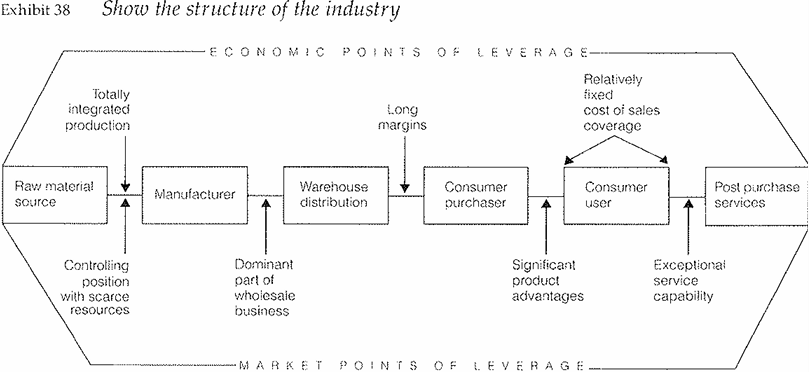
Another typical analysis at the beginning of a study is to try to understand the business process and key trends in an industry, as a basis for identifying danger areas. Here, you segment the industry (Exhibit 38) and determine volume and competitive structure for each segment. You can also attempt to determine where value is added, how costs behave, where profits are made, where profits are sensitive, and where assets are committed. Then you can look for points of leverage, and from those gather data to determine where the business is vulnerable.
1 From an internal presentation at Andersen Consulting.
الاكثر قراءة في Writing
اخر الاخبار
اخبار العتبة العباسية المقدسة
الآخبار الصحية

قسم الشؤون الفكرية يصدر كتاباً يوثق تاريخ السدانة في العتبة العباسية المقدسة
"المهمة".. إصدار قصصي يوثّق القصص الفائزة في مسابقة فتوى الدفاع المقدسة للقصة القصيرة
(نوافذ).. إصدار أدبي يوثق القصص الفائزة في مسابقة الإمام العسكري (عليه السلام)


