الوضع الليلي


 12:21:25
  2023-07-06
  1277
1277
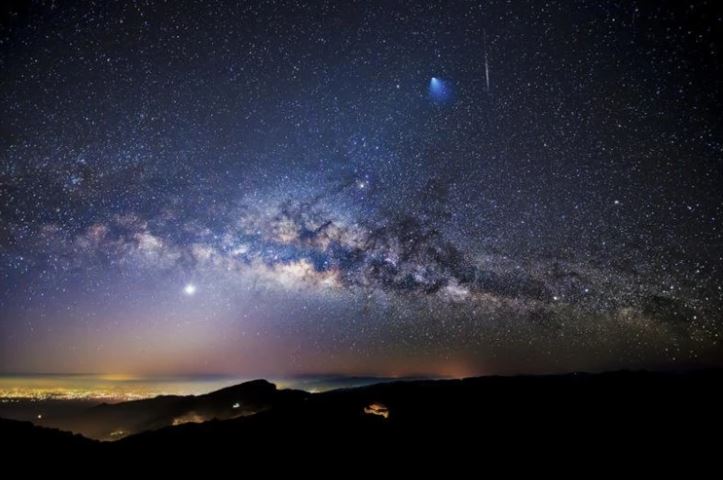
Alien astronomers (if any) living in another galaxy might see the Milky Way's 100 billion stars as little more than a tiny blur of light in the night sky.
However, if these so-called extraterrestrials analyzed the frequencies of light in that faint smudge, they might be able to decipher what our galaxy is made of.
This raises the question: what does the chemistry of the Milky Way look like millions of light years away?
Research conducted by the Max Planck Institute for Astronomy in Germany and Yunnan University in China provided the following answer: Our galaxy is a strange sphere, although it is not unique.
The Milky Way stands out among other galaxies of similar size with very low metallic concentrations in the center, rising toward the midpoint, and then fading at the galaxy's fringes.
By comparison, the metallic distribution of other galaxies is much flatter, more like a pie than a doughnut.
The researchers reported that our galaxy "is not unique, but it is not common. The Milky Way may not have the typical metallic distribution for a galaxy of its mass."
Astronomers use the word "metal" to refer to all elements heavier than hydrogen and helium.
The hydrogen and helium nuclei formed about three minutes after the Big Bang, as electrons traveled about 380,000 years to form the atoms. Heavier elements are the product of billions of years of stellar evolution, which takes more time to appear.
For this reason, stars born early in the history of the universe tend to have less metallicity than stars born later.
The researchers compared our Milky Way to 321 galaxies of similar masses observed as part of the mapping of nearby galaxies in the Apache Point Observatory (MaNGA) survey.
They found that only one percent of these galaxies match the Milky Way in terms of metal distribution.
The researchers also compared the Milky Way to 134 galaxies created in the TNG50 simulation of the universe, modeling the evolution of tens of thousands of galaxies over the course of 13.8 billion years.
Only 11% of the simulated galaxies were like ours.
Reality Of Islam |
|

MIT researc

Researchers
Researchers

New phononi
 9:3:43
2018-11-05
9:3:43
2018-11-05
10 benefits of Marriage in Islam
7:5:22
2019-04-08
benefits of reciting surat yunus, hud &
9:45:7
2018-12-24
advantages & disadvantages of divorce
11:35:12
2018-06-10
6:0:51
2018-10-16
11:11:59
2023-02-01
11:34:48
2022-06-29
8:30:23
2022-03-03
7:32:24
2022-02-14
1:38:41
2021-12-08
8:19:41
2018-06-21
the happy life of mankind requirement
6:36:36
2022-01-25
5:41:46
2023-03-18
| LATEST |
 HOME
HOME