Determiners and quantifiers
The first type of functional category which we shall deal with is the category of determiner (abbreviated to D, or sometimes DET). Items such as those bold-printed in (17) below (as used there) are traditionally said to be (referential) determiners (because they determine the referential properties of the italicized noun expression which follows them):

Referential determiners are used to introduce referring expressions: an expression like the car in a sentence such as Shall we take the car? is a referring expression in the sense that it is typically used to refer to a specific car which is assumed to be familiar to the hearer/addressee.
A related class of words are those which belong to the category quantifier (abbreviated to Q), and this is traditionally said to include items like those bold-printed below:
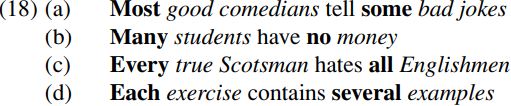
Such items are termed quantifiers because they serve to quantify the italicized noun expression which follows them. Since determiners and quantifiers are positioned in front of nouns (cf. the boys and many boys), and adjectives can similarly be positioned in front of nouns (cf. tall boys), an obvious question to ask at this point is why we couldn’t just say that the determiners/quantifiers in (17) and (18) have the categorial status of adjectives. The answer is that any attempt to analyze determiners or quantifiers as adjectives in English runs up against a number of serious descriptive problems. Let’s see why.
One reason for not subsuming determiners/quantifiers within the category of adjectives is that they are syntactically distinct from adjectives in a variety of ways. For example, adjectives can be iteratively (i.e. repeatedly) stacked in front of a noun they modify, in the sense that you can go on putting more and more adjectives in front of a given noun (as in handsome strangers, dark handsome strangers, tall dark handsome strangers, sensitive tall handsome strangers etc.). By contrast, neither determiners nor quantifiers can be stacked in this way (so that although we can have a quantifier+determiner+noun expression like both the twins, we cannot have a multiple determiner expression like ∗the these books or a multiple quantifier expression such as ∗all both twins). Moreover, determiners, quantifiers and adjectives can be used together to modify a noun, but when they do so, any determiner or quantifier modifying the noun has to precede any adjective(s) modifying the noun:

Thus, determiners and quantifiers seem to have a different distribution (and hence to be categorially distinct) from adjectives.
A further difference between determiners/quantifiers and adjectives can be illustrated in relation to what speaker B can – and cannot – reply in the following dialogue:
 As noted earlier, nouns like chair have the property that they are countable (in the sense that we can say one chair, two chairs etc.), and in this respect they differ from mass nouns like furniture which are uncountable (hence we can’t say ∗one furniture, ∗two furnitures etc). We see from (20) that a singular count noun like chair cannot stand on its own as a complete noun expression, nor indeed can it function as such even if modified by an adjective like comfortable; rather, a singular count noun requires a modifying determiner or quantifier like a/another/the/that etc. This provides us with clear evidence that determiners and quantifiers in English have a different categorial status from adjectives.
Indeed, a more general property which differentiates determiners/quantifiers from adjectives is that determiners/quantifiers tend to be restricted to modifying nouns which have specific number (or countability) properties. For example, a modifies a singular count noun, much modifies a (singular) mass noun, several modifies a plural count noun, more modifies either a plural count or a (singular) mass noun:

By contrast, typical adjectives like nice, simple, comfortable, modern etc. can generally be used to modify all three types of noun:

(It should be noted, however, that a determiner like the can also be used to modify singular/plural count and non-count nouns alike.)
It seems reasonable to suppose that determiners and quantifiers are functional categories whereas adjectives are a lexical/substantive category. After all, there is an obvious sense in which adjectives (e.g. thoughtful) have descriptive content but determiners and quantifiers do not – as we can illustrate in terms of the following contrast (? and ! are used to denote increasing degrees of semantic/pragmatic anomaly):

As (23a) illustrates, an adjective like thoughtful can only be used to modify certain types of noun; this is because its descriptive content is such that it is only compatible with (e.g.) an expression denoting a rational (mind-possessing) entity. By contrast, determiners/quantifiers like those bold-printed in (23b) lack specific descriptive content, and hence can be used to modify any semantic class of noun (the only restrictions being grammatical in nature – e.g. a(n)/another can only be used to modify a singular count noun expression). Thus, it seems appropriate to conclude that determiners and quantifiers are functional categories, and adjectives a lexical category
Some linguists (e.g. Lyons 1999 and Adger 2003) treat quantifiers as a subtype of determiner and hence assign them to the category D: one possibility along these lines is to suppose that items like the/this/that are definite determiners, and those like a/some/many are indefinite determiners (and such a categorisation could be said to be implicit in the traditional claim that the is a ‘definite article’ and a an ‘indefinite article’). However, the fact that a determiner like the can combine with a quantifier like all/every in a sentence like:
 Provides some syntactic evidence that the two have different distributions and hence may belong to different categories. Moreover, quantifiers and determiners exhibit different syntactic behavior in respect of questions such as:

In both cases, who is the complement of the word of and is moved to the front of the sentence from its original position after of. But whereas fronting who when it is the complement of the quantifier expression any pictures of results in a grammatical sentence, fronting who when it is the complement of a determiner expression like the pictures of generally leads to a sentence of rather more questionable grammaticality (the relevant phenomenon being known as the definiteness effect. It should be noted, however, that there is quite a bit of variation between speakers as to how good or bad they judge sentences like (25b) to be). So, sentences like (24) and (25) could be said to provide evidence that quantifiers and determiners are syntactically distinct and so belong to different categories (though there is no general agreement on this).








