0
EN
1
المرجع الالكتروني للمعلوماتية

Grammar

Tenses

Present

Present Simple

Present Continuous

Present Perfect

Present Perfect Continuous

Past

Past Simple

Past Continuous

Past Perfect

Past Perfect Continuous

Future

Future Simple

Future Continuous

Future Perfect

Future Perfect Continuous

Parts Of Speech

Nouns

Countable and uncountable nouns

Verbal nouns

Singular and Plural nouns

Proper nouns

Nouns gender

Nouns definition

Concrete nouns

Abstract nouns

Common nouns

Collective nouns

Definition Of Nouns

Animate and Inanimate nouns

Nouns

Verbs

Stative and dynamic verbs

Finite and nonfinite verbs

To be verbs

Transitive and intransitive verbs

Auxiliary verbs

Modal verbs

Regular and irregular verbs

Action verbs

Verbs

Adverbs

Relative adverbs

Interrogative adverbs

Adverbs of time

Adverbs of place

Adverbs of reason

Adverbs of quantity

Adverbs of manner

Adverbs of frequency

Adverbs of affirmation

Adverbs

Adjectives

Quantitative adjective

Proper adjective

Possessive adjective

Numeral adjective

Interrogative adjective

Distributive adjective

Descriptive adjective

Demonstrative adjective

Pronouns

Subject pronoun

Relative pronoun

Reflexive pronoun

Reciprocal pronoun

Possessive pronoun

Personal pronoun

Interrogative pronoun

Indefinite pronoun

Emphatic pronoun

Distributive pronoun

Demonstrative pronoun

Pronouns

Pre Position

Preposition by function

Time preposition

Reason preposition

Possession preposition

Place preposition

Phrases preposition

Origin preposition

Measure preposition

Direction preposition

Contrast preposition

Agent preposition

Preposition by construction

Simple preposition

Phrase preposition

Double preposition

Compound preposition

prepositions

Conjunctions

Subordinating conjunction

Correlative conjunction

Coordinating conjunction

Conjunctive adverbs

conjunctions

Interjections

Express calling interjection

Phrases

Sentences

Clauses

Part of Speech

Grammar Rules

Passive and Active

Preference

Requests and offers

wishes

Be used to

Some and any

Could have done

Describing people

Giving advices

Possession

Comparative and superlative

Giving Reason

Making Suggestions

Apologizing

Forming questions

Since and for

Directions

Obligation

Adverbials

invitation

Articles

Imaginary condition

Zero conditional

First conditional

Second conditional

Third conditional

Reported speech

Demonstratives

Determiners

Direct and Indirect speech

Linguistics

Phonetics

Phonology

Linguistics fields

Syntax

Morphology

Semantics

pragmatics

History

Writing

Grammar

Phonetics and Phonology

Semiotics

Reading Comprehension

Elementary

Intermediate

Advanced

Teaching Methods

Teaching Strategies

Assessment

قم بتسجيل الدخول اولاً لكي يتسنى لك الاعجاب والتعليق.

Lawyers

المؤلف:  L.A Hill

المصدر:  Advanced steps to understanding

الجزء والصفحة:  42-1

7/9/2022

2071

+

-

20

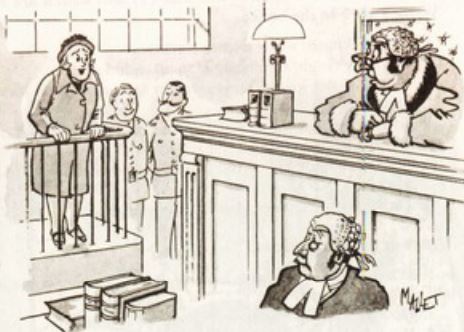
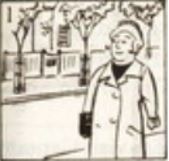
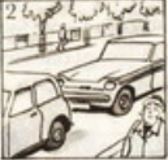
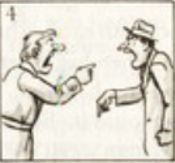
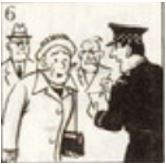
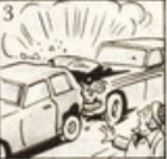
While Mrs. Edwards was in town one Saturday, she saw a crash in an avenue: two cars ran into each other. The drivers got out, and an argument arose between them, but then a policeman arrived. He asked the drivers what had happened, and then he turned to the crowd which had collected round and said, 'Did anyone see the accident?' Several people said they had, and Mrs. Edwards was one of them.

A week later she was asked whether she was willing to be a witness in a court case concerning the accident, and she said she was; and a month later, a lawyer was questioning her in court. She began everything with, I think that ...,' until the lawyer got angry and said, 'You're not here to say what you think: you're here to say what you know.'

I'm sorry,' objected Mrs. Edwards, but I'm not a lawyer, so I can't say things without thinking.


A  Which of these sentences are true (T) and which are false (F)? Write T or F in the boxes.

  1. Mrs. Edwards saw a car crash into a tree, and two other cars run into each other.
  2. She told a policeman that she had seen the crash.
  3. She refused to go to court to be a witness.
  4. The lawyer did not want to give Mrs. Edwards time to think before she answered his questions.
  5. The lawyer meant that he wanted Mrs. Edwards to give facts, not opinions.
  6. Mrs Edwards was suggesting that lawyers say things without thinking.


B  Answer these questions.

  1. What did Mrs. Edwards see on Saturday?
  2. What did the policeman ask the crowd?
  3. Who answered?
  4. What did Mrs. Edwards agree to do a week later?
  5. What happened a month later?
  6. How did she answer the lawyer's questions?
  7. What did he say to Mrs. Edwards?
  8. What did Mrs. Edwards answer?


C    Put the right sentences under the right pictures.


1- A few weeks later she was a witness in a court case.
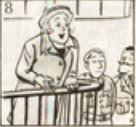
2- A policeman came and questioned the drivers.
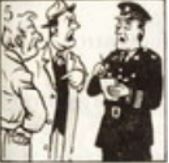
3- Mrs. Edwards said she would be one.
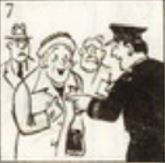
4- Mrs. Edwards was walking along an avenue.
5- One car was following another.
6- The drivers got out and had an argument.
7- Then he asked for witnesses.
8- The second car hit the first.
 

اخر الاخبار

اشترك بقناتنا على التلجرام ليصلك كل ما هو جديد


