Yes–no questions
Implicit in our earlier claim (41) is the following assumption about wh-questions in English:

This assumption has interesting implications for the syntax of yes–no questions such as:

It implies that not only wh-questions but also yes–no questions are CPs containing an interrogative specifier. But what kind of specifier could yes–no questions contain? The answer suggested in Grimshaw (1993) and Roberts (1993) is that they contain a null question operator which is directly generated in spec-CP (i.e. which is positioned in spec-CP by simple merger rather than movement). From a historical perspective, the null-operator analysis is by no means implausible, since in Elizabethan English we found main-clause yes–no questions introduced by the overt question word whether, as illustrated below:

Given the null-operator analysis of yes–no questions, we can posit that yes– no questions have essentially the same syntax in present-day English as in Elizabethan English, save that yes–no questions could be introduced by the overt interrogative operator whether in Elizabethan English, but are introduced by a null interrogative operator (a null counterpart of whether) in present-day English.
A second piece of evidence in support of the null-operator analysis comes from the fact that yes–no questions can be introduced by whether when they are transposed into reported speech (and so occur in a complement clause), as we see from the examples below:

A third piece of evidence is that yes–no questions with auxiliary inversion resemble whether questions in that in both cases yes/no are appropriate answers:
 A fourth argument is that main-clause yes–no questions can be tagged by or not in precisely the same way as complement-clause whether questions:

If yes–no questions are CPs containing a null yes–no question operator (a null counterpart of whether) in spec-CP, we can arrive at a unitary characterization of questions as CPs with an interrogative specifier.
What all of this means is that (69) Is it raining? will be derived as follows. The present-tense auxiliary is merges with the verb raining to form the T-bar is raining. The resulting T-bar merges with the subject it to form the TP it is raining. This TP in turn merges with a null C which has [TNS, WH, EPP] features. The [TNS] feature of C attracts (a copy of) the T constituent is to merge with C; the requirement imposed by the [WH, EPP] features of C for CP to contain a wh-specifier is satisfied by merging a null yes–no question operator in spec-CP (which, for concreteness, we can take to be a null counterpart of the adverb whether, below symbolized as weather ), ultimately deriving the structure shown below (after deletion of the features of C and of the original occurrence of is):
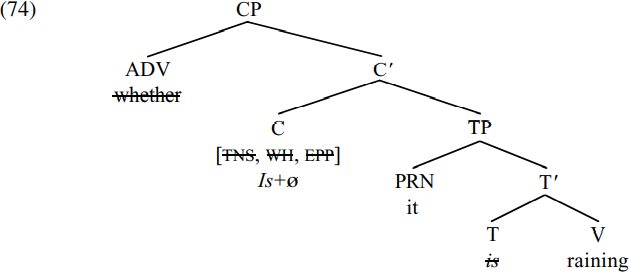
If we take the yes–no question operator to be a null counterpart of whether, the lexical entry for whether will need to specify that it receives a null spellout in main clauses but is spelled out as |weðə| elsewhere.








