Syllables
Syllables consist of an onset and a rhyme. The rhyme is made up of an obligatory nucleus and a coda. Some languages have obligatory onsets, or rule out codas, but no language has obligatory codas.
Languages constrain this basic structure in different ways: English allows up to three consonants in onset position, but is strict about the three-consonant combinations it permits: the first must be /s/, the second a stop, and the third a liquid (e.g. sprint, scroll, splash); Russian, by contrast, allows much greater flexibility, e.g. ‘suddenly’;
  ‘seizes’. While there are languages which require onsets (e.g. Arabic) or rule out codas (e.g. Hawaiian), there are none that require codas, supporting the view that the basic syllable structure cross-linguistically is Consonant+ Vowel (CV).
Further evidence for the primacy of the CV structure comes from the Maximum Onset Principle, which states that, whenever consonants can be assigned to either onset or coda position, as many as possible should be assigned to the onset, subject to the phonotactic constraints of the given language. So, for example, in the case of a word like express, the proper syllable division is  , because *
 is not an acceptable syllable-initial cluster in English, while
 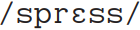 is well formed and meets the requirement that the maximum number of consonants be assigned to the onset.
As April McMahon (2002: 110–12) points out, this principle explains a number of otherwise puzzling phenomena. Why, for example, do non-rhotic speakers pronounce the /r/ in carry, even though it follows a vowel, but not in orchard? The answer is that, by the Maximum Onset Principle, the syllable divisions are  and
and  respectively: in the latter case English rules out *
  as an initial syllable sequence, so the /r/ is assigned to coda position in the previous syllable, where non-rhotic speakers delete it (rhotic speakers, of course, maintain /r/ in both onset and coda positions). Likewise, it might seem surprising that wool for most British English speakers has a dark
 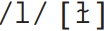 , but its derivative woolly has a clear one [l]. Again, the Maximum Onset Principle assigns the
  in woolly to onset position
  and thereby predicts, correctly, that clear
  will be selected.








