Trochees preferred
Let us now deal with the fact that -ize attaches overwhelmingly to prosodically left-headed words. There is a whole class of forms that in Raffelsiefen's account are treated as exceptional, namely those derivatives formed on the basis of words with ultimate primary stress, and monosyllables. What the iambic derivatives show is that IDENT-HEAD must be ranked higher than * CLASH-HEAD, because they never shift the main stress to a preceding syllable. Consider for example banálìze:
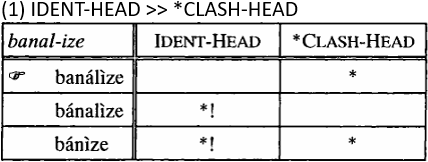
With monosyllabic bases, a violation of * CLASH-HEAD seems inevitable, because such derivatives cannot be improved by stem allomorphy (cf. Márxìze). The violation of these highly ranked constraints makes the at tested derivatives highly marked and therefore dispreferred -ize words. In our corpus of 284 20th century neologisms only the following forms are attested: banálìze, cyclize (trisyllabic pronunciation is preferred), Czechize, ecize, Maoize (again, trisyllabic pronunciation is preferred), Marxize, quantize, routìnìze.
In Raffelsiefen's model, derivatives involving primary stressed immediately before -ize are completely ruled out by the M-PARSE constraint, because this constraint is ranked lower than * CLASH. Hence, the optimal candidate is one in which the affix is not attached at all, which, according to Raffelsiefen, leads to a lexical gap. I propose a different reason for the near-absence of iambic or monosyllabic base words with -ize, namely the competition with -ify. The present model therefore dismisses M-PARSE as a necessary constraint for -ize derivatives.
There are only four derivatives in the neologism corpus that could possibly be classified as stress-shifted, i.e. as violators of IDENT-HEAD: bácterize (bactéria), lyóphilìze (lýophìle/lýophil), multímerìze (múltimer) and phagocýtìze (phágocỳte). However, bácterize could well be argued to be coined on the basis of the bound stem bacter-, which would naturally account for the existence and the prosodic structure of the attested cadidate. If bactéria (instead of bacter-) were the base, we would expect bactériìze as optimal.1 Forms such as bácteroid show that there is a bound stem allomorph bacter- available and forms such as bactèriólogy indicate the general possibility of schwa deletion (with the main stress of the base form surviving as a secondary stress). The form multímerìze is only considered as a minor variant in the OED, whereas the non-stress-shifted múltimerìze is presented as the standard pronunciation (also with the participles listed). This bears witness to the exceptionality of the stress-shifted form.
The remaining two forms (phagocýtìze and lyóphilìze) should be treated as exceptions. However, it is remarkable that both forms share their unusual stress patterns with other derived forms of their word families. Thus, in lyóphilìze the secondary stress of lyòphilizátion surfaces as main stress. This suggests that it might be a back-formation from the nomen actionis. The aberrant stress pattern of the -ize derivative makes the verb more similar to the nominalization than to the underived base word, and this may be exactly what the coiners and users aim at. Hence the nomen actionis is the output form with which stress correspondence is established. Evidence for this claim can be gleaned from the dates of the first citations of the forms as given in the OED. Thus lyóphilìze is first attested in the same text as the corresponding nomen actionis, respectively.
With the base word phágocỳte, we would predict the candidate phágoc[i]tìze to be optimal. Notably, this candidate is also cited in the OED in its participial form (phágocytìzed), with a primary stress on the first syllable. Thus there are in fact two competing forms attested, one of which is in accordance with the predictions of our model. Furthermore, a converted form to phágocỳte is attested with the same meaning, which might also be interpreted as indicative of the oddity of phagocýtìze. But again, the stress shift is reminiscent of other derived forms such as phagocýtai and phagocýtòse.
1 Perhaps for orthographic reasons (unusual clash of two <i> s) !bacteriize is avoided in written language.








