

Grammar


Tenses


Present

Present Simple

Present Continuous

Present Perfect

Present Perfect Continuous


Past

Past Simple

Past Continuous

Past Perfect

Past Perfect Continuous


Future

Future Simple

Future Continuous

Future Perfect

Future Perfect Continuous


Parts Of Speech


Nouns

Countable and uncountable nouns

Verbal nouns

Singular and Plural nouns

Proper nouns

Nouns gender

Nouns definition

Concrete nouns

Abstract nouns

Common nouns

Collective nouns

Definition Of Nouns

Animate and Inanimate nouns

Nouns


Verbs

Stative and dynamic verbs

Finite and nonfinite verbs

To be verbs

Transitive and intransitive verbs

Auxiliary verbs

Modal verbs

Regular and irregular verbs

Action verbs

Verbs


Adverbs

Relative adverbs

Interrogative adverbs

Adverbs of time

Adverbs of place

Adverbs of reason

Adverbs of quantity

Adverbs of manner

Adverbs of frequency

Adverbs of affirmation

Adverbs


Adjectives

Quantitative adjective

Proper adjective

Possessive adjective

Numeral adjective

Interrogative adjective

Distributive adjective

Descriptive adjective

Demonstrative adjective


Pronouns

Subject pronoun

Relative pronoun

Reflexive pronoun

Reciprocal pronoun

Possessive pronoun

Personal pronoun

Interrogative pronoun

Indefinite pronoun

Emphatic pronoun

Distributive pronoun

Demonstrative pronoun

Pronouns


Pre Position


Preposition by function

Time preposition

Reason preposition

Possession preposition

Place preposition

Phrases preposition

Origin preposition

Measure preposition

Direction preposition

Contrast preposition

Agent preposition


Preposition by construction

Simple preposition

Phrase preposition

Double preposition

Compound preposition

prepositions


Conjunctions

Subordinating conjunction

Correlative conjunction

Coordinating conjunction

Conjunctive adverbs

conjunctions


Interjections

Express calling interjection

Phrases

Sentences


Grammar Rules

Passive and Active

Preference

Requests and offers

wishes

Be used to

Some and any

Could have done

Describing people

Giving advices

Possession

Comparative and superlative

Giving Reason

Making Suggestions

Apologizing

Forming questions

Since and for

Directions

Obligation

Adverbials

invitation

Articles

Imaginary condition

Zero conditional

First conditional

Second conditional

Third conditional

Reported speech

Demonstratives

Determiners


Linguistics

Phonetics

Phonology

Linguistics fields

Syntax

Morphology

Semantics

pragmatics

History

Writing

Grammar

Phonetics and Phonology

Semiotics


Reading Comprehension

Elementary

Intermediate

Advanced


Teaching Methods

Teaching Strategies

Assessment
Idiomatic adjectives
المؤلف:
PETER SVENONIUS
المصدر:
Adjectives and Adverbs: Syntax, Semantics, and Discourse
الجزء والصفحة:
P36-C2
2025-04-02
604
Idiomatic adjectives
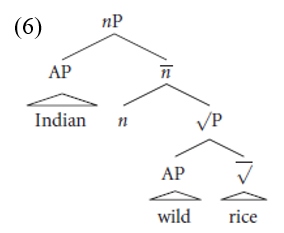
Similarly, Marantz (2001) argues that the n level is the level of lexical idiosyncracy, so that idiomatically combined adjectives must attach below it. Expressions like those in (1) are illustrations; wild rice is a species of rice (zizania palustris), and need not have the properties conventionally associated with wildness. This contrasts, for example, with wild tomato, which has no idiomatic association and so would refer to an uncultivated (or ill-behaved, etc.) tomato. The idiom persists even when wild rice is modified by another adjective, such as Minnesotan, so that Minnesotan wild rice could be zizania palustris, when grown inMinnesota, for example.1 However, if an adjective is inserted below wild, as in wild Minnesotan rice, the idiomatic reading is lost, and the rice must be conventionally “wild” (in the case of rice, this would most likely mean uncultivated).

Along the same lines, nervous system is a kind of idiom, as is French toast; if regularly merged, compositional adjectives can only be merged outside nP, and these idiomatic adjectives are merged below, then the regular adjective cannot appear in between the idiomatic adjective and the noun.
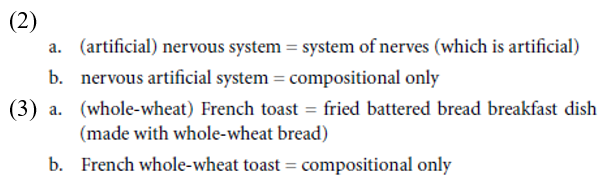
Note that under the right circumstances, idioms in general can be disrupted by adjoined material. For example, ply X’s trade means “do X’s usual work”; it can be applied to activities in which the word trade would not be used otherwise, for example as in (4).
(4) A team of young filmmakers plied their trade aquarium.
Even part from the status of the possessive pronoun and the tense on the verb, an idiomatic noun like trade here can easily be modified by adjectives.
(5) A team of young filmmakers plied their glamorous trade at the aquarium.
Thus, it is not the case that idioms cannot be interrupted by non-idiomatic material (Nunberg et al. 1994; Svenonius 2005). Instead, if A can only have an idiomatic meaning in NP when it is merged below n, and if non-idiomatic A’s must be merged above n, then the right results are achieved (in the diagram I depict the root as category-less, following Marantz; it could also be depicted as category N, as elsewhere in this chapter).
1 A–N idioms can be distinguished from A–N compounds on the basis of stress; see e.g. Liberman and Sproat (1992). Compare the A–N idiom wild ríce to the A–N compound wíld man.
الاكثر قراءة في Linguistics fields
اخر الاخبار
اخبار العتبة العباسية المقدسة
الآخبار الصحية

قسم الشؤون الفكرية يصدر كتاباً يوثق تاريخ السدانة في العتبة العباسية المقدسة
"المهمة".. إصدار قصصي يوثّق القصص الفائزة في مسابقة فتوى الدفاع المقدسة للقصة القصيرة
(نوافذ).. إصدار أدبي يوثق القصص الفائزة في مسابقة الإمام العسكري (عليه السلام)


