Occurrence as predicative complements in copular structures
Regular qualitative adjectives that can be used both pre- and postnominally can occur as predicates of copular sentences; see (1). As has frequently been noted, in this construction they only retain the restrictive meaning typical of postnominal adjectives, as the comments in the glosses are meant to show:

In other words, in los libros que son interesantes the predicative adjective has the same restrictive meaning that we find in los libros interesantes. The sense of “modification of a central property or modification of the reference” which we find in los interesantes libros does not appear in the copular construction.
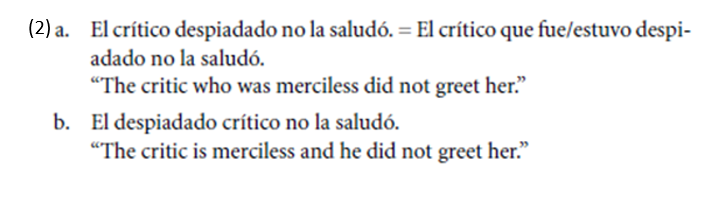
In the case of human disposition adjectives, the adjective appearing in copular constructions generally refers to a temporary or stage level-like property; this is the meaning we find in postnominal position (2a) in contrast with the individual level reading in (2b), where the adjective is prenominal.
The remaining adjectives appearing in prenominal position – modal (posible), restrictive (mero), degree/quantifying (total), and event modifier/deictic (futuro), are either banned from occurring in predicative structures or when they do occur in such structures they have a different meaning which corresponds to the one they receive as postnominal modifiers of N, when they appear in such a context. Let us consider some cases that illustrate these contrasts.
Observe, first, in (3), that in the cases in which modal adjectives appear as predicates of copular sentences, they are either unacceptable (the examples in 3a–b) or have an implicit relative reading (3c).
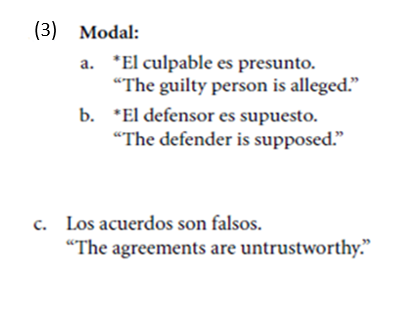
The meaning in (3c) is the same we find in los acuerdos falsos, which is different from the one in los falsos acuerdos, the latter being fake agreements or agreements that do not have the properties required to be considered as agreements.
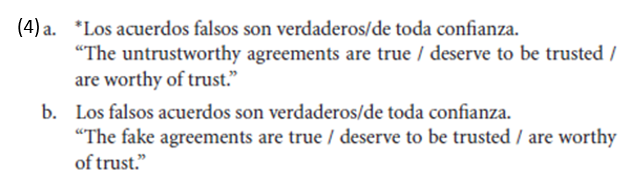
In fact, Larson (2000b: 3) noted that the possible candidate is ambiguous between meaning ‘the potential candidate’ (= a direct modification reading) and ‘the X which Y considers as a possible candidate’ (= implicit relative reading). In Spanish, as expected, this analysis does not hold for el posible candidato, which only means ‘the potential candidate’. There is also no ambiguity in copular constructions: El ataque es posible does not refer to ‘the potential attack’ but rather entails that ‘X considers that the attack is feasible’, the same meaning we find in el ataque posible and different from that in el posible ataque. Observe that we can say El ataque es posible/viable pero arriesgado ‘the attack is possible (=feasible) but risky’ (i.e., there are constraints on its feasibility) but not #El ataque es posible pero no hay modo de hacerlo ‘the attack is possible (=feasible) but there is no way to launch it’ – here there is a contradiction.1 The contrast in (4) illustrates the same contrast with falso and completes the series in (3):
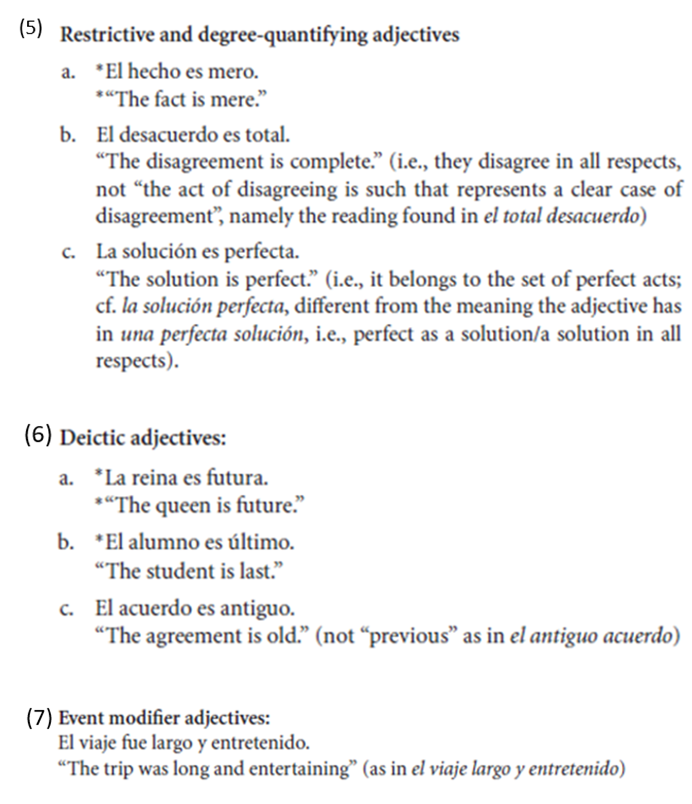
Restrictive, degree/quantifying, and deictic/event modifier adjectives are usually not possible either in postnominal position or in copular structures. In case they appear postnominally, a different reading usually obtains; we find the same in copular structures. Let us consider both cases separately.
In the case of restrictive and degree/quantifying adjectives, the meaning contrast evokes the opposition non-intersective/intersective. While the nonintersective reading appears in prenominal position, the intersective reading appears in postnominal position and copular sentences (see the second series of examples in 5a). In the case of deictic adjectives, the deictic function sometimes cannot be expressed through postnominal modification2 and even less so through copular predicative structures (see the first series in 6). When deictic adjectives appear postnominally it would perhaps be better to think of them as polysemic: adjectives like nuevo “new,” antiguo “old,” viejo “old” are interpreted postnominally not as deictic but as qualitative adjectives.
1 In this regard there appear to be differences with English and Italian where both interpretations are possible in copular sentences.
2 The reason for this remains obscure to me. Perhaps these forms are not non-predicative adjectives but rather close to deictic determiners.








