Expressive predicate modification
The problem remains, however, of building up the interpretations in the previous section compositionally, and of doing so in a way that captures the syntactic constraints on where such nonrestrictive readings are available.
The rule Since this is a two-dimensional semantics, with distinct dimensions of meaning being computed and distinct composition rules assembling them, perhaps rules that introduce expressive meaning may look quite different in principle from ones that do not. Specifically, maybe rules that introduce expressive meaning can be directly sensitive to precedence in a way ordinary non-expressive meaning is not. This would accord naturally with the intuition that nonrestrictive modifiers are in some sense secondary or additional, extra comments on the current utterance that happen to be interleaved with it.
In view of this, we can adopt the rule in (1). Potts’ framework already has a rough counterpart to standard function application that operates in the expressive-meaning dimension – namely, the rule of Conventional Implicature Function Application mentioned earlier. Adopting (1) would maintain the parallelism by adding an expressive counterpart to a rule of intersective modifier interpretation.1
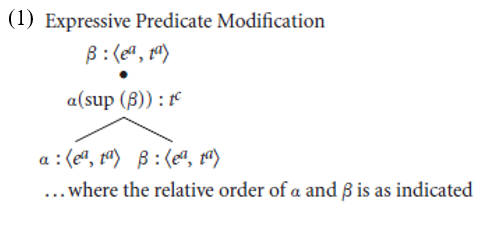
This rule can be understood to do three things:
_ The sup operator picks out the largest plural individual in the extension of the modified expression (ᵝ).
_ The denotation of the modifier (α) is predicated of this plural individual. Crucially, this happens in the expressive dimension of interpretation.
_ The ordinary descriptive meaning of the modified expression is simply passed up as the ordinary descriptive meaning of the whole.
How this works This rule will give rise to interpretations such as (2) and (3).2
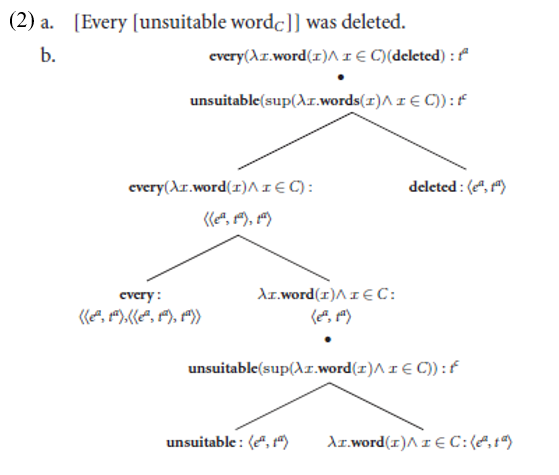
This mirrors the Larson and Marušiˇc (2004) paraphrase. We obtain similar results for the adverbial cases:
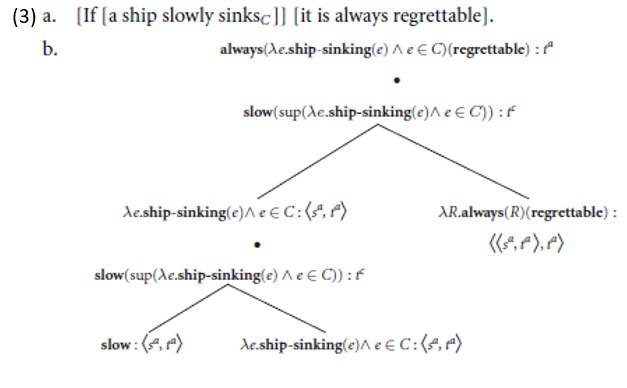
It bears pointing out here that I am assuming that C is interpreted on the head noun rather than on the determiner. This is crucial. It is this that ensures that the extension of the NP is whittled down appropriately before the nonrestrictive modifier applies to it.
How is this intersective? In what sense is this a rule of intersective modifier
interpretation? True, nothing is conjoined. But this does capture the same intuitive content of such a rule, and shares some of its essential properties. The expressions it combines must both be of the same semantic type, for example. As with predicate modification, they must in fact both denote properties. Moreover, because sup(ᵝ) must satisfy both α and ᵝ (the latter by definition), the conjunctive character of such a rule is implicitly captured.
In fact, the way (3) is formulated requires that it target only intersective modifiers. This makes a substantive prediction: that nonrestrictive readings of the relevant kind should be possible only for intersective modifiers. This seems to be the case. Certainly, it is difficult to see how the modifiers in (4) could get nonrestrictive interpretations:
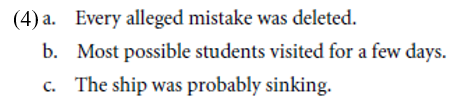
This may actually serve as a useful diagnostic for intersective modification in cases which remain unclear, such as subsective adjectives generally (Siegel 1976b; Landman 2001; Larson 1998).
1 This is slightly simplified, in that strictly speaking, it should reflect that the daughters can themselves have expressive meaning. This makes no substantive difference in this framework.
2 I am adopting the conventions that events (or, as would ultimately be necessary, situations) are of type s and that (i) holds:









