

Grammar


Tenses


Present

Present Simple

Present Continuous

Present Perfect

Present Perfect Continuous


Past

Past Simple

Past Continuous

Past Perfect

Past Perfect Continuous


Future

Future Simple

Future Continuous

Future Perfect

Future Perfect Continuous


Parts Of Speech


Nouns

Countable and uncountable nouns

Verbal nouns

Singular and Plural nouns

Proper nouns

Nouns gender

Nouns definition

Concrete nouns

Abstract nouns

Common nouns

Collective nouns

Definition Of Nouns

Animate and Inanimate nouns

Nouns


Verbs

Stative and dynamic verbs

Finite and nonfinite verbs

To be verbs

Transitive and intransitive verbs

Auxiliary verbs

Modal verbs

Regular and irregular verbs

Action verbs

Verbs


Adverbs

Relative adverbs

Interrogative adverbs

Adverbs of time

Adverbs of place

Adverbs of reason

Adverbs of quantity

Adverbs of manner

Adverbs of frequency

Adverbs of affirmation

Adverbs


Adjectives

Quantitative adjective

Proper adjective

Possessive adjective

Numeral adjective

Interrogative adjective

Distributive adjective

Descriptive adjective

Demonstrative adjective


Pronouns

Subject pronoun

Relative pronoun

Reflexive pronoun

Reciprocal pronoun

Possessive pronoun

Personal pronoun

Interrogative pronoun

Indefinite pronoun

Emphatic pronoun

Distributive pronoun

Demonstrative pronoun

Pronouns


Pre Position


Preposition by function

Time preposition

Reason preposition

Possession preposition

Place preposition

Phrases preposition

Origin preposition

Measure preposition

Direction preposition

Contrast preposition

Agent preposition


Preposition by construction

Simple preposition

Phrase preposition

Double preposition

Compound preposition

prepositions


Conjunctions

Subordinating conjunction

Correlative conjunction

Coordinating conjunction

Conjunctive adverbs

conjunctions


Interjections

Express calling interjection

Phrases

Sentences


Grammar Rules

Passive and Active

Preference

Requests and offers

wishes

Be used to

Some and any

Could have done

Describing people

Giving advices

Possession

Comparative and superlative

Giving Reason

Making Suggestions

Apologizing

Forming questions

Since and for

Directions

Obligation

Adverbials

invitation

Articles

Imaginary condition

Zero conditional

First conditional

Second conditional

Third conditional

Reported speech

Demonstratives

Determiners


Linguistics

Phonetics

Phonology

Linguistics fields

Syntax

Morphology

Semantics

pragmatics

History

Writing

Grammar

Phonetics and Phonology

Semiotics


Reading Comprehension

Elementary

Intermediate

Advanced


Teaching Methods

Teaching Strategies

Assessment
Evaluatives in interrogatives
المؤلف:
OLIVIER BONAMI AND DANIELE GODARD
المصدر:
Adjectives and Adverbs: Syntax, Semantics, and Discourse
الجزء والصفحة:
P302-C9
2025-04-30
966
Evaluatives in interrogatives
We noted that although evaluatives are not felicitous sentenceinitially in questions, they are possible if linearized in other positions. This holds not only for wh-questions, but also for polar questions:
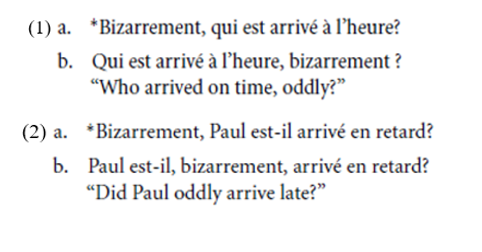
This observation poses an interesting interface issue. Note that, leaving aside the problems posed by sentence-internal occurrences of adverbs, the fragment presented above can be extended quite easily to questions. All we need are appropriate definitions for a query utterance type parallel to (2) in the fragment of Grammar and an interrogative-clause type parallel to (1) in the fragment of Grammar. However the ban on initial occurrences is quite surprising. If only wh-questions were affected, one could assume that the head-filler-phrase turns a proposition into a question, and thus that evaluative adverbs are not possible on the left of the wh-phrase because they find no proposition to combine with. But in the case of polar questions no such account is available: since there is no overt marking of the polar interrogative status, we cannot forbid the possibility that the adverb combines with the (proposition-denoting) basic clause before the type-shifting from proposition to question occurs.
Although we presently have no account of the data in (1–2), we note that the phenomenon at hand might shed new light on the status of adverbs occurring in the initial position of questions in general. First, Bonami et al. (2004: 167–170) notes that the class of adverbs occurring sentence-initially in questions is quite odd, and corresponds only loosely to the set of adverbs that occur sentence-initially in assertions. Second, in assertions, it is clear that sentence-initial adverbs may scope lower than some sentence-internal operators, such as tense. As Bonami (2002) emphasizes, the choice of a perfective tense in (3a) can only be justified by the fact that this tense takes the sentenceinitial time-span adverbial in its scope. But initial adverbials in questions exhibit no evidence of a similar behavior: note in particular that time-span adverbials are infelicitous in this position (3b).
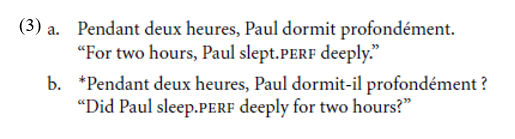
This and similar observations suggest that the syntax–semantics interface works quite differently for sentence-initial adverbials in assertions and in questions. A detailed investigation of this issue will have to await future work.
الاكثر قراءة في Linguistics fields
اخر الاخبار
اخبار العتبة العباسية المقدسة
الآخبار الصحية

قسم الشؤون الفكرية يصدر كتاباً يوثق تاريخ السدانة في العتبة العباسية المقدسة
"المهمة".. إصدار قصصي يوثّق القصص الفائزة في مسابقة فتوى الدفاع المقدسة للقصة القصيرة
(نوافذ).. إصدار أدبي يوثق القصص الفائزة في مسابقة الإمام العسكري (عليه السلام)


