

Grammar


Tenses


Present

Present Simple

Present Continuous

Present Perfect

Present Perfect Continuous


Past

Past Simple

Past Continuous

Past Perfect

Past Perfect Continuous


Future

Future Simple

Future Continuous

Future Perfect

Future Perfect Continuous


Parts Of Speech


Nouns

Countable and uncountable nouns

Verbal nouns

Singular and Plural nouns

Proper nouns

Nouns gender

Nouns definition

Concrete nouns

Abstract nouns

Common nouns

Collective nouns

Definition Of Nouns

Animate and Inanimate nouns

Nouns


Verbs

Stative and dynamic verbs

Finite and nonfinite verbs

To be verbs

Transitive and intransitive verbs

Auxiliary verbs

Modal verbs

Regular and irregular verbs

Action verbs

Verbs


Adverbs

Relative adverbs

Interrogative adverbs

Adverbs of time

Adverbs of place

Adverbs of reason

Adverbs of quantity

Adverbs of manner

Adverbs of frequency

Adverbs of affirmation

Adverbs


Adjectives

Quantitative adjective

Proper adjective

Possessive adjective

Numeral adjective

Interrogative adjective

Distributive adjective

Descriptive adjective

Demonstrative adjective


Pronouns

Subject pronoun

Relative pronoun

Reflexive pronoun

Reciprocal pronoun

Possessive pronoun

Personal pronoun

Interrogative pronoun

Indefinite pronoun

Emphatic pronoun

Distributive pronoun

Demonstrative pronoun

Pronouns


Pre Position


Preposition by function

Time preposition

Reason preposition

Possession preposition

Place preposition

Phrases preposition

Origin preposition

Measure preposition

Direction preposition

Contrast preposition

Agent preposition


Preposition by construction

Simple preposition

Phrase preposition

Double preposition

Compound preposition

prepositions


Conjunctions

Subordinating conjunction

Correlative conjunction

Coordinating conjunction

Conjunctive adverbs

conjunctions


Interjections

Express calling interjection

Phrases

Sentences


Grammar Rules

Passive and Active

Preference

Requests and offers

wishes

Be used to

Some and any

Could have done

Describing people

Giving advices

Possession

Comparative and superlative

Giving Reason

Making Suggestions

Apologizing

Forming questions

Since and for

Directions

Obligation

Adverbials

invitation

Articles

Imaginary condition

Zero conditional

First conditional

Second conditional

Third conditional

Reported speech

Demonstratives

Determiners


Linguistics

Phonetics

Phonology

Linguistics fields

Syntax

Morphology

Semantics

pragmatics

History

Writing

Grammar

Phonetics and Phonology

Semiotics


Reading Comprehension

Elementary

Intermediate

Advanced


Teaching Methods

Teaching Strategies

Assessment
A case study of the semantics of clear - The paradox of asserting clarity
المؤلف:
GINA TARANTO
المصدر:
Adjectives and Adverbs: Syntax, Semantics, and Discourse
الجزء والصفحة:
P311-C10
2025-05-01
760
A case study of the semantics of clear - The paradox of asserting clarity
The starting point for a semantic analysis of clear is to review the paradox of asserting clarity, as introduced in Barker and Taranto (2003). The paradox as it is presented here is faithful to the analysis in Barker and Taranto, but the formal semantics that is introduced, which takes as its starting point the model of context update proposed by Gunlogson (2001), is taken from Taranto (2006). The discussion in this chapter takes clear to be representative of the entire class of discourse adjectives.
The paradox of asserting clarity arises from the standard assumption in (1), namely that an assertion is felicitous only if it adds new information to the common ground.

After all, what use could it be to claim that a proposition is true if it is already accepted as true? A possible answer is that some sentences can have side-effects besides adding new information about the world to the common ground, and it can be worth asserting a sentence entirely for the sake of these side-effects. To motivate this claim, consider the variation of Partee’s famous marble example in (2).
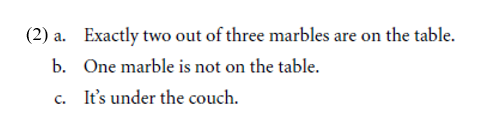
Sentence (2b) is entailed by (2a). It adds no new information about the situation under discussion. However, it does cause the creation of a discourse referent for the missing marble, which allows a pronominal reference in (2c). If (2b) were omitted from the discourse, it would be infelicitous to use the pronoun it in (2c). Thus, as pointed out in Beaver (2002), it is possible to assert a sentence purely for the sake of its side-effects, in this case, building a discourse referent to facilitate anaphora.
What will emerge in the discussion of the discourse adjective clear is that assertions of clarity are useful in establishing which propositions are genuinely in the common ground of a discourse and which are not. With this in mind, consider the core example for this chapter’s discussion of clear, the sentence in (3).
(3) It is clear that Briscoe is a detective.
Intuitively, if (3) is true, then before it is uttered, both the speaker and addressee must already believe that Briscoe is a detective. If either is not already convinced that Briscoe is a detective, then it is not clear at all. But if it was already evident that Briscoe is a detective, then asserting (3) adds no new information to the context, contra the assumption in (1). The question to ask, then, is what new information might an utterance of (3) provide?
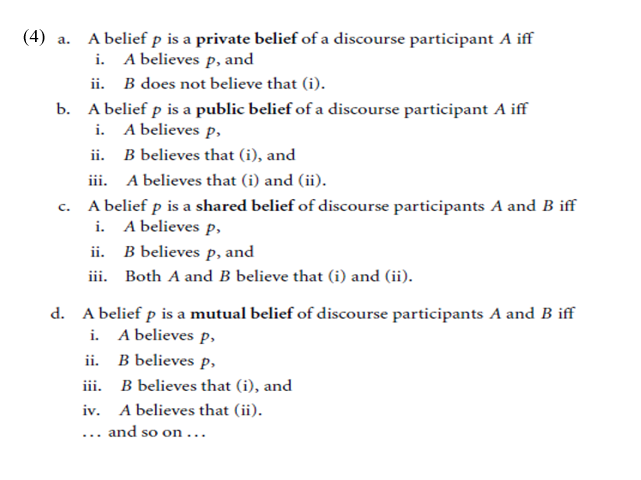
In order to address this question, it is necessary to distinguish between the different types of beliefs that individuals in a discourse may have. I propose the definitions provided in (4), which assume a conversation with exactly two participants, A and B.
الاكثر قراءة في Articles
اخر الاخبار
اخبار العتبة العباسية المقدسة
الآخبار الصحية

قسم الشؤون الفكرية يصدر كتاباً يوثق تاريخ السدانة في العتبة العباسية المقدسة
"المهمة".. إصدار قصصي يوثّق القصص الفائزة في مسابقة فتوى الدفاع المقدسة للقصة القصيرة
(نوافذ).. إصدار أدبي يوثق القصص الفائزة في مسابقة الإمام العسكري (عليه السلام)


