Meaning-preserving alternations
Passive
Consider the following pair of Japanese sentences (from Tsujimura 1996):
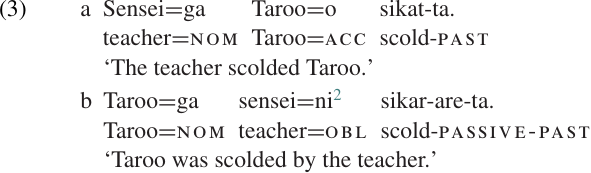
Clearly the two sentences are quite similar. Their meaning is essentially the same, in the sense that they describe the same kind of event, and it would be impossible for one to be true while the other is false. The word order is essentially the same: in both cases the subject (marked with nominative case) comes first, and the verb comes last. In fact, there seem to be only two significant differences. First, the verb in (3b) contains an additional morpheme, the suffix-(r) are, which does not occur in (3a). Second, while the same participants bear the same semantic roles in both sentences, there is a shift in the assignment of Grammatical Relations. The patient Taroo is the direct object in(3a), but the subject in(3b); the agent sensei is the subject in (3a), but an oblique argument in (3b).
The pair of Malayalam sentences in (4) illustrates the same kind of alternation. We have already seen that word order in Malayalam is quite free, provided the verb comes last. In both of these sentences the patient occurs before the agent, but once again the change in case marking indicates a change in the Grammatical Relations: the patient is the OBJ in (4a) and the SUBJ in (4b).
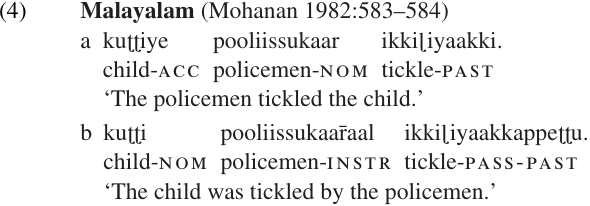
Examples (3a) and (4a) are referred to as active clauses, in contrast to (3b) and (4b), which are called passive. Notice that in both cases the active verb is morphologically simpler than the passive.3 The terms “active” and “passive” are used primarily for clauses which contain a transitive (or ditransitive) verb stem, and refer to specific patterns of Grammatical Relation assignment. In an active clause, like (3a) and (4a), the agent is the subject and the patient is the direct object. In a passive clause, like (3b) and (4b), the patient is “promoted” to become the subject. At the same time, the agent is “demoted” to become an optional oblique argument. In Japanese and Malayalam this is indicated by the use of an oblique case marker; in English, the passive agent is marked with the preposition by. The two configurations are represented in (5), using the English verb bite (active) ∼ be bitten (passive):
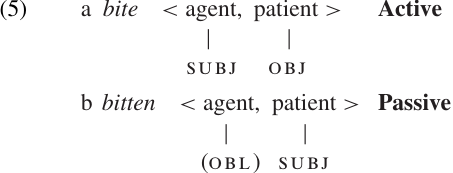
As the diagrams in (5) indicate, the active verb has two terms, SUBJ and OBJ, while the passive verb has only one (its SUBJ). Thus, passivization is a valence-decreasing process. It is also sometimes referred to as a DETRANSITIVIZING process, because it changes transitive verbs into intransitives. Notice that the passive agent is optional in English: This rope was deliberately cut (by a vandal). The same is true in most other languages that have a passive construction. In fact, in a number of languages the passive agent is rarely if ever expressed.
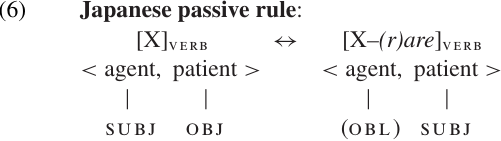
One way to represent the relationship between an active verb and its passive counterpart is through the use of Word Formation Rules. We will not be able to develop a detailed account of the passive, or of the other constructions. However, a rough approximation to the kind of passive rule we might propose is suggested in (6).
The active–passive contrast is the most common example of a VOICE alternation. “Voice” is a traditional term for alternations that affect the identity (i.e. the semantic role) of the subject. As we have seen, passivization causes the patient, rather than the agent, to be expressed as subject.
An important warning is needed here. We pointed out that Grammatical Relations like SUBJ and OBJ must be identified on the basis of syntactic properties. In our discussion of the passive, we have been assuming that case marking is a reliable indicator of Grammatical Relations. While the normal expectation in languages like Japanese and Malayalam is that subjects will take nominative case and objects will take accusative case, there are certain contexts in a number of languages where this expected pattern does not hold. These issues are too complex to address here.4 We will continue to choose examples where case and word order have been shown to be reliable indicators of Grammatical Relations. But the reader should bear in mind that claims of this kind need to be confirmed by syntactic evidence which we cannot present here.
2. The clitic =ni can also be used to mark Dative case. This gloss follows the analysis adopted by Tsujimura.
3. It is harder to see the morpheme boundaries in the Malayalam verb in (4b) than in its Japanese counterpart (3b), because of morphophonemic changes (see Allomorphy). But in both examples, it is clear that the active verb is morphologically simpler than the passive. In some languages, there is no passive affix. Rather, the passive is marked by the use of a special auxiliary element or some other function word.
4. See Kroeger (2004, Non-verbal predicates) for a discussion of the relationship between case marking and Grammatical Relations; and Constituent structure for evidence that the applied object (promoted oblique) in examples like (7–9) is the primary object.








