Passive
The active–passive distinction is traditionally considered one of voice.1 (12a) represents the active voice, and (12b) the passive:
(12) a. Ashley wrote this article
b. This article was written by Ashley
Ashley and this article are considered arguments of the verb. The arguments of a verb are individuals, entities, or items that are required to be present because of the verb’s lexical entry. In its transitive use, write has two arguments, an agent and a theme. In the active sentence (12a), the agent is in subject position, and the theme is in object position. (We have assumed that readers have at least a passive understanding of thematic roles such as agent, instrument, and theme.)
Below we give an example of the passive contrasted with the active voice from Bajau, an Austronesian language (Donohue 1996: 784):2
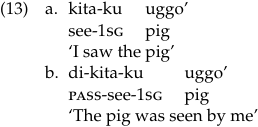
With these two sentences we see that although the passive entails a change in word order in English, it does not in all languages. In Bajau, the passive is formed via the affixation of a passive morpheme, di-, to the verb.
Kujamaat Jóola also has a passive that looks very different from the English passive. The Kujamaat Jóola passive is used infrequently, and it is restricted for the most part to constructions with inanimate subjects. It is marked by the suffix -i:
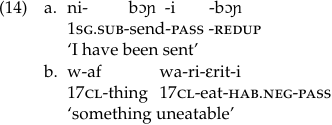
Without the passive morpheme -i, (14a) would have the meaning ‘I sent’.
We said that in Kujamaat Jóola, the passive is used less frequently than the active. Another way of saying this would be to call use of the active voice neutral, and use of the passive voice non-neutral. Whenever a situation like this arises in the world’s languages, we call the neutral case the unmarked case and the non-neutral case the marked case. This is literally true in the examples we presented from Bajau and Kujamaat Jóola. In both cases, the passive is marked by a special morpheme, but the active requires no such marker. The terms marked and unmarked are frequently encountered in linguistics and are by no means limited to describing grammatical-function-changing phenomena.
1 Some people make the mistake of referring to the passive or active as tenses. Tense, as we noted earlier, indicates time: past, present, future.
2 The active may be expressed in two different ways in Bajau. There is what Donohue calls the actor voice and what he calls the object voice. We present the object voice here because passives do not occur with the actor voice.








