The semantics of zero-derivation
We now address a type of word formation which is much more abstract: zero-derivation. Zero-derivation results in lexemes whose interpretation is context-dependent in much the same way as the words we looked at in The Polysemy Problem.1 The data on zero-derived verbs dis cussed here come from Clark and Clark (1979), but the analysis is that of Aronoff (1980).
The peculiarity of zero-derived verbs is that they often have a wide range of meanings. To give you just one example, the verb to sand denotes two very different actions. The most common meaning is ‘to rub with sandpaper’. The second meaning is ‘to spread or cover with sand’, as is done in winter to make roads less slippery.
While sand is well established as a verb, zero-derivation is a productive derivational process in English (cf. 4.2.2), as shown by the following nonce forms presented by Clark and Clark. All of these sentences are actual quotations:
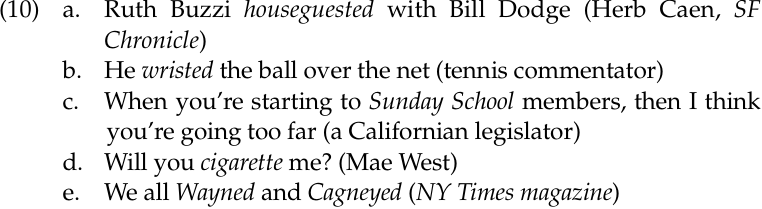
Clark and Clark classify noun-to-verb derivations into various categories. For each category, they give numerous examples, of which we have given only a few:
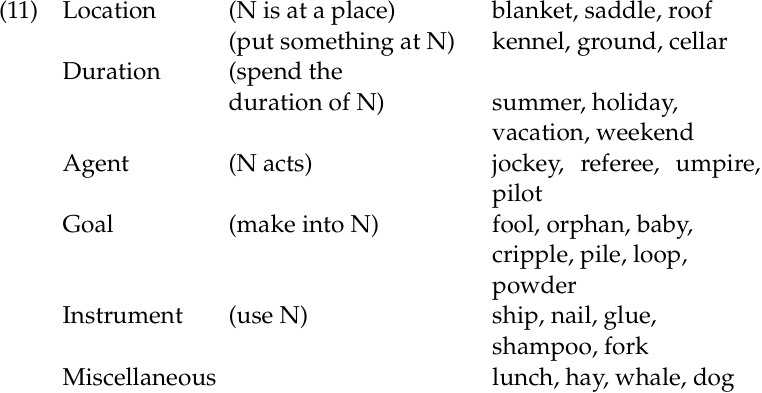
The descriptions given in (11) for each of the categories are slightly vague. One of the meanings given for the Location category is ‘put something at N’. To be more precise, verbs like kennel, ground (e.g., a teenager), or cellar involve keeping, not simply putting. Likewise, the true description of the Instrument category is much trickier than ‘use N’ because often you don’t use the noun – you use something else. For example, while shipping originally took place via ship, today we ship things by truck or air. We might redefine this category as ‘do what you do with N’. Even this, however, needs to be interpreted fairly broadly. Clark and Clark describe a fictional Max, who has a strange fetish – he likes to sneak up to people and stroke the backs of their legs with a teapot. When one of Max’s friends says to another, “Well, this time Max has gone too far. He tried to teapot a policeman,” we need to interpret teapot as ‘rub the back of the leg with a teapot’. By no stretch of the imagination is this what we think of as ‘doing what you do with a teapot’.
The miscellaneous category includes some interesting words. We use the verb whale to mean ‘catch whales’ or fish to mean ‘catch fish’ but are hard pressed to come up with many other verbs of this type. We don’t use a verb deer to mean ‘hunt deer’ or butterfly for ‘catch butterflies’. The verb dog patterns with words like clown in having the meaning ‘act like a dog’. Cub, foal, and pup all mean to ‘give birth to’ these animals.
The zero-derived verbs with the most extensive semantic possibilities are probably those that are derived from personal names. To understand them, you need to know something about the person and often about a particular event. To understand the sentence in (6), repeated in (12), you have to know the circumstances of Houdini’s death:
(12) Joe was Houdini’d and died.
To understand the sentences in (13) (from Clark and Clark 1979: 784), you have to know other things about Houdini, namely that he was famous for sensational and seemingly impossible escapes (13a) and that he made a lifetime crusade of showing phony mediums and spiritualists to be frauds:
(13) a. My sister Houdini’d her way out of the locked closet.
b. I would love to Houdini those ESP experiments.
The semantic obscurity of verbs derived from personal names results in speakers forgetting very rapidly that there even was a zero-derivation. While any English speaker can see the connection between nurse (noun) and nurse (verb) or bottle (noun) and bottle (verb), most aren’t aware that boycott and lynch are of the same ilk.2
Robert Lees, in his classic book on English nominals (1960), derived the meanings of denominal verbs from sentences containing them. The verb summer would be derived from the phrase spend the summer and the verb kennel from keep in a kennel. Marchand (1969) has a similar strategy: he associates a denominal verb with a sentence containing the noun from which it is derived. Hale and Keyser (1993) also relate the lexical semantics of verbs to a syntactic structure.
Given the sometimes idiosyncratic array of meanings that zero-derived verbs may have, what kind of semantics can we write for the noun-to-verb rule? We can potentially go two ways. We can either be very inclusive, or specific, and formulate precise rules that generate all the cases. Or we can do the opposite and write a very general – what we call a sparse – rule. A sparse rule says very little but, as you will see, yields the right answer.
Let’s review all of the examples of zero-derived verbs that we have given here and ask what is going on, in general. Each verb has something to do with the noun. Because it is a verb, it has the meaning of some action or activity, and on basic Gricean principles of cooperation (Grice 1975), we know that that action or activity is connected to the noun. Grice tells us that when people speak to one another, they have to assume that they are being cooperative. We give a more specific answer below, but first we need to examine a fact about evaluative adjectives like good, bad, or wonderful.
The meanings of evaluative adjectives may seem to be infinite. Wonderful means something very different in the sentences Moby-Dick is a wonderful book and George is a wonderful nurse. For one thing, the first sentence is true only if Moby-Dick is both a book and wonderful. The second sentence can be true even if George is not a nurse but a stockbroker. This is because wonderful can be construed as describing either the noun nurse or the activity associated with it. George is a wonderful nurse as long as he takes care of sick people (such as his kids) quite wonderfully. However, we do not need to say that the meanings of evaluative adjectives are infinite or even that they are polysemous. Instead, following Katz (1964), we can say that evaluative adjectives modify “that component of the meaning of a noun which has to do with the particular respect in which evaluations are made, within the language, of things in the extension of the noun” (p. 751). (The noun’s extension is the set of entities it picks out in the world.) We can refer to this as the evaluative domain of the word.
The evaluative domain of simple lexemes like nurse, knife, or dog is the same as the evaluative domain of zero-derived verbs like pilot or shampoo. If Mary is good at piloting, it means that she is a good pilot. If this is good shampoo, it is good for what you do with shampoo. This tells us that the mechanisms by which speakers assign meanings to evaluative adjectives and to zero-derived verbs on the basis of context are likely the same.
To restate this analysis, the wide array of meanings of zero-derived verbs results from two properties. The first is that the rule by which they are formed is very simple, specifying only that we take a noun and form a verb. The second is that conversational convention dictates only that the verb have something to do with the noun. We can reasonably pare this analysis down even further and say that the proper analysis of zero-derived verbs is that they are simply verbs. The fact that they denote an activity connected with the noun is derivable on purely conversational grounds.
While other derivational formations don’t have as dramatic an array of potential meanings as zero-derived verbs, we still find variety. Aronoff (1976: 38) points out that new English nouns of the form X-ousness have three possible meanings, depending on context:
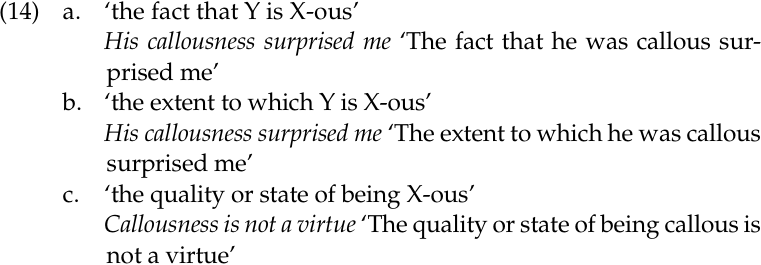
The difference between lexemes of the form X-ousness and zero-derived verbs lies in the rules that produce them. While the meaning of words like callousness is constrained by the semantics of the suffixes -ous and -ness, as well as by the meaning of the stem itself, the meaning of zero-derived verbs is constrained only by the meaning of the base noun.
1 Another good example of a morphological process that results in lexemes whose interpretation is context-dependent is noun–noun compounding; see Downing (1977). In what follows, we focus on zero-derivation of verbs from nouns. English also allows zero-derivation of nouns from verbs. Nouns derived from verbs generally signify an instance or result of the activity denoted by the verb. So, the noun hit denotes an ‘instance of hitting’, while the noun run can denote either an instance (She went for a run) or a result (She scored two runs). It is possible to form a verb from the noun run in this second baseball sense of the term: we outrunned them (meaning that we scored more runs than they did). The fact that the past tense of outrun in this sense is not *outran shows that the verb is derived from the noun in this case. This whole sequence (verb to noun to verb) indicates that these rules are directional, contrary to what some scholars have claimed.
2 Lynch ‘the punishment of persons suspected of crime without due process of law’ appeared in 1811 and comes from Captain William Lynch of Pittsylvania County, Virginia. Lynch and his neighbors were plagued by criminals, but couldn’t appeal to the courts because they were too far away. The men drew up a contract on September 22, 1780, in which they agreed to deal with the criminals themselves, even inflicting corporal punishment if necessary. Charles C. Boycott was an English land agent in County Mayo, Ireland. He was ostracized in 1880 for preferring to evict his tenants than to reduce rents, and found himself and his family without servants, farm help, or even mail delivery. His name came to be synonymous with this kind of cold-shoulder treatment, whether it be abstention from buying a product or dealing with a person, as a means of protest (definitions and etymologies from American Heritage Dictionary of the English Language).








