Typology
The term typology refers to a classification based on the comparative study of types, and morphological typology was the first systematic method used by linguists in the nineteenth century to compare the structures of different languages. While other sorts of typology flourish today, especially syntactic typology, morphological typology has languished since it was criticized by the first American structuralists, especially Edward Sapir in his Language (1921). Still, the traditional terms are used often enough to warrant mention, and the distinctions, while they may not be valid for entire languages, are still useful for describing individual morphological phenomena.
The basic typology has to do with a scale running from analytic to synthetic languages, which encodes the degree to which the individual meaningful elements in a language are expressed separately. At the analytic end we have the isolating languages, of which Vietnamese is the prototypical example, because the only morphology it has is com pounding. It has no derivational or inflectional processes of any kind. The next type is inflective, of which the more analytic subtype is agglutinating. An agglutinating language like Turkish or Hungarian has affixes, but they are strung out quite separately, each expressing a single notion, and easily identified. Consider the following simple table of Hungarian words:
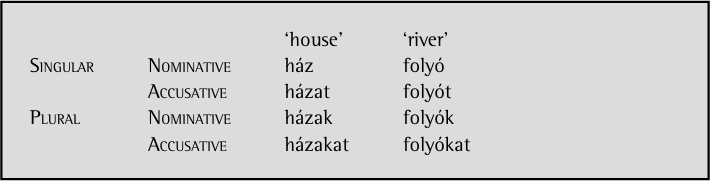
The accusative case marker is -at (the vowel is deleted after a stem-final vowel), while the plural marker is -ak (with the vowel again deleting after a stem-final vowel). When a word is both accusative and plural, both affixes appear one after the other. Compare a fusional language, like Latin, shown in the next table:
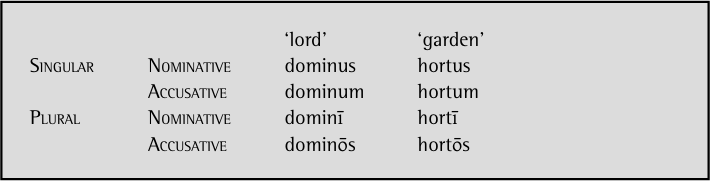
In these Latin forms, the same four slots, singular and plural nominative and accusative, are filled by four distinct suffixes: -s, -m, -ī, and -ōs (here, the stem vowel deletes before the suffix vowel), so we say that the two morphosyntactic features in each of the cells of the table (e.g., NOMINATIVE SINGULAR) are fused. Latin is actually much more complicated, since these two nouns represent only one of five main types (declensions), each of which has a distinct set of forms.
The last stop on this continuum is polysynthetic languages. The languages of this type cited most often come from North America. One example of a polysynthetic language is Nuuchahnulth (called Nootka in earlier literature), a language spoken on Vancouver Island in British Columbia (see Stonham 2004, who reanalyzes data originally published by Sapir 1921 and recasts them according to modern transcription conventions). In Nuuchahnulth and other polysynthetic languages, speakers can build complex words that express what a speaker of English or Vietnamese would express using several words or even an entire, multiword sentence. Following is an example from Nuuchahnulth (Stonham 2004: 65). /kw/ is a labialized velar stop; /m̓/ is a glottalized labial nasal consonant; /ḥ/ is a pharyngeal fricative. The final /a/ is a variable-length vowel (see Stonham 2004: 24–6), although not marked as such here.

Even English can have one-word sentences. Go! is a perfectly well-formed such utterance. But compared to English, polysynthetic languages are able to express much more complex notions using a single word, including subject, verb, object, and other information. The English gloss of this single Nuuchahnulth word, for example, contains a complex subject noun phrase, a progressive verb, and a prepositional phrase expressing location.








