

Grammar


Tenses


Present

Present Simple

Present Continuous

Present Perfect

Present Perfect Continuous


Past

Past Simple

Past Continuous

Past Perfect

Past Perfect Continuous


Future

Future Simple

Future Continuous

Future Perfect

Future Perfect Continuous


Parts Of Speech


Nouns

Countable and uncountable nouns

Verbal nouns

Singular and Plural nouns

Proper nouns

Nouns gender

Nouns definition

Concrete nouns

Abstract nouns

Common nouns

Collective nouns

Definition Of Nouns

Animate and Inanimate nouns

Nouns


Verbs

Stative and dynamic verbs

Finite and nonfinite verbs

To be verbs

Transitive and intransitive verbs

Auxiliary verbs

Modal verbs

Regular and irregular verbs

Action verbs

Verbs


Adverbs

Relative adverbs

Interrogative adverbs

Adverbs of time

Adverbs of place

Adverbs of reason

Adverbs of quantity

Adverbs of manner

Adverbs of frequency

Adverbs of affirmation

Adverbs


Adjectives

Quantitative adjective

Proper adjective

Possessive adjective

Numeral adjective

Interrogative adjective

Distributive adjective

Descriptive adjective

Demonstrative adjective


Pronouns

Subject pronoun

Relative pronoun

Reflexive pronoun

Reciprocal pronoun

Possessive pronoun

Personal pronoun

Interrogative pronoun

Indefinite pronoun

Emphatic pronoun

Distributive pronoun

Demonstrative pronoun

Pronouns


Pre Position


Preposition by function

Time preposition

Reason preposition

Possession preposition

Place preposition

Phrases preposition

Origin preposition

Measure preposition

Direction preposition

Contrast preposition

Agent preposition


Preposition by construction

Simple preposition

Phrase preposition

Double preposition

Compound preposition

prepositions


Conjunctions

Subordinating conjunction

Correlative conjunction

Coordinating conjunction

Conjunctive adverbs

conjunctions


Interjections

Express calling interjection

Phrases

Sentences

Clauses

Part of Speech


Grammar Rules

Passive and Active

Preference

Requests and offers

wishes

Be used to

Some and any

Could have done

Describing people

Giving advices

Possession

Comparative and superlative

Giving Reason

Making Suggestions

Apologizing

Forming questions

Since and for

Directions

Obligation

Adverbials

invitation

Articles

Imaginary condition

Zero conditional

First conditional

Second conditional

Third conditional

Reported speech

Demonstratives

Determiners

Direct and Indirect speech


Linguistics

Phonetics

Phonology

Linguistics fields

Syntax

Morphology

Semantics

pragmatics

History

Writing

Grammar

Phonetics and Phonology

Semiotics


Reading Comprehension

Elementary

Intermediate

Advanced


Teaching Methods

Teaching Strategies

Assessment
GRAMMATICAL UNITS AND RANK OF UNITS
المؤلف:
Angela Downing
المصدر:
ENGLISH GRAMMAR A UNIVERSITY COURSE
الجزء والصفحة:
P11-C1
2026-04-28
45
GRAMMATICAL UNITS AND RANK OF UNITS
The moving-around of bits of language, suggests, in Randolph Quirk’s famous simile, that language is not a series of words strung together like beads on a string. Language is patterned, that is, certain regularities can be distinguished throughout every linguistic manifestation in discourse. A unit will be defined as any sequence that constitutes a semantic whole and which has a recognized pattern that is repeated regularly in speech and writing. For instance, the previous sentence is a unit containing other units such as a recognized pattern and in speech and writing. Sequences such as defined as any and repeated regularly in, which also occur in the same sentence, do not constitute units since they have no semantic whole and no syntactic pattern. The following sequence, which comments on the effects of a nuclear accident, constitutes one syntactic unit which is composed of further units:
The effects of the accident are very serious.
In English, it is useful to recognize four structural units which can be arranged in a relationship of componence on what is called a rank-scale:
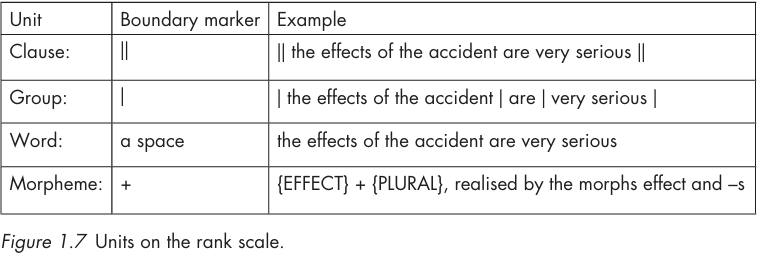
For the initial stages of analysis it may be helpful to mark off the boundaries of each unit by a symbol, such as those adopted in the example. The symbol for ‘clause boundary’ is a double vertical line ǀǀ, that for ‘group boundary’ is a single vertical line ǀ, and that for ‘word boundary’ is simply a space, as is conventionally used in the written language. The independent clause is the equivalent of the traditional ‘simple sentence’.
The relationship between the units is, in principle, as follows. Looking downwards, each unit consists of one or more units of the rank below it. Thus, a clause consists of one or more groups, a group consists of one or more words and a word consists of one or more morphemes. For instance, Wait! consists of one clause, which consists of one group, which consists of one word, which consists of one morpheme. More exactly, we shall say that the elements of structure of each unit are realized by units of the rank below.
Looking upwards, each unit fulfils a function in the unit above it. However, as we shall see later, units may be ‘embedded’ within other units, such as the clause who live in the north within the nominal group people who live in the north. Similarly, the prepositional phrase of the accident is embedded in the nominal group the effects of the accident.
We shall be concerned mainly with two units: clause and group. The structure and constituents of these units will be described later, together with their functions and meanings.
الاكثر قراءة في Syntax
اخر الاخبار
اخبار العتبة العباسية المقدسة
الآخبار الصحية

قسم الشؤون الفكرية يصدر كتاباً يوثق تاريخ السدانة في العتبة العباسية المقدسة
"المهمة".. إصدار قصصي يوثّق القصص الفائزة في مسابقة فتوى الدفاع المقدسة للقصة القصيرة
(نوافذ).. إصدار أدبي يوثق القصص الفائزة في مسابقة الإمام العسكري (عليه السلام)


