INDIRECT SPEECH ACTS, CLAUSE TYPES AND DISCOURSE FUNCTIONS
PERFORMATIVES AND THE DECLARATIVE
All language in use carries out acts, and this is what distinguishes an utterance from a sentence. A sentence is a grammatical object, but when it is used in context what we have is an utterance. The meaning of an utterance depends on what it is being used to do – what kind of speech act is being performed.
We have seen that making a statement is the basic function of the declarative. A statement describes a state of affairs in the world and has a truth value, which can be confirmed, questioned or denied (She is at home; Is she at home? She is not at home). Stating something is performing the verbal act of stating. The declarative is unique among clause types, however, in its ability to carry out certain acts by naming them. These are explicit performatives.
With certain verbs – such as promise, advise and warn – a declarative carries out the speech act it names. Such declaratives usually address the hearer directly, as in:
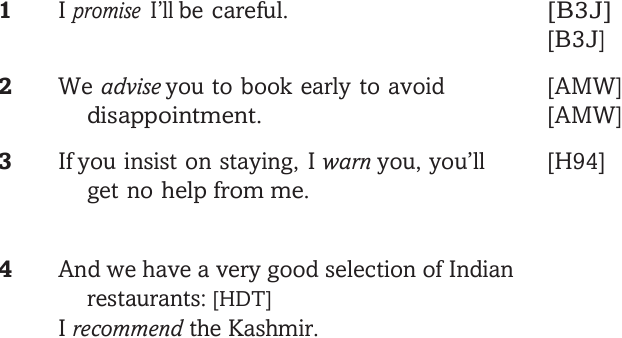
That is, the speaker carries out the act of promising, advising, warning and recommending, respectively. Declaratives such as these don’t have truth value. It makes no sense to ask if they are true or false. Instead, we can ask if they work as performatives. With a 1st person speaker and present tense, as in I promise I’ll be careful, the performative is explicit and the speaker is fully accountable as the doer of the speech act.
As long as the underlying Subject is the speaker or the writer, the passive forms 5, 6, or an active form with an impersonal NG Subject 7, have the same effect:
5 You are advised to book early to avoid disappointment.
6 Passengers are requested to have their boarding cards ready.
7 John Lennon Airport apologize for any inconvenience caused to the public during building works.
Performatives become less explicit when modalized (with can or must), when introduced by let, want, I’m afraid or when nominalized. They still count as performatives, however:
8 I can offer you beer, whisky, gin, cola . . .
9 Let me thank you once more for your collaboration.
10 My apologies for cross-postings.
11 I must beg you not to tell anyone about this.
12 I am afraid I have to request you to move to another seat.
13 I wanna thank you all. God bless you. (President George W. Bush to the American people in the aftermath of 11 September 2001)
These ‘hedged’, that is, indirect, forms are felt to be still performing the act named by the verb. In addition, they are more polite than direct forms because they avoid invoking power and status. Hearers may perceive them to be more sincere, as is also the case with the informal use of wanna instead of want to in the President’s thanks.
Other verbs that can be used as explicit performatives include: agree, bet, congratulate, declare, guarantee, object, wish and many others.
With pronouns other than I/we, or with past tense or perfect aspect, such verbs do not carry out the act they name; instead, they are statements which report a speech act:
I offered them beer, whisky, gin, cola . . .
They have requested passengers to have their boarding cards ready.
You might wonder why we don’t use performatives all the time, if they are so efficient. One reason is that not all verbs are potentially performative. For instance, we can’t threaten someone in English by saying ‘I threaten you’, nor hint by saying ‘I hint that you are wrong’. These acts have to be done indirectly.
A second reason is that explicit performatives sometimes appear to invoke authority or status. The power factor is most obvious in ‘ritual performatives’ such as:
Then I declare the meeting closed. [GUD]
I name this ship Aurora. (Authorized person at launching of the ship) [9W7]
Negative declaratives typically express a negative statement, which may have the force of a rejection 1. Negating an explicit performative can have the effect of greatly attenuating the force, as in 2, though this is not the case with passives 5. Negative declaratives can also express a polite question 3, an exclamation 4 or a prohibition 5:
1 I don’t need any more calendars, thank you.
2 I don’t promise you that I’ll convince him.
3 Bill hasn’t said anything about the weekend?
4 I never heard such rubbish!
5 Smoking is not allowed in here
With some performatives such as advise, what we have is transferred negation. The negative particle not is transferred from its logical place in the dependent clause to the main clause (for other verbs, such as think, which behave this way):
I don’t advise you to buy those shares (= I advise you not to buy those shares).
Certain verbs such as promise and bet are sometimes used performatively to carry out a different act from the one they name. Basically, promise carries out acts which benefit the addressee, while bet is used to lay a wager. But, in the examples that follow, this is not the case: promise is being used to threaten the addressee while bet informally expresses strong probability:
And don’t you dare make fun of me! [JXV]
One sound from you and you won’t make another, I promise you.
I bet they have their problems, like us. [H94]








