Word order and morphology
Externally headed relative clauses
In English, as all of the preceding examples illustrate, the modifying clause always follows the head noun. This is probably the most common ordering of these elements across languages, but it is certainly not the only possibility. A large number of languages have the opposite order, with the modifying clause preceding the head noun. Both of these possibilities are examples of EXTERNALLY HEADED relative clauses, i.e. those in which the head noun occurs outside the modifying clause, whether before or after. The other possibility, namely an INTERNALLY HEADED relative clause, is quite rare.
If we examine externally headed relative constructions in many different languages, we will discover a partial correlation between the position of the modifying clause (before or after the head noun) and other word order facts in the language. Verb-initial languages (those in which the verb occurs first in a basic declarative sentence, whether VSO or VOS) almost always have POSTNOMINAL (or POST-POSED) relative clauses, with the modifying clause following the head noun. A large number of verb-final (SOV) languages have PRENOMINAL (or PRE-POSED) relative clauses, with the modifying clause preceding the head noun. A Turkish example showing this structure is given in (42) (the abbreviation NMLZ stands for NOMINALIZER).10 But other verb-final languages have postnominal relative clauses instead.

Most SVO languages (including English) use postnominal relative clauses. Some of these languages also have a prenominal relative construction, but these are typically more restricted in their distribution. We can summarize these observations by saying that, across languages, post-nominal relatives are more common than prenominal, and that prenominal relatives are the preferred option only in SOV languages.
Aside from the prenominal order, there is another important difference between the Turkish example in (42) and the English examples in (35–41). In English relative clauses, the modifying clause contains a normal finite verb form, fully inflected for tense and agreement. In Turkish, however, the verb inside the modifying clause must be NOMINALIZED; that is, it is changed into a form which belongs to the category N.12 Because of this change, the subject of the modifying clause is marked for genitive case, rather than the expected nominative. This kind of prenominal relative clause, with a nominalized verb form and a genitive subject, is found in a number of other SOV languages as well.
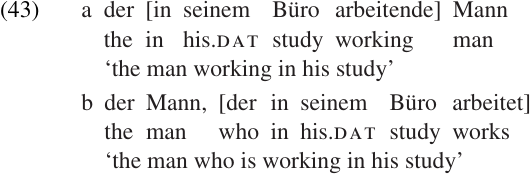
Another common pattern is for the verb inside the modifying clause to appear as a PARTICIPLE. German has two kinds of relative clauses: a prenominal relative containing a participial form of the verb (43a); and a postnominal relative containing a normal finite verb form (43b). Note that English also allows participial relatives, as illustrated in the translation of (43a).
10. (42–43) and (45) are from Keenan (1985), as are many of the typological generalizations.
11. The possessor agreement marker–i on the nominalized verb agrees with the person and number of the genitive subject, in the same way that a possessed noun agrees with its genitive possessor in a Turkish noun phrase.
12. We will discuss morphological processes of this type in more detail in Derivational morphology.








