Coordinate vs. subordinate clauses
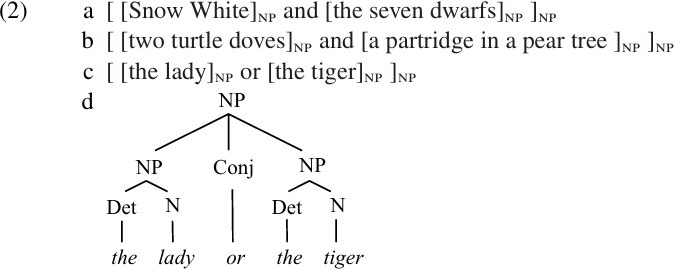
There are two basic ways in which one clause can be embedded within another: COORDINATION vs. SUBORDINATION. In a COORDINATE structure, two constituents belonging to the same category are con joined to form another constituent of that category. Such a structure is usually considered to be doubly headed, since both of the conjoined elements function as heads of the larger unit. Some simple examples of coordinate NPs are shown in (2):
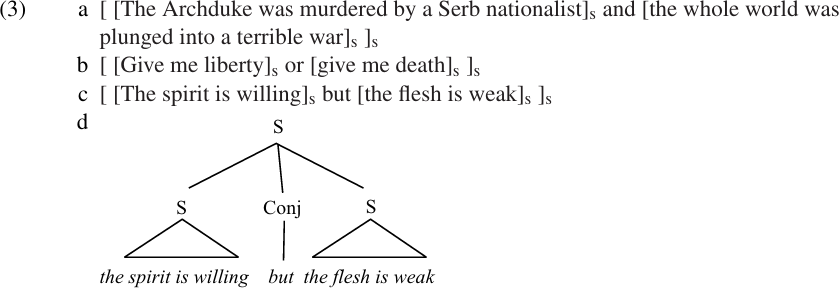
In a coordinate sentence, two (or more) S constituents occur as daughters and co-heads of a higher S. Each of the daughter clauses has the internal structure of an independent sentence, and neither is embedded in the other. Coordinate sentences in English are normally linked by conjunctions such as and, but, and or, as in the examples in (3). In other languages, coordinate sentences may be formed by simply juxtaposing two independent clauses, with only the second receiving final intonation.
A SUBORDINATE clause is one which functions as a dependent, rather than a co-head. We will discuss three basic types of subordinate clause:
a Complement clauses
b Adjunct (or Adverbial) clauses
c Relative clauses
COMPLEMENT CLAUSES are clauses that occur as complements of a verb; in other words, they are required or licensed by the subcategorization features of the verb. They typically function as the subject or object of another clause, which is referred to as the MATRIX clause. ADJUNCT CLAUSES, as their name suggests, are clauses which function as an adjunct or adverbial element of another clause. RELATIVE CLAUSES are clauses which function as modifiers within an NP.
For simplicity, we will use primarily English examples in our discussion of complement clauses and adjunct clauses. However, we will discuss examples of relative clauses from a wide variety of languages.








