Argument structure
The assumption that subjects originate internally within VP ties up in interesting ways with traditional ideas from predicate logic which we touched on briefly. As we saw there, traditional work in logic maintains that propositions (which can be thought of as representing the substantive semantic content of clauses) comprise a predicate and a set of arguments. Simplifying somewhat, we can say that a predicate is an expression denoting an activity or event, and an argument is an expression denoting a participant in the relevant activity or event. For example, in sentences such as those below, the italicized verbs are predicates and the bracketed expressions represent their arguments.

In other words, the arguments of a verb are typically its subject and complement(s). It has been widely assumed in work spanning more than half a century that complements of verbs are contained within a projection of the verb – e.g. the suspect in (18b) is the direct-object complement of arrested and is contained within the verb phrase headed by arrested (so that arrested the suspect is a VP). Under the VP-Internal Subject Hypothesis, we can go further than this and make the following (more general) claim:

Such an assumption allows us to maintain that there is a uniform mapping (i.e. relationship) between syntactic structure and semantic argument structure – more specifically, between the position in which arguments are initially merged in a syntactic structure and their semantic function.
To see what this means in practice, consider the derivation of (18b) The police have arrested the suspect. The verb arrested merges with its direct-object complement the suspect (a DP formed by merging the determiner the with the noun suspect) to form the V-bar arrested the suspect. The resulting V-bar is in turn merged with the subject DP the police (formed by merging the determiner the with the noun police) to form the VP shown in (20) below (simplified by not showing the internal structure of the two DPs):
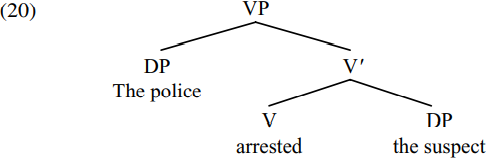
In a structure such as (20), the complement the suspect is said to be the internal argument of the verb arrested (in the sense that it is the argument contained within the immediate V-bar projection of the verb, and hence is a sister of the verb), whereas the subject the police is the external argument of the verb arrested (in that it occupies a position external to the V-bar constituent which is the immediate projection of the verb arrested). The VP in (20) is then merged with the present tense auxiliary [T have], forming the T-bar have the police arrested the suspect. Since a finite T has an [EPP] feature requiring it to have a subject of its own, the DP the police moves from being the subject of arrested to becoming the subject of [T have], forming The police have the police arrested the suspect. Merging the resulting TP with a null declarative complementizer in turn derives the structure shown in simplified form in (21) below:
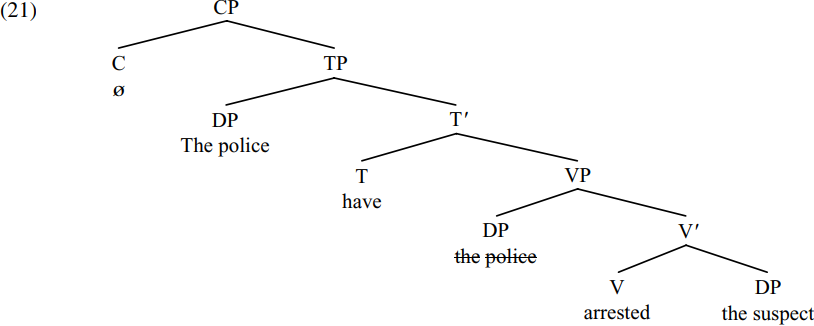
Under the analysis in (21), the argument structure of the verb arrest is directly reflected in the internal structure of the VP which it heads, since the suspect is the internal (direct-object) argument of arrested and the police was initially merged as its external (subject) argument – and indeed a null copy of the police is left behind in spec-VP, marking the spec-VP position as associated with the police.








