0
EN
1
المرجع الالكتروني للمعلوماتية

Grammar

Tenses

Present

Present Simple

Present Continuous

Present Perfect

Present Perfect Continuous

Past

Past Simple

Past Continuous

Past Perfect

Past Perfect Continuous

Future

Future Simple

Future Continuous

Future Perfect

Future Perfect Continuous

Parts Of Speech

Nouns

Countable and uncountable nouns

Verbal nouns

Singular and Plural nouns

Proper nouns

Nouns gender

Nouns definition

Concrete nouns

Abstract nouns

Common nouns

Collective nouns

Definition Of Nouns

Animate and Inanimate nouns

Nouns

Verbs

Stative and dynamic verbs

Finite and nonfinite verbs

To be verbs

Transitive and intransitive verbs

Auxiliary verbs

Modal verbs

Regular and irregular verbs

Action verbs

Verbs

Adverbs

Relative adverbs

Interrogative adverbs

Adverbs of time

Adverbs of place

Adverbs of reason

Adverbs of quantity

Adverbs of manner

Adverbs of frequency

Adverbs of affirmation

Adverbs

Adjectives

Quantitative adjective

Proper adjective

Possessive adjective

Numeral adjective

Interrogative adjective

Distributive adjective

Descriptive adjective

Demonstrative adjective

Pronouns

Subject pronoun

Relative pronoun

Reflexive pronoun

Reciprocal pronoun

Possessive pronoun

Personal pronoun

Interrogative pronoun

Indefinite pronoun

Emphatic pronoun

Distributive pronoun

Demonstrative pronoun

Pronouns

Pre Position

Preposition by function

Time preposition

Reason preposition

Possession preposition

Place preposition

Phrases preposition

Origin preposition

Measure preposition

Direction preposition

Contrast preposition

Agent preposition

Preposition by construction

Simple preposition

Phrase preposition

Double preposition

Compound preposition

prepositions

Conjunctions

Subordinating conjunction

Correlative conjunction

Coordinating conjunction

Conjunctive adverbs

conjunctions

Interjections

Express calling interjection

Phrases

Sentences

Clauses

Part of Speech

Grammar Rules

Passive and Active

Preference

Requests and offers

wishes

Be used to

Some and any

Could have done

Describing people

Giving advices

Possession

Comparative and superlative

Giving Reason

Making Suggestions

Apologizing

Forming questions

Since and for

Directions

Obligation

Adverbials

invitation

Articles

Imaginary condition

Zero conditional

First conditional

Second conditional

Third conditional

Reported speech

Demonstratives

Determiners

Direct and Indirect speech

Linguistics

Phonetics

Phonology

Linguistics fields

Syntax

Morphology

Semantics

pragmatics

History

Writing

Grammar

Phonetics and Phonology

Semiotics

Reading Comprehension

Elementary

Intermediate

Advanced

Teaching Methods

Teaching Strategies

Assessment

قم بتسجيل الدخول اولاً لكي يتسنى لك الاعجاب والتعليق.

The functions of pronouns

المؤلف:  EVELYNP.ALTENBERG & ROBERTM.VAGO

المصدر:  English Grammar Understanding the basics

الجزء والصفحة:  P183-C13

2025-11-14

535

+

-

20

The functions of pronouns

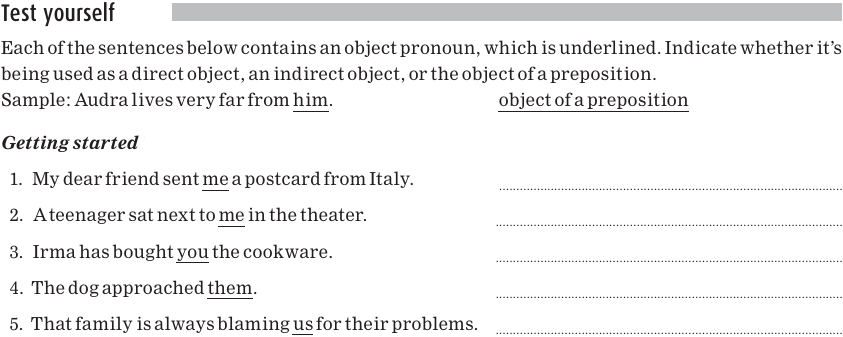
Now that we’ve talked about subjects and objects in some detail, it’s a good idea for us to reexamine subject and object pronouns.


Take a look at the noun phrase the teacher in each of the sentences below.

1. The teacher went home early today.

(The teacher is the subject.)

2. The students liked the teacher very much.

(The teacher is the direct object.)

3. Theparentsgavethequestionnaireto the teacher.

(The teacher is the indirect object.)


Notice that the teacher has the same form whether it’s functioning as the subject, the direct object, or the indirect object in a sentence. This is true for all nouns in English: they don’t change form when they change function.


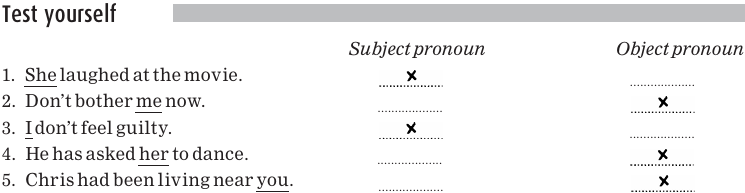
In contrast, there are subject pronouns and object pronouns. Subject pronouns are used when a pronoun is functioning as the subject of a sentence. The subject pronoun is underlined in the following sentences:

4. I read the newspaper every day.

5. She is happy.

6. We love potato chips.


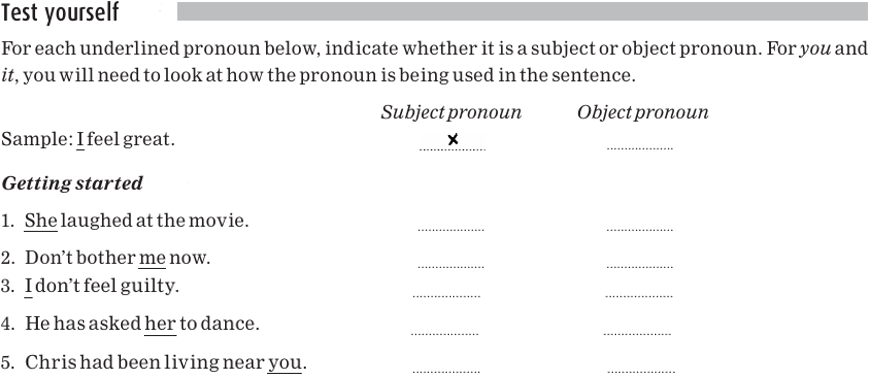
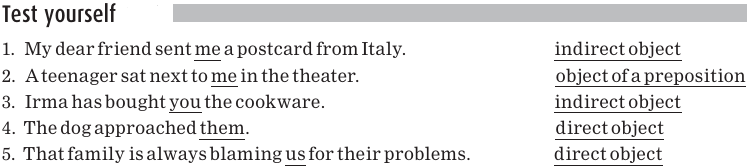
Object pronouns are used in all other contexts. The three major uses for object pronouns are: direct object (Direct objects), indirect object (Indirect objects), and object of a preposition (The basic structure of prepositional phrases). The object pronouns are underlined in the following sentences:

7. My sister congratulated me on my birthday. (direct object)

8. The direct or sent her a message. (in direct object)

9. Mrs. Raffsky spoke to us on the phone. (object of a preposition)


Quick tip

A subject pronoun is used when it is functioning as the subject of the sentence. An object pronoun is used when it is functioning as: (a) the direct object of the sentence; (b) the indirect object of the sentence; (c) the object of a preposition.
 

Answers
 

Answers
 

To enhance your understanding

In the past, who and whom worked the same way as subject and object pronouns. In particular, who was used when functioning as a subject and whom was used when functioning as an object:

10. Who is running away? (subject: Who is doing the action.)

11. Whom does Katie like?(direct object: Whom is receiving the action.)


However, like all languages, English changes overtime, and today, for all but the strictest traditional grammarians, who is used in all contexts, except when it directly follows a preposition (see below). So today a sentence like the following is perfectly grammatical:

12.Who does Katie like? (direct object)


While most of us prefer to use who in sentence 12, it’s still okay to use whom in these contexts. It’s just not necessary to do so, and it tends to sound very formal.


Note that whom must be used when it follows a preposition. In the following examples, whom and the preposition before it are underlined.

13. With whom would you like to speak?

14. To whom may I direct your question?

اخر الاخبار

اشترك بقناتنا على التلجرام ليصلك كل ما هو جديد