Examples of pronoun systems
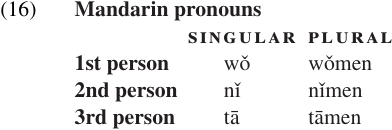
Ingram (1978) states that the most commonly occurring pronoun system among the world’s languages is one containing six different forms, representing all the possible combinations of three person categories with two number categories. This pattern can be illustrated with Mandarin Chinese:
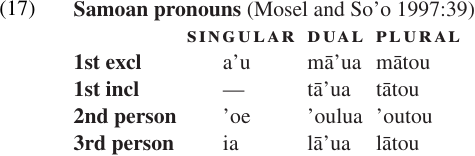
The next most common system in Ingram’s corpus is one which adds the dual number category and distinguishes inclusive from exclusive in the first person. This produces eleven distinct combinations of person and number features, as in Samoan:
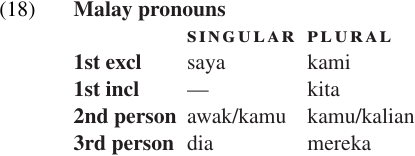
The third most common system in Ingram’s study is one which has no dual number category but does distinguish inclusive from exclusive, for a total of seven distinct forms. This is the basic pattern found in Malay, if we ignore the politeness factors discussed above:
These examples have referred only to the categories of person and number. If we take into account other features as well, such as case and/or gender, the systems can obviously become quite complex. And there can be significant variations even between relatively closely related languages. To illustrate this last point, consider the following systems from two western Malayo-Polynesian languages spoken within a few hundred miles of each other: Kayan, spoken in central Borneo; and Kimaragang Dusun, spoken in northeastern Borneo. Kimaragang has only one dual form, namely the first person inclusive; but Kayan has not only a complete dual set but also a complete paucal set. As is often the case, the Kayan dual and paucal forms contain reduced forms of the words meaning ‘two’ and ‘three,’ dua’ and təlo’, respectively.
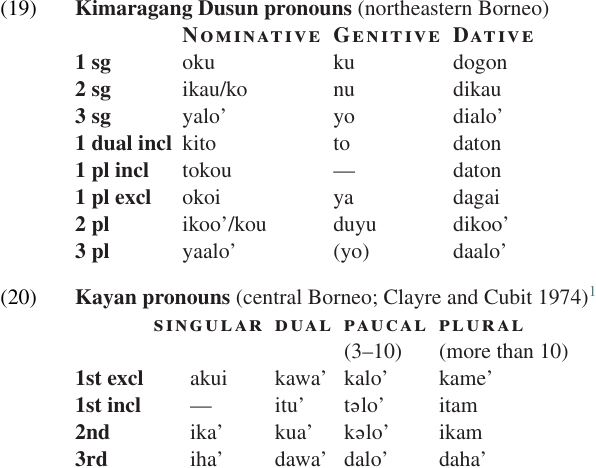
10. There are minor variations in some Kayan forms relating to case functions. These variant forms are not shown here.
Noun classes and pronouns.








