Ergativity
Most languages that have grammatical case markers follow one of two basic patterns. The more common of these patterns can be observed in English. As mentioned above, case marking in modern English is found only in pronouns, so our interest will be focused on the distribution of the pronominal forms in examples like the following:
(5) a I dance.
b He dances.
c I like him.
d He likes me.
As these examples illustrate, subject pronouns have the same form (I and he) whether the clause is intransitive, as in (5a, b), or transitive, as in (5c, d). Following standard terminology, we would call this the nominative form.
Direct objects occur in a different form (me and him). We could call this the accusative form. This pattern of case marking is referred to as a Nominative Accusative system, or ACCUSATIVE for short. Example (6), showing the distribution of English pronoun forms in transitive vs. intransitive clauses, illustrates the Nominative–Accusative pattern.

Now imagine that you are ship wrecked on a South Pacific island where you find people speaking a previously undescribed variety of Pidgin English, which we will call “Pseudo-English.” You record the following utterances:
(7) a mi dans. ‘I dance.’
b him dans. ‘He dances.’
c ai laik him. ‘I like him.’
d hi laik mi. ‘He likes me.’
In these examples, we see that direct objects of transitive clauses take the same form as subjects of intransitive clauses, namely mi or him. Subjects of transitive clauses take a special form, ai or hi. This kind of case-marking pattern, summarized in (8), is referred to as an ERGATIVE system. The form used for transitive subjects is called ERGATIVE case, while the form used for transitive objects and intransitive subjects is called ABSOLUTIVE case.

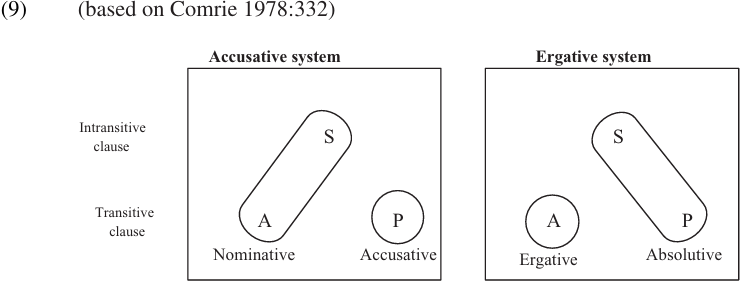
The accusative and ergative patterns are compared in (9), using “S” for the subject of an intransitive clause, “A” (Agent) for the subject of a transitive clause, and “P” (Patient) for the object of a transitive clause. As this diagram illustrates, the defining characteristic of the ergative pattern is a unique case marker for transitive subjects, while the defining characteristic of the accusative pattern is a unique case marker for transitive objects.
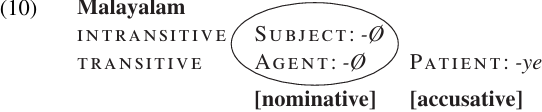
Based on the examples in (1), how should we classify the case-marking pattern of Malayalam? We can see that subjects get the same marking (namely-Ø) whether the clause is intransitive, as in (1a, b), transitive, as in (1c-e), or ditransitive, as in (1f-h). Direct objects get a special case marker (-ye) which is distinct from the marking for subjects. This distribution, which is summarized in (10), clearly fits the Nominative–Accusative pattern.
Based on the examples in (11), how would you classify the case-marking pattern of Walmatjari?
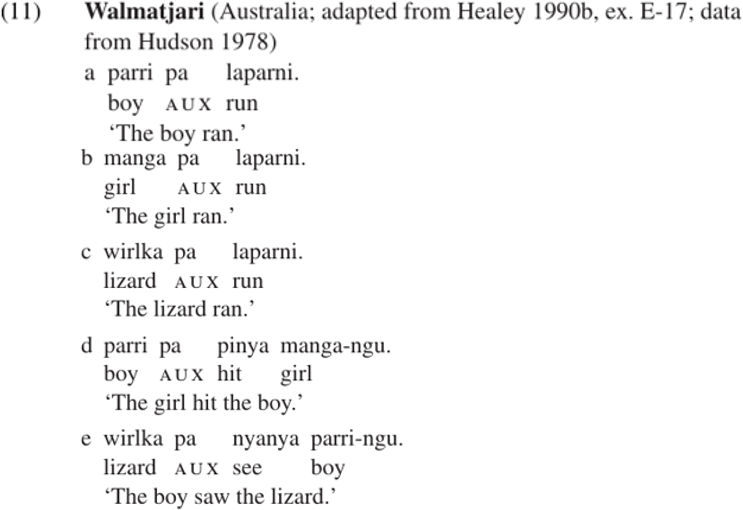
These examples show that in Walmatjari, direct objects of transitive clauses get the same case marking as subjects of intransitive clauses, namely-Ø.
Subjects of transitive clauses get a special case marker (-ngu). This distribution, which is summarized in (12), follows the ergative pattern.

The Malayalam and Walmatjari data illustrate an interesting fact about case systems. If a language has an “unmarked” case, or zero case marker, it is most likely to be the case that is used for intransitive subjects: the nominative in an accusative language like Malayalam, and the absolutive in an ergative language like Walmatjari.1
1. Greenberg (1963), universal #38.








