The demonstrative channel
As in the noun channel, the strategy underlying this channel involves a complement of the main clause which is grammaticalized to a complementizer. The complement in this case is a demonstrative pronoun (not a demonstrative attribute), which is either distal (‘that’) or proximal (‘this’). Accordingly, a structure underlying something like sentence (44a) is grammaticalized into (44b). The main effects of grammaticalization are summarized in (45).
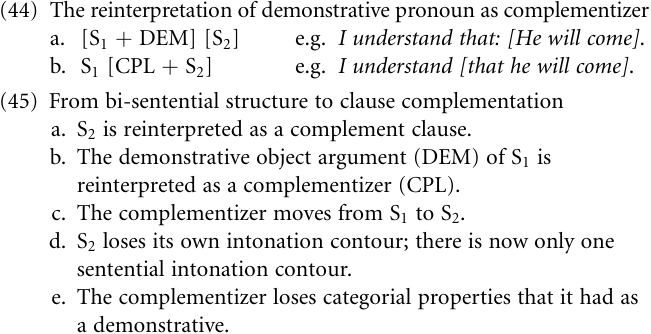
This process has been described in some detail for Germanic languages such as English, German, and Faroese (Lockwood 1968: 222–3; Heine, Claudi, and Hünnemeyer 1991: 180; Hopper and Traugott 1993: 185–9; Harris and Campbell 1995: 287–8; Heine and Kuteva 2002a). An example from the Australian language Gunwinggu is discussed by Hopper and Traugott (2003: 185). The following case is taken from the !Xun language of south western Africa; cf. (46): The use of the proximal demonstrative pronoun kā ē ‘this’ (referring to nouns of the inanimate noun class 4 [N4]) is exemplified in (46a). In (46b) there are two clauses, where the second clause is interpreted as a complement of the first clause, and the demonstrative pronoun kā ē as a complementizer introducing the second clause, even if it could also be interpreted in its non-grammaticalized sense, where (46b) could be translated roughly as ‘Ask him this: he’ll be at home tomorrow’.
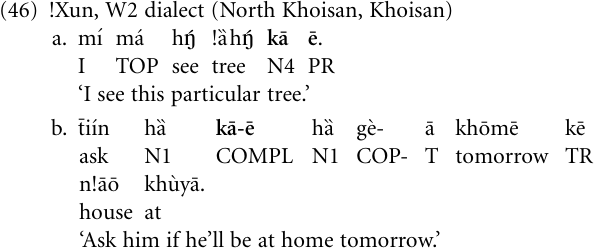
The development from the demonstrative kā ē to the complementizer kā-ē involved all of the parameters of grammaticalization: Extension had the effect that the form was used in a new kind of context, namely at the beginning of a clause, desemanticization led to loss of spatial deixis, decategorialization meant that the form no longer participates in the variable paradigm of demonstrative categories, and erosion had the effect that the glottal stop and the contour tone (high–low) of the demonstrative [kāʔḕ] was lost in the complementizer, which is [kāē], or even [kē].
In the early stages of development, the grammaticalization from demonstrative pronoun to complementizer tends to be confined to object complements, and in many languages the process has stopped at this point. But in other languages, the process has proceeded further, in that the use of the complementizer was extended to subject complements. For example, the English distal demonstrative that acquired uses as an object complementizer already in Old English, while its use as a subject complementizer in subject position did not evolve prior to the fourteenth century (Hopper and Traugott 2003: 194).1
Diachronic evidence for this evolution comes from languages where we have sufficient historical records, such as English, German, etc.: Items such as English that were first used as demonstratives before their use was extended to also serve as complementizers. Germanic languages abound with examples showing that the process from demonstrative pronoun in the matrix clause to conjunction introducing complement clauses is documented by means of historical evidence. An example from Faroese is discussed by Lockwood (1968: 222–3; see also Heine, Claudi, and Hünnemeyer 1991: 180); the development of the English complementizer that is discussed by Hopper and Traugott (2003: 190–4), and Harris and Campbell (1995: 287f.) analyze the development of German das/dass ‘that’. Conversely, we are not aware of any data that would suggest that, in the history of English or of any other languages, complementizers developed into demonstratives.
1 There is an example of that from ca. 1000 AD where it appears to be a subject complementizer, though not in subject position (Hopper and Traugott 2003: 192, ex. (41)).








