The interrogative channel
Question words do not only develop into relative clause markers; they may in the same way give rise to markers introducing complement clauses, that is, complementizers. European languages have plentiful examples of question words (QW) meaning ‘what?’, ‘who?’, ‘when?’, ‘where?’, ‘why?’, etc. being grammaticalized to devices for presenting complement clauses. The process appears to have involved clause integration of the following kind: Two clauses, where one is an interrogative one (47a), are conflated into one sentence, where the question word assumes the function of a complementizing pronoun and the interrogative clause into a complement clause, as sketched in (47b).1

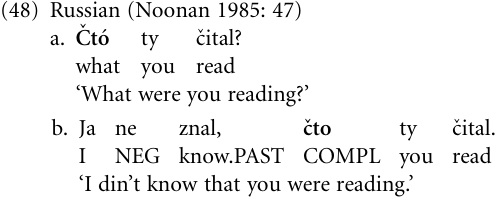
The Russian interrogative pronoun c̆to̒ ‘what?’ has given rise to both a relative pronoun and a complementizer. Example (48a) illustrates the interrogative and (48b) the complementizer use. That the latter is a grammaticalized form of the former is suggested by the fact that it is contextually restricted (decategorialization) and that it has lost the ability to be stressed (erosion), which is a characteristic of c̆to as a pronoun (Noonan 1985: 47).
While common in Indo-European languages, this channel is also found in some other languages. One example is provided by Georgian, where the complementizer ray-ta-mca ‘that’ is derived from the question word ray ‘what?’ (Harris and Campbell 1995: 298):

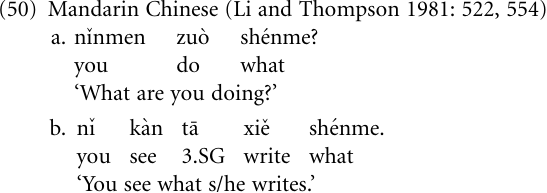
Another example comes from Mandarin Chinese, where question words appear to have grammaticalized to pronouns introducing complement clauses. For example, in (50a), she̒nme ‘what?’ is an interrogative pronoun while in (50b) it is an object complementizer.
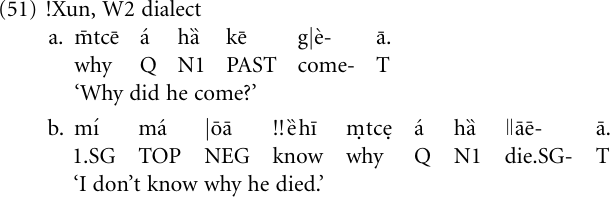
Finally, we may cite an example from the North Khoisan language !Xun, where the question word m̄tcē...-ā ‘why?’, illustrated in (51a), appears to have been grammaticalized to a reason complementizer; note that the complementizer in (51b) has retained the question marker a̒ (Q).
1 So far, no historical data have been found to corroborate this reconstruction.








