From complementizer or relativizer to adverbial clause subordinator
We sketched the main channels leading to clause subordination. We saw that complement and adverbial-clause subordination may follow different channels of grammaticalization, but that they can use the same channel as well. The question then arises how the two kinds of clause subordination differ from one another in their development. The evidence available suggests that both relative and complement clauses can develop into adverbial clauses while a development in the opposite direction is unlikely to happen. The evidence for this hypothesis is as follows. Wherever there is diachronic evidence it indicates that in the grammaticalization of demonstratives to subordinators there was first a relativizer or complementizer stage before the relevant marker turned into an adverbial clause subordinator. For example, in the evolution of demonstrative pronouns, the following stages can be observed:
(68) The main stages in the development from demonstrative pronoun to clause subordinator
a. Demonstrative pronoun introducing relative or object complement clauses
b. Demonstrative pronoun introducing subject complement clauses
c. Demonstrative pronoun introducing adverbial clauses
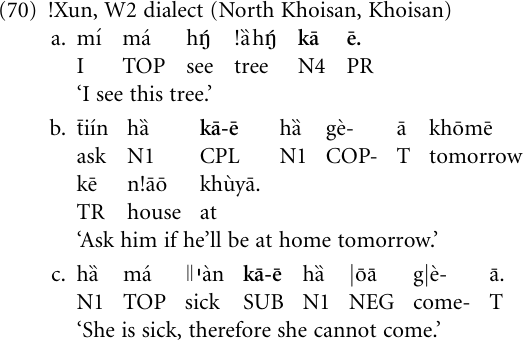
One piece of evidence is provided by the diachronic criterion: As we will see in “Clause Subordination Case studies”, there are historical data to show that relativizers and complementizers can develop further into adverbial clause subordinators. A second piece of evidence comes from crosslinguistic observations on grammaticalization. A number of languages have reached stage (68b) but not (68c), that is, a demonstrative has been grammaticalized to a complementizer but not to an adverbial clause subordinator. English is such a language: It uses the item that as a demonstrative pronoun (69a), as an object complementizer (69b), and a subject complementizer (69c), but essentially not as an adverbial clause subordinator. In the Khoisan language !Xun, all stages of (68) are represented: In (70a), the form kā ē is a proximal demonstrative modifier of noun class 4 (‘this’), in (70b) it is an object complementizer, while in (70c) it is an adverbial-clause subordinator—more specifically a reason conjunction, but it has a number of other subordinating functions in addition, such as marking temporal and conditional clauses.
(69) English
a. I know that.
b. I know that she’ll come.
c. That he’ll not come worries her.
A third piece of evidence comes from verbs for ‘say’. As we saw in “The verb channel” (37), there is a crosslinguistically common channel whereby ‘say’ verbs may develop first into complementizers and only thereafter into adverbial-clause subordinators (see e.g. Heine, Claudi, and Hünnemeyer 1991: 158; Ebert 1991: 87; Crass 2002; see below). Languages differ in the extent to which they have proceeded along this channel. For example, whereas the Tibeto-Burman language Chamling has not proceeded beyond the stage of complementizer, the Indo-Aryan language Nepali has gone through all stages, having developed its verb for ‘say’ into an adverbial clause subordinator (Ebert 1991: 88). We will deal with another example illustrating the extension from complementizer to adverbial clause subordinator in “The rise of complement and adverbial clauses”.
A final piece of evidence for the development from complement to adverbial clause marking is provided by the adposition channel and the development from allative to purpose markers, involving the following stages, where the main verb denotes goal-directed motion (‘go to’, ‘take to’, etc.):
(71) From allative case marker to purpose clause subordinator
a. [X goes to place Y]
b. [X goes to (do) activity Y]
c. [X goes in order to do Y]
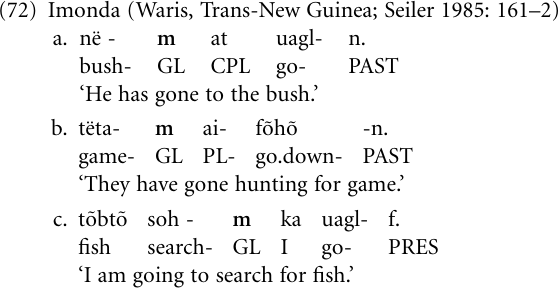
In (71a) there is a nominal locative complement marked by an allative adposition or case affix, as in example (72a) from the Papuan language Imonda, where the allative marker consists of the nominal goal suffix-m (GL). In (72b), the locative complement is conceived of as an activity, irrespective of whether it is encoded by a noun, as in (72b), or as a nominalized verb (see below). Finally, in (72c) the erstwhile locative complement is now a verb that may take complements and is conceived of as expressing the purpose of the motion.
To conclude, there is evidence to establish that whenever one and the same construction gives rise to both relative or complement and adverbial clause subordination, the former types of subordination are likely to have preceded the latter in time. Historical evidence can be found in creole languages, where it is possible on the basis of written documents to establish sequences of historical development; see “Clause subordination case studies”.








