The rise of a relative clause construction
As we observed in “The demonstrative channel”, the most frequent development in the languages of the world is to create a new relative clause structure via the grammaticalization of demonstrative pronouns (not attributes), and creoles have also made use of this mechanism, as we will now demonstrate with an example from the English-based creole Sranan of Suriname.1 Sranan arose in the late seventeenth century on the plantations of Suriname, which was made a British Colony in 1651; in 1668, Dutch became the colonial language. As in pidgins and newly emerged creoles, there were essentially no formally marked relative clauses in early Sranan: The English relativizers were lost, and most of the text examples that were seemingly unmarked relative clauses might also receive alternative interpretations, and there is no evidence that there was a recursive structure of relativization. Zero marking of relative clauses continued throughout the nineteenth and twentieth centuries.
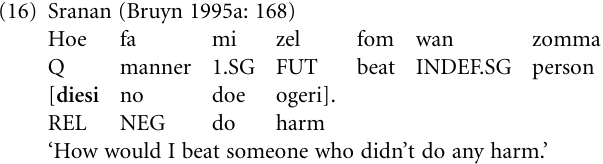
For most of the seventeenth century, the demonstrative disi ‘this’ (< English this) was functioning both as a nominal modifier and a pronoun (we will refer to this as stage 0). Probably around the end of the seventeenth century, disi developed from demonstrative to relativizer within the short period of half a century, thereby giving rise to an overtly recursive structure (stage 1). In the course of the eighteenth century, disi underwent extension as an explicit relativizer. However, while disi could be understood as a relative clause marker determining the preceding noun, an interpretation of disi as a demonstrative in an independent clause could not be ruled out in most cases. However, there are eighteenth century examples such as (16), where disi was already unambiguously a relativizer.
But disi underwent a further grammaticalization, namely one from relative marker to adverbial clause subordinator (CONJ): In the second half of the eighteenth century, if not earlier, its use was extended to introduce temporal, causal, and concessive clauses; cf. (17a), which illustrates its temporal, and (17b) its causal uses.
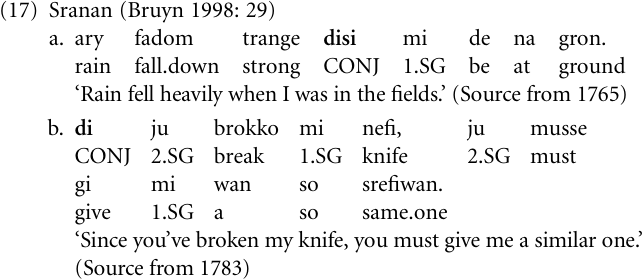
In eighteenth-century sources, the relativizer had the form disi; in the course of the nineteenth century, the new relativizer disi underwent erosion, that is, it was shortened to di, leading to the separation of demonstrative and relative marker. As example (17b) shows however, instances of erosion of disi can be found much earlier.
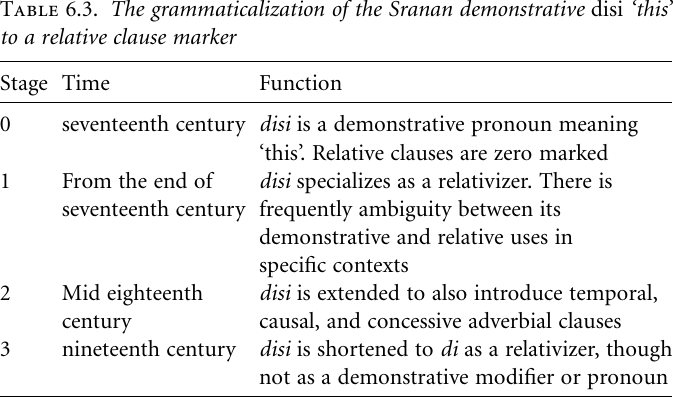
The whole process of the rise and development of new forms of clause subordination, however, did not mean that the original zero-marked structure was abandoned; rather, the latter survived to some extent and is still accessible today. The major stages in the development of Sranan disi are summarized in Table 6.3.
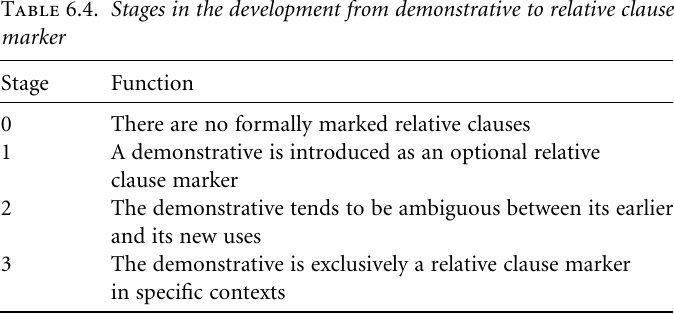
To conclude, Sranan speakers appear to have created subordinate clause structures in accordance with universal parameters of grammaticalization. A strikingly similar example was presented in “The rise of new functional categories”, involving the development of the Kenya Pidgin Swahili demonstrative ile ‘that’. As grammaticalization theory would predict, in both cases there was a sequence of stages as sketched in Table 6.4.
Accordingly, in both cases there was a demonstrative pronoun used non-recursively that was grammaticalized to a new syntactic structure, thereby giving rise to a recursive structure of clause subordination.
1 For the data on this process, see Bruyn (1995a, 1995b, 1998).








