The rise of complement and adverbial clauses
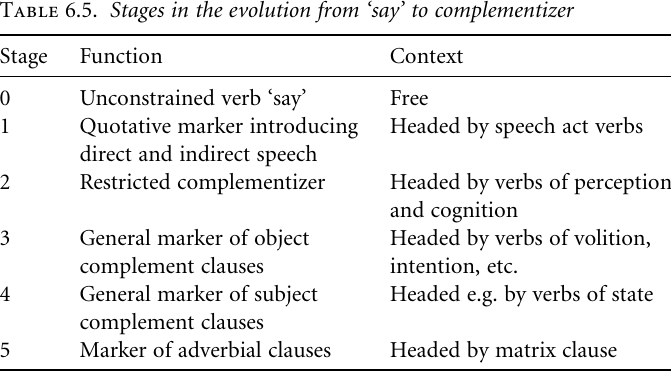
Our second case concerns another crosslinguistically widely attested pathway from non-recursive to recursive construction of clause subordination, namely one leading from verbs meaning ‘say’ to complementizers as well as to adverbial clause subordinators. The main stages of this process are summarized in Table 6.5 (see “The verb channel” for general discussion). The following is a summary of the detailed analysis by Plag (1993, 1994b, 1995), describing the genesis of clause subordination in Sranan, where the verb taki ‘say, talk’ (< English talk) has been grammaticalized to a complementizer and eventually to an adverbial clause subordinator.
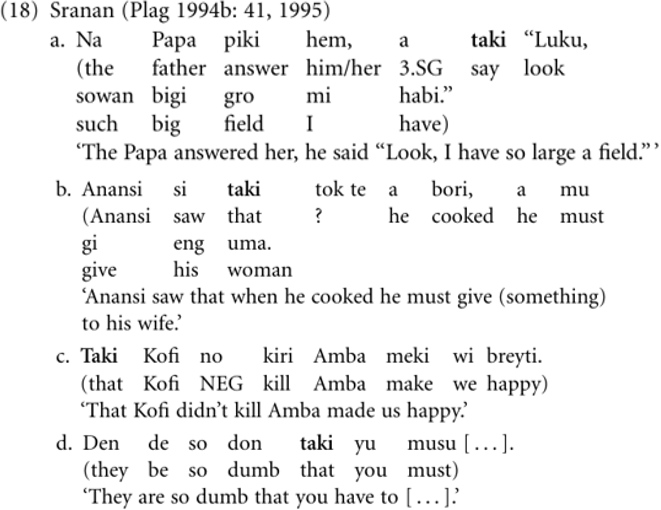
The initial stage of this development in Sranan falls into a period probably dating from 1780 to 1850. In (18a), taki is suggestive of a quotative marker (stage 1), although it can still be understood in its literal sense (stage 0). Sentence (18b) shows the use of taki as an object complementizer (stage 2), while (18c) is an example of the subsequent stage of a marker of subject complement clauses (stage 4). Finally, in (18d), taki has acquired the function of an adverbial clause subordinator.
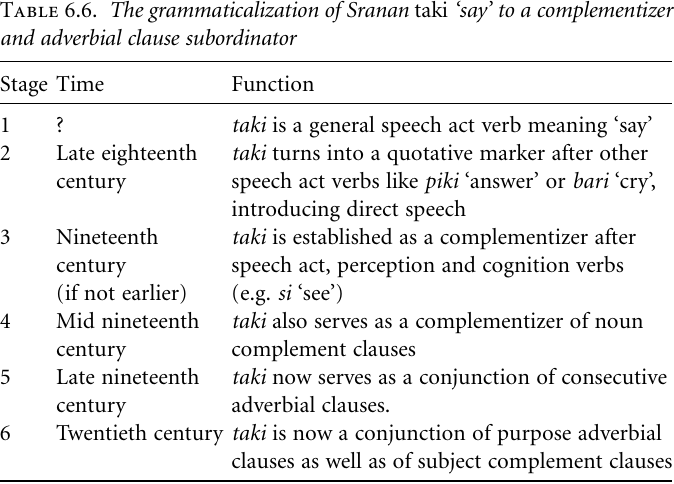
The historical development from main clause combining to clause subordination is summarized in Table 6.6. The data provided by Plag suggest that up until the middle of the nineteenth century, taki was largely confined to introducing arguments, that is quotes and complement clauses, and it is only after 1850 that taki came to introduce adjuncts such as purpose clauses (see especially Plag 1995: 130, 134).
Like the preceding example of Sranan disi/di, the present case shows how two independent sentences merge into one sentence via integration (cf. (14b)), where one of the sentences is grammaticalized to a clause that is subordinate to the other sentence, thereby giving rise to a morphosyntactic structure of embedding recursion, first of complement clauses and subsequently of adverbial clauses—in other words, a non-recursive combination of two sentences [S1 þ S2] turned into a recursive combination [S1[S2]] in accordance with (14b) and (15).