The clause as interaction: mood structures
The clause is also the major grammatical unit used by speakers to ask questions, make statements and issue directives. Unless the conversation is very one-sided, the roles of ‘questioner’ and ‘informant’ tend to alternate between the interlocutors engaged in a conversation, as can be seen in the exchange of speech roles between Chris and Janice.
The exchange of information is typically carried out by the indicative mood or clause type, as opposed to directives, which are typically expressed by the imperative mood. Within the indicative, making a statement is associated characteristically with the declarative mood, and asking a question with the interrogative. More exactly, it is one part of these structures – consisting of the Subject and the Finite element – that in English carries the syntactic burden of the exchange. The rest of the clause remains unchanged.
In a declarative clause, the Subject precedes the Finite.
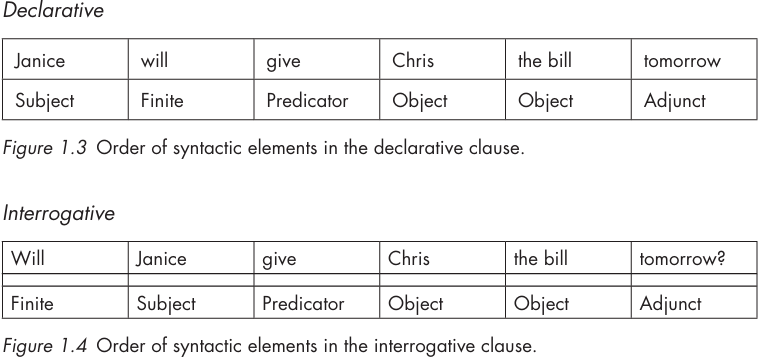
In the interrogative structure, the positions of Finite and Subject are reversed, the Predicator and the rest of the clause remaining the same. The Finite is that element which relates the content of the clause to the speech event. It does this by referring to present or past time, through tense, or by expressing an attitude of the speaker, through the modal auxiliaries, such as will, among other features.








