Combining the three types of structure
The three types of structure are here mapped simultaneously onto the example clause, in order to show the tripartite nature and analysis of English clauses from a functional point of view. Predicator, Objects and Adjunct are included as syntactic elements or functions, which correspond to the semantic roles.
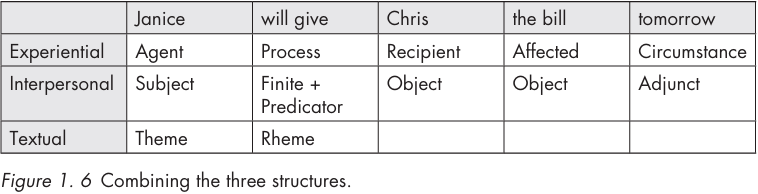
In a typical active declarative clause such as this, Agent, Subject and Theme coincide and are realized in one wording, in this case Janice. But in natural language use, a situation can be expressed in different ways, in which the order of clause elements can vary, since different elements of structure can be moved to initial position. Our present example admits at least the following possible variants:
Chris will be given the bill (by Janice) tomorrow.
The bill will be given to Chris tomorrow (by Janice).
Tomorrow, Chris will be given the bill (by Janice).
The motivation for these and other variants is not to be found in the clause in isolation, but in its relationship to that part of the discourse at which it is located. Speakers organize the content of the clause in order to achieve the best effect for their communicative purpose. This involves establishing the point of departure of the clausal message – that is, the Theme – in relation to what has gone before. This choice conditions to a large extent the way the clausal message will develop.
As we shall encounter instances of the passive voice in use in the forthcoming pages, it may be useful at this point to provide a brief summary of this important option.








