0
EN
1
المرجع الالكتروني للمعلوماتية

Grammar

Tenses

Present

Present Simple

Present Continuous

Present Perfect

Present Perfect Continuous

Past

Past Simple

Past Continuous

Past Perfect

Past Perfect Continuous

Future

Future Simple

Future Continuous

Future Perfect

Future Perfect Continuous

Parts Of Speech

Nouns

Countable and uncountable nouns

Verbal nouns

Singular and Plural nouns

Proper nouns

Nouns gender

Nouns definition

Concrete nouns

Abstract nouns

Common nouns

Collective nouns

Definition Of Nouns

Animate and Inanimate nouns

Nouns

Verbs

Stative and dynamic verbs

Finite and nonfinite verbs

To be verbs

Transitive and intransitive verbs

Auxiliary verbs

Modal verbs

Regular and irregular verbs

Action verbs

Verbs

Adverbs

Relative adverbs

Interrogative adverbs

Adverbs of time

Adverbs of place

Adverbs of reason

Adverbs of quantity

Adverbs of manner

Adverbs of frequency

Adverbs of affirmation

Adverbs

Adjectives

Quantitative adjective

Proper adjective

Possessive adjective

Numeral adjective

Interrogative adjective

Distributive adjective

Descriptive adjective

Demonstrative adjective

Pronouns

Subject pronoun

Relative pronoun

Reflexive pronoun

Reciprocal pronoun

Possessive pronoun

Personal pronoun

Interrogative pronoun

Indefinite pronoun

Emphatic pronoun

Distributive pronoun

Demonstrative pronoun

Pronouns

Pre Position

Preposition by function

Time preposition

Reason preposition

Possession preposition

Place preposition

Phrases preposition

Origin preposition

Measure preposition

Direction preposition

Contrast preposition

Agent preposition

Preposition by construction

Simple preposition

Phrase preposition

Double preposition

Compound preposition

prepositions

Conjunctions

Subordinating conjunction

Correlative conjunction

Coordinating conjunction

Conjunctive adverbs

conjunctions

Interjections

Express calling interjection

Phrases

Sentences

Clauses

Part of Speech

Grammar Rules

Passive and Active

Preference

Requests and offers

wishes

Be used to

Some and any

Could have done

Describing people

Giving advices

Possession

Comparative and superlative

Giving Reason

Making Suggestions

Apologizing

Forming questions

Since and for

Directions

Obligation

Adverbials

invitation

Articles

Imaginary condition

Zero conditional

First conditional

Second conditional

Third conditional

Reported speech

Demonstratives

Determiners

Direct and Indirect speech

Linguistics

Phonetics

Phonology

Linguistics fields

Syntax

Morphology

Semantics

pragmatics

History

Writing

Grammar

Phonetics and Phonology

Semiotics

Reading Comprehension

Elementary

Intermediate

Advanced

Teaching Methods

Teaching Strategies

Assessment

قم بتسجيل الدخول اولاً لكي يتسنى لك الاعجاب والتعليق.

INTRODUCTION: MAJOR COMPLEMENTATION PATTERNS AND VALENCY

المؤلف:  Angela Downing

المصدر:  ENGLISH GRAMMAR A UNIVERSITY COURSE

الجزء والصفحة:  P79-C3

2026-05-08

201

+

-

20

INTRODUCTION: MAJOR COMPLEMENTATION PATTERNS AND VALENCY

Complementation of the verb refers to the syntactic patterns made up by configurations of the clause elements. Each pattern contains a Subject and a Verb. The number and type of other elements in each pattern is determined by the verb. Complementation of the verb is a very rich and complex area of English grammar.


The aim here is to outline as simply as possible the main choices open to speakers from the standpoint of the verb. Choices are, however, balanced by requirements. Certain verbs in English may not admit a pattern, or a realization of a pattern, that is perfectly normal in another language.


There are three main types of complementation: intransitive, copular and transitive. The transitive has three sub-types.
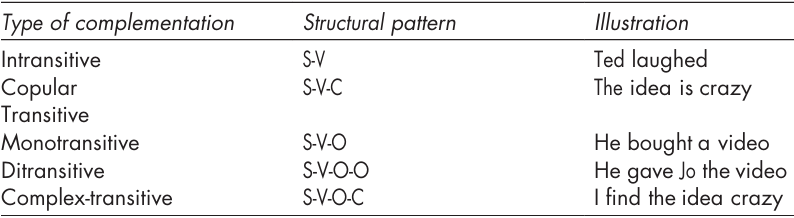


The number of verbs in common use in English is very large, especially in certain constructions, such as the monotransitive. In addition, many verbs – especially those of general meaning, such as get, turn and make – admit more than one type of complementation, each of which reflects a different type of situation. Make, for instance, can enter into all but intransitive patterns:

I’ll make some tea.                              SVOd

I’ll make you a pizza.                          SVOiOd

He made the coffee too strong.         SVOdCo

They make a good couple.                 SVCs

It makes for good relations.               SVPC


The potential number of participants, including the subject – that is, the number of places’ in the clause that the verb controls – is sometimes referred to as its semantic valency. Different classes of verbs have different semantic valencies. The verb eat, for example, is a two-place verb: it has a semantic valency of two, because in any event of eating there must be an eater and a thing eaten. There are one-place verbs, which have a subject only, belonging in principle to the SV pattern. Two-place verbs have a subject and one other element, as in the SVC and SPO patterns. Three-place verbs have a subject and two other elements as in the SVOO and SVOC patterns. Syntactic valency refers to the number of nominal elements present in any given clause that have a direct grammatical relation to the verb. In The lions ate away at their prey, there is one nominal element, as their prey does not have a direct grammatical relation to the verb. Syntactic valency often corresponds to its semantic valency, but not always. Weather verbs such as rain and snow, for instance, have no semantic participant and so have a semantic valency of zero. As finite clauses in English require a subject, however, dummy it is used with such verbs, giving a syntactic valency of 1. Valency is reduced when one or more elements are omitted in use. For instance, eat has a semantic valency of 2 as in He ate an orange; the valency is reduced to 1 in What time do you eat here?


اشترك بقناتنا على التلجرام ليصلك كل ما هو جديد

