0
EN
1
المرجع الالكتروني للمعلوماتية

Grammar

Tenses

Present

Present Simple

Present Continuous

Present Perfect

Present Perfect Continuous

Past

Past Simple

Past Continuous

Past Perfect

Past Perfect Continuous

Future

Future Simple

Future Continuous

Future Perfect

Future Perfect Continuous

Parts Of Speech

Nouns

Countable and uncountable nouns

Verbal nouns

Singular and Plural nouns

Proper nouns

Nouns gender

Nouns definition

Concrete nouns

Abstract nouns

Common nouns

Collective nouns

Definition Of Nouns

Animate and Inanimate nouns

Nouns

Verbs

Stative and dynamic verbs

Finite and nonfinite verbs

To be verbs

Transitive and intransitive verbs

Auxiliary verbs

Modal verbs

Regular and irregular verbs

Action verbs

Verbs

Adverbs

Relative adverbs

Interrogative adverbs

Adverbs of time

Adverbs of place

Adverbs of reason

Adverbs of quantity

Adverbs of manner

Adverbs of frequency

Adverbs of affirmation

Adverbs

Adjectives

Quantitative adjective

Proper adjective

Possessive adjective

Numeral adjective

Interrogative adjective

Distributive adjective

Descriptive adjective

Demonstrative adjective

Pronouns

Subject pronoun

Relative pronoun

Reflexive pronoun

Reciprocal pronoun

Possessive pronoun

Personal pronoun

Interrogative pronoun

Indefinite pronoun

Emphatic pronoun

Distributive pronoun

Demonstrative pronoun

Pronouns

Pre Position

Preposition by function

Time preposition

Reason preposition

Possession preposition

Place preposition

Phrases preposition

Origin preposition

Measure preposition

Direction preposition

Contrast preposition

Agent preposition

Preposition by construction

Simple preposition

Phrase preposition

Double preposition

Compound preposition

prepositions

Conjunctions

Subordinating conjunction

Correlative conjunction

Coordinating conjunction

Conjunctive adverbs

conjunctions

Interjections

Express calling interjection

Phrases

Sentences

Clauses

Part of Speech

Grammar Rules

Passive and Active

Preference

Requests and offers

wishes

Be used to

Some and any

Could have done

Describing people

Giving advices

Possession

Comparative and superlative

Giving Reason

Making Suggestions

Apologizing

Forming questions

Since and for

Directions

Obligation

Adverbials

invitation

Articles

Imaginary condition

Zero conditional

First conditional

Second conditional

Third conditional

Reported speech

Demonstratives

Determiners

Direct and Indirect speech

Linguistics

Phonetics

Phonology

Linguistics fields

Syntax

Morphology

Semantics

pragmatics

History

Writing

Grammar

Phonetics and Phonology

Semiotics

Reading Comprehension

Elementary

Intermediate

Advanced

Teaching Methods

Teaching Strategies

Assessment

قم بتسجيل الدخول اولاً لكي يتسنى لك الاعجاب والتعليق.

SUBJECT – VERB – DIRECT OBJECT – PREPOSITIONAL COMPLEMENT

المؤلف:  Angela Downing

المصدر:  ENGLISH GRAMMAR A UNIVERSITY COURSE

الجزء والصفحة:  P89-C3

2026-05-11

174

+

-

20

SUBJECT – VERB – DIRECT OBJECT – PREPOSITIONAL COMPLEMENT

Although predicted by the verb, the PC in this ditransitive pattern (e.g. It reminds me of you) is further away from the verb and the NG is not a central participant. However, it encodes a participant that can be formally questioned (Of whom 1, For what 2) placed before the preposition or, informally, stranded. It can also occur in a wh-cleft 3:

1 Who does it remind you of? (Of whom does it remind you?)

2 What are you thanking me for? (For what are you thanking me?)

3 What it reminds me of is Italy.


In discourse, the PC may be omitted when its referent is understood, as in They blamed me (for something already mentioned). The Direct Object is usually a person and the PC may be an entity or an event.


Some of the verbs taking this construction are listed here according to preposition. Remember that a NG is placed between the verb and the preposition.
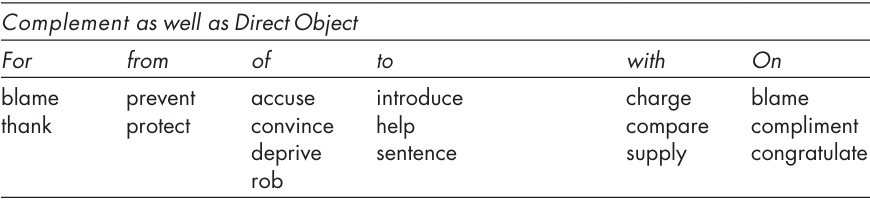



Only the direct object constituent can become subject in the passive clause:

Your skin will be protected from the sun’s rays.

She was robbed of her watch and jewels.

He was charged with assault.

Janet was congratulated on her success.


Blame, a three-place verb, admits two alternative constructions with different prepositions, which reflect the way the event is viewed in each case. The more central of the two participants is placed first, as Od. In one version this is Jane; in the other the accident.

blame someone (Od) for something (PC)          He blamed Jane for the accident

blame something (Od) on someone (PC)           He blamed the accident on Jane.


There are thus two passives – Jane was blamed for the accident, The accident was blamed on Jane – which centre respectively on ‘Jane’ and on ‘the accident’.


Likewise, the NG following the preposition can be questioned by who or what (What was Jane blamed for? Who was the accident blamed on?).


Other verbs that present a similar variation are supply, load and drain:

We supply the school with paper (PC).         We supply paper(Od) to the school (PC).

They loaded the cart with hay. (PC).              They loaded hay on to the cart. (Cloc).

They drained the pool of water. (PC).            They drained water from the pool. (Clo).


With load and drain the cognitive representation is rather different with each alternative. With the receptacle the cart and the pool as object, there is a notion of totality: the cart is completely full of hay, the pool completely drained of water. By contrast, with hay and water as object, there is an impression of partialness: some hay is loaded, some water is drained. If the definite article is used (the hay, the water), the implication is of totality.


اشترك بقناتنا على التلجرام ليصلك كل ما هو جديد

